When Does a Sculpture Become a Building? East Hampton’s Lawsuit Over Matt Johnson’s Meditating Figure
Large-scale public and private art installations can raise issues well beyond copyright, contracts, and exhibition agreements. Once an artwork reaches monumental scale, land-use regulation, permit requirements, easements, development restrictions, and even federal moral-rights questions can all come into play.
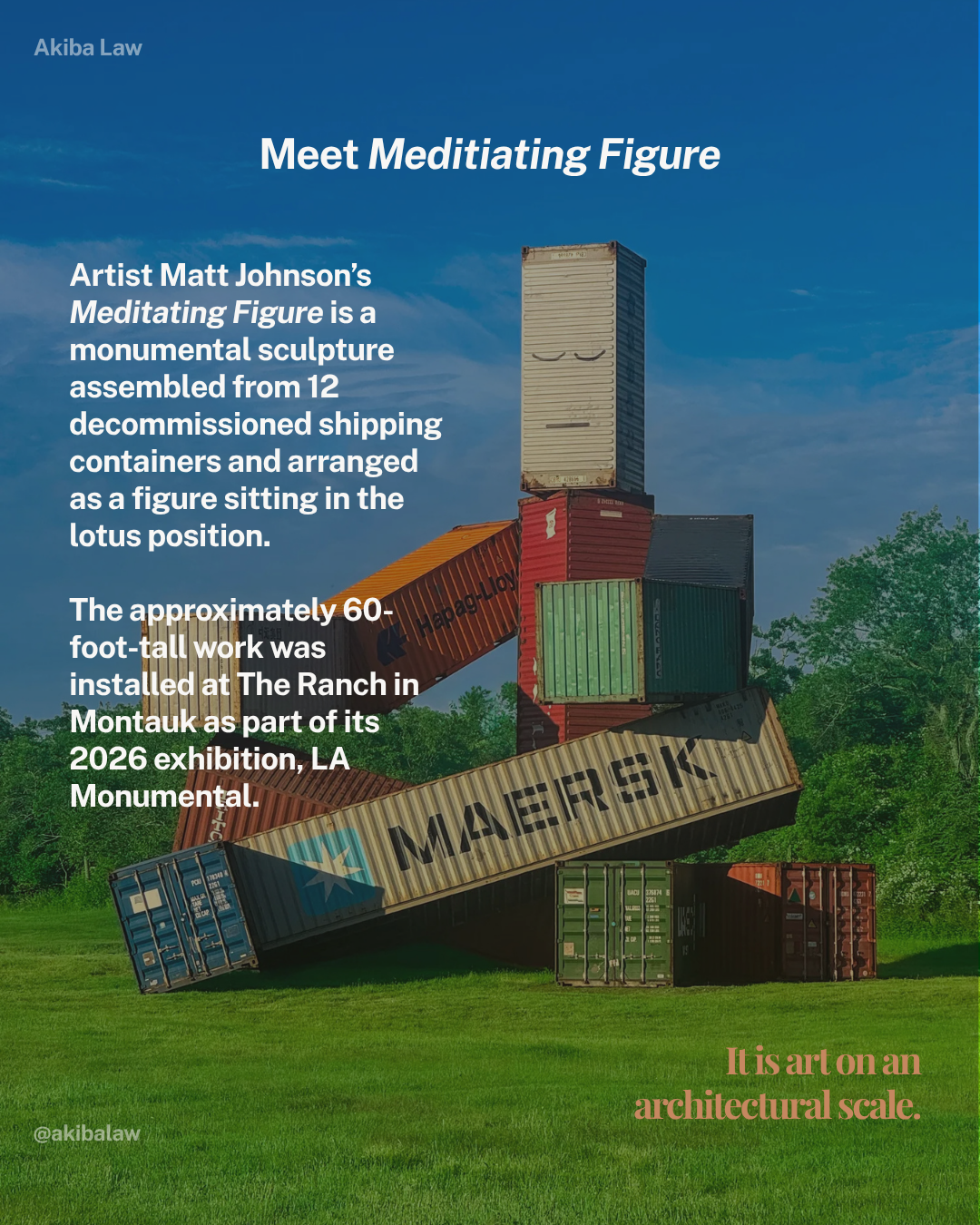
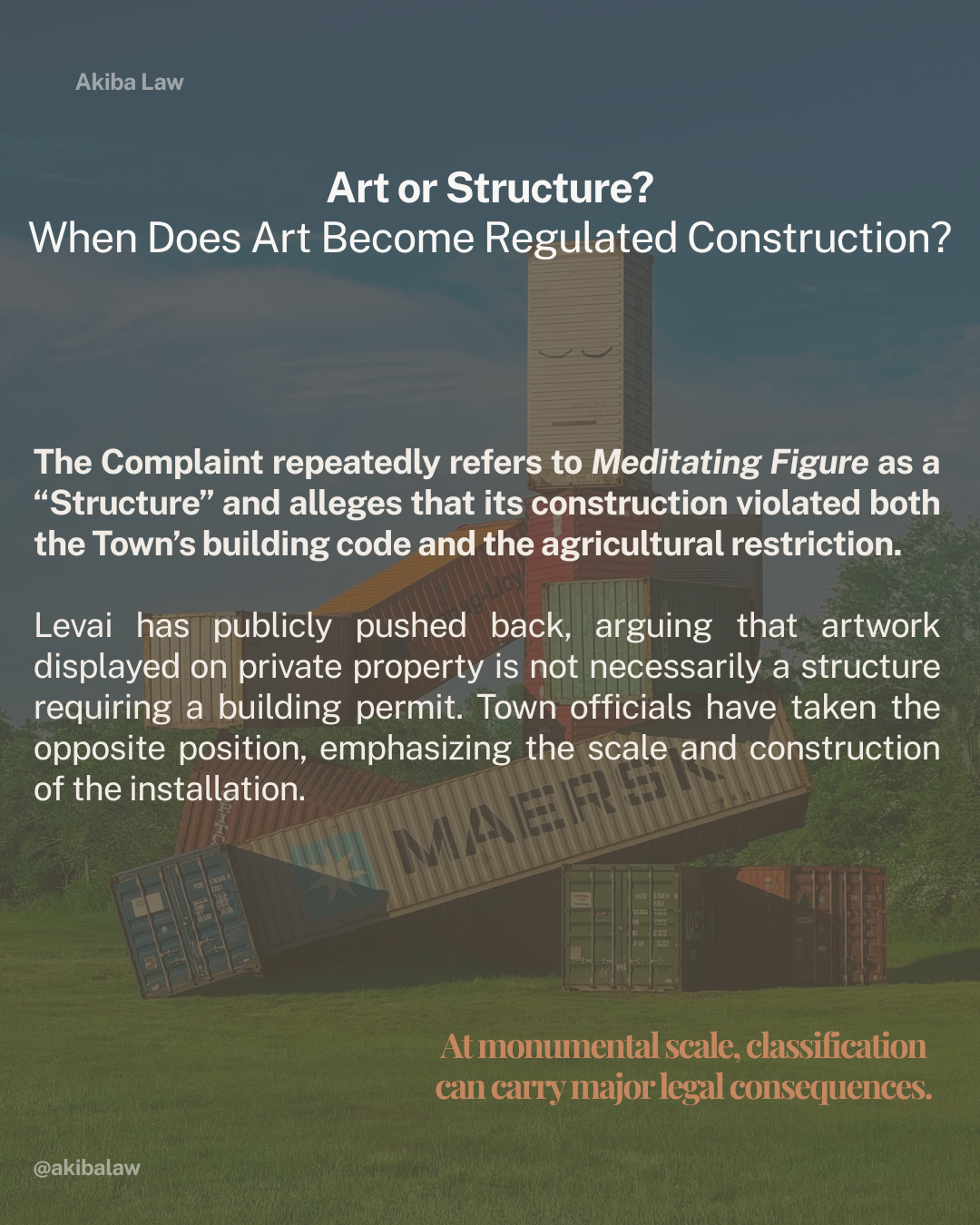
That is exactly what appears to be happening in a new East Hampton dispute over Meditating Figure, a roughly 60-foot sculpture by artist Matt Johnson made from decommissioned shipping containers and installed at The Ranch in Montauk as part of its 2026 exhibition, LA Monumental.
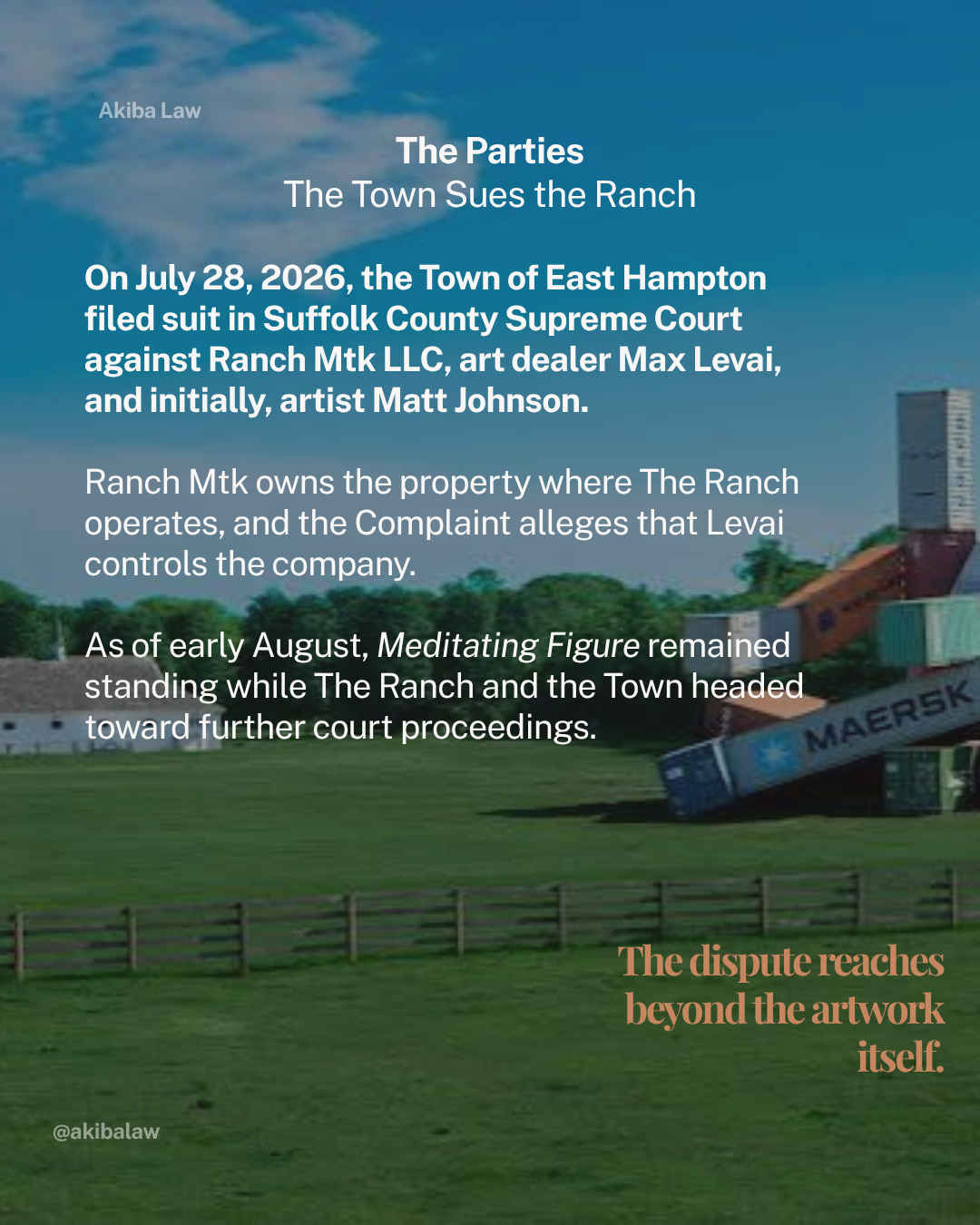
The Town of East Hampton filed suit in Suffolk County Supreme Court against Ranch Mtk LLC, art dealer Max Levai, and initially artist Matt Johnson. The Town’s position is that the work is not simply art, but an unpermitted “structure” placed, at least in part, on land subject to longstanding agricultural restrictions.
The case appears to turn on a deceptively simple question: when does a sculpture become regulated construction?
The Town alleges that no building permit was obtained and seeks removal of the work. The defense position, at least publicly, is that artwork displayed on private property is not necessarily a structure requiring a permit. The dispute therefore sits at the intersection of art law, land-use law, and local code enforcement.
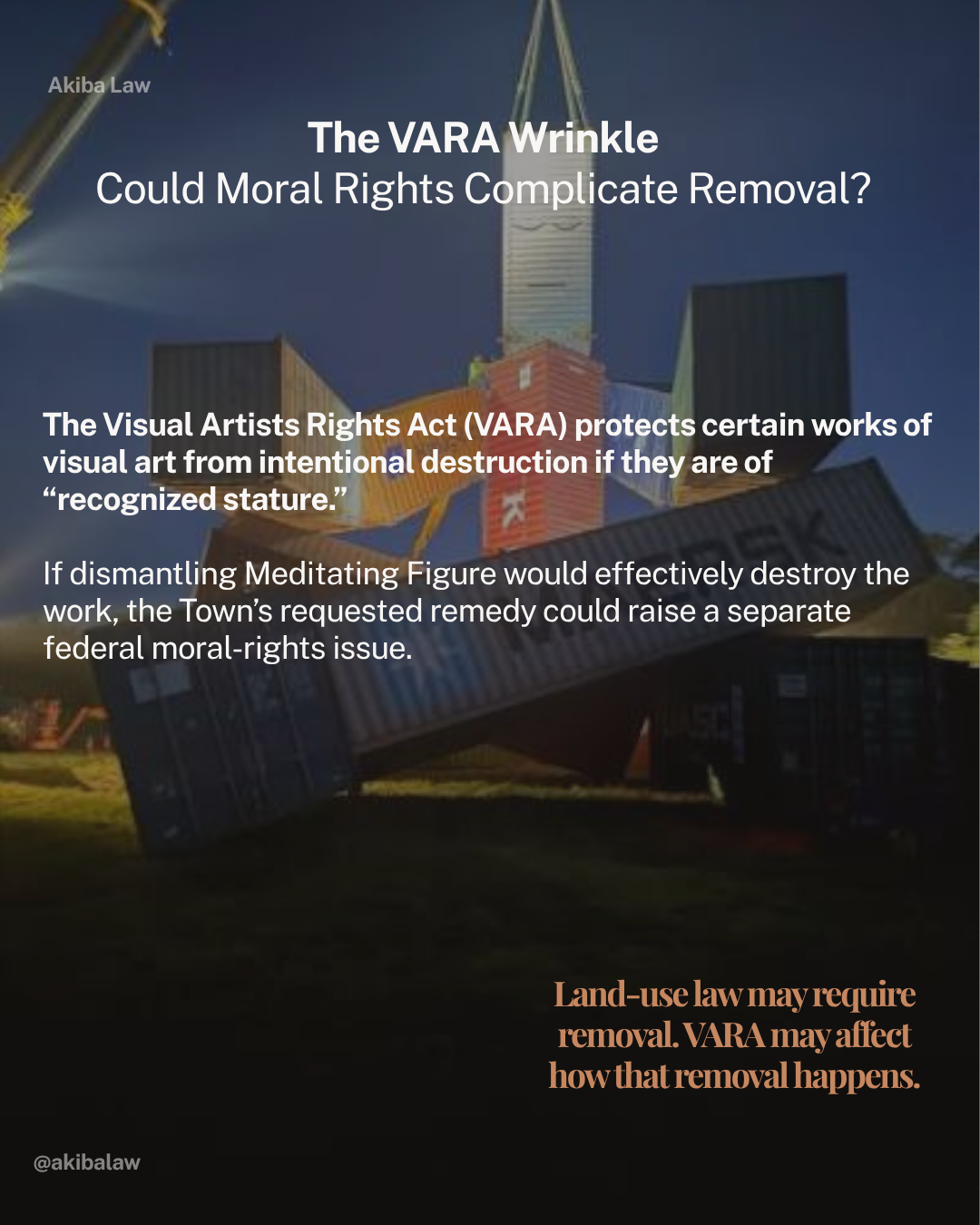
There is also a potential federal overlay. If dismantling the work would effectively destroy it, removal could implicate the Visual Artists Rights Act, or VARA, which protects certain works of recognized stature from intentional destruction.
The allegations remain just that, allegations. Still, the case is a strong reminder that for monumental, site-specific work, legal due diligence can become just as important as artistic vision.

Monumental Art Can Trigger Local Land-Use Law
Art lawyers often focus on ownership, consignment, copyright, moral rights, and contracts. Those issues are critical, but they are not the whole picture when the work is physically large, installed outdoors, and tied to a specific parcel of land.
A monumental installation may also implicate:
- zoning and land-use rules;
- building and safety codes;
- permit requirements;
- easements and development-right restrictions;
- agricultural-use covenants; and
- nuisance or enforcement remedies.
In other words, once a work occupies physical space in a serious way, the legal analysis can begin to resemble a real-estate and construction matter as much as an art-law matter.
The Core Fight Appears to Be Classification
The central question in this dispute appears to be whether Meditating Figure should be treated as a work of art, a structure, or both.
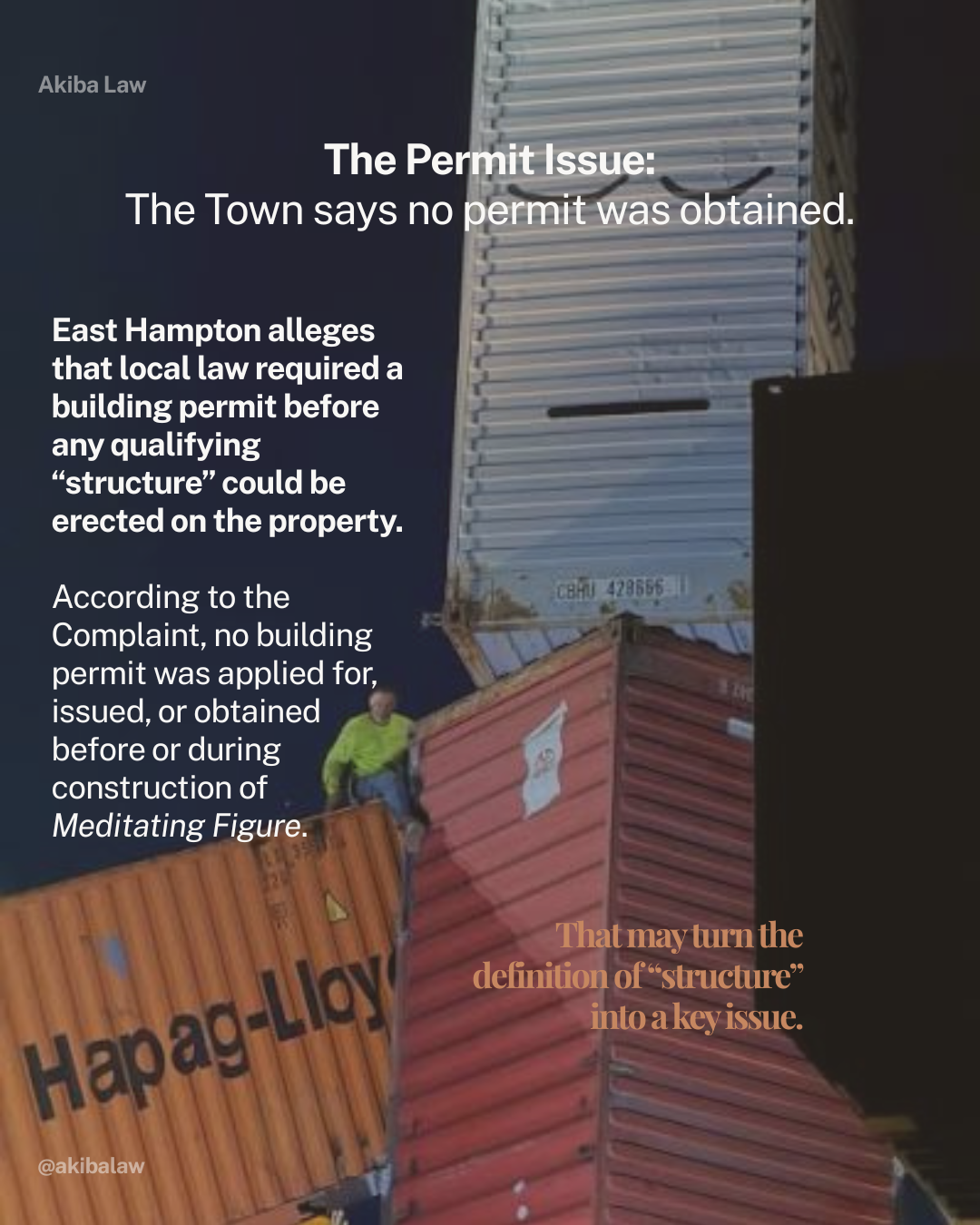
The Town’s reported theory is straightforward. It characterizes the installation as a “structure,” alleges that local law required a building permit before such a structure could be erected, and claims that no permit was obtained. It also alleges that the installation sits, at least in part, on restricted land that must remain in agricultural production.
The opposing position appears to be that artwork on private property is not automatically the type of structure that triggers a building-permit requirement.
That classification issue can affect nearly everything that follows, including:
- whether a permit was required at all;
- whether the location of the work was lawful;
- whether the Town can compel removal;
- whether the land must be restored; and
- what defenses the property owner and organizers may have.
Site Restrictions Can Matter as Much as the Work Itself
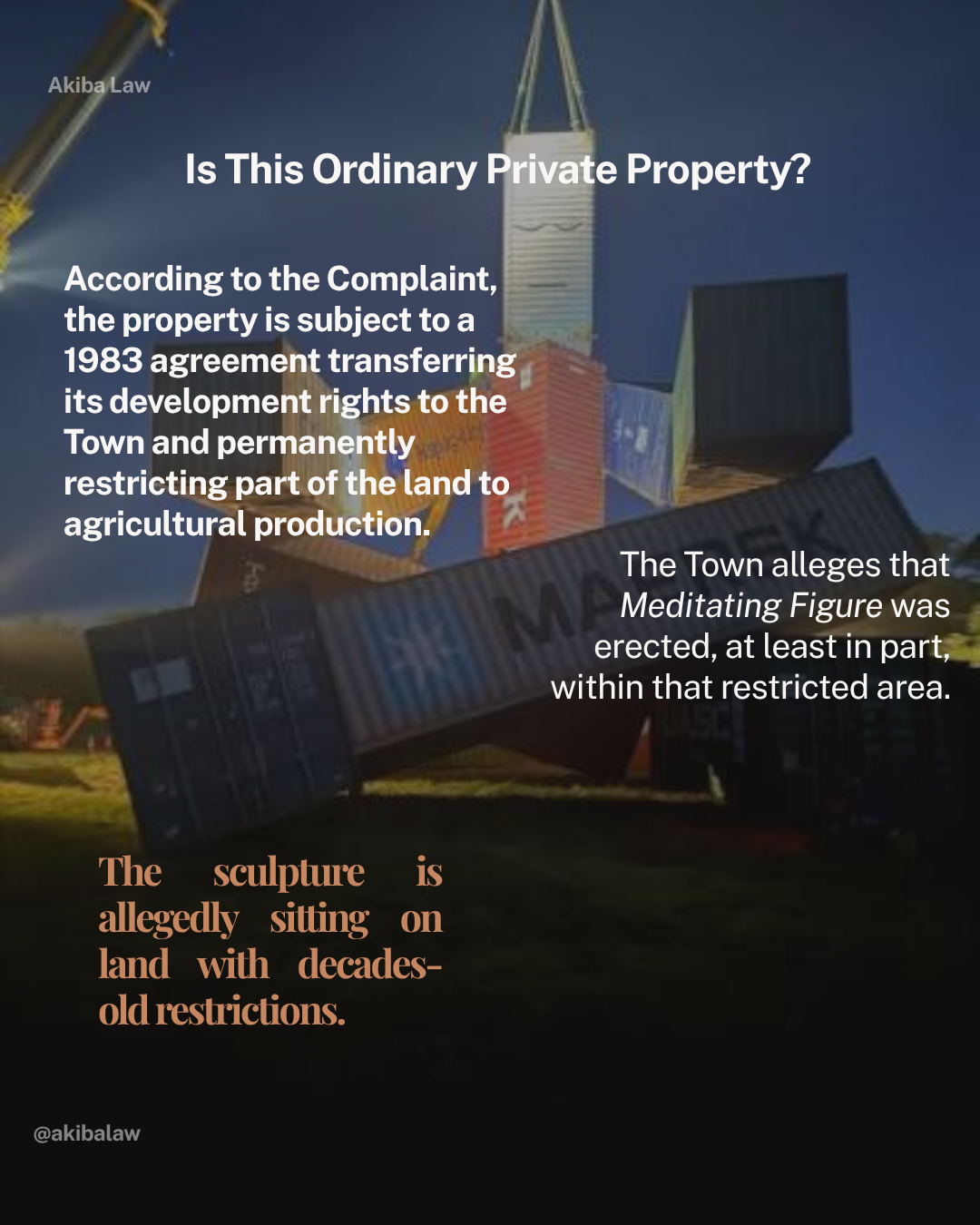
The Town relies on a 1983 agreement transferring development rights and permanently restricting part of the land to agricultural production.
If that is correct, the dispute is not only about what the sculpture is, but also where it was placed.
That distinction is important. A work that may be unobjectionable on one parcel may create immediate problems on another parcel if the land is burdened by:
- conservation restrictions,
- agricultural easements,
- scenic easements,
- development-right transfers,
- deed restrictions, or
- special local overlay rules.
For owners, curators, and institutions presenting large outdoor works, site review should happen before installation, not after objections arise.
The Permit Question Is Not Always Simple
A common mistake in the art world is assuming that if something is “art,” it falls outside ordinary municipal regulation.
Sometimes that may be true. Sometimes it may not.
A town or village may look to practical factors such as:
- the scale of the work;
- the method of assembly;
- whether heavy equipment was used;
- whether the work is anchored or fixed in place;
- how long it will remain installed;
- whether it implicates safety concerns;
- whether it affects land use; and
- whether local code definitions sweep broadly enough to include the installation.
A temporary freestanding artwork can be treated very differently from a massive container-based installation that reads, from a municipal perspective, like built construction.
Removal Remedies Can Be Extremely Consequential
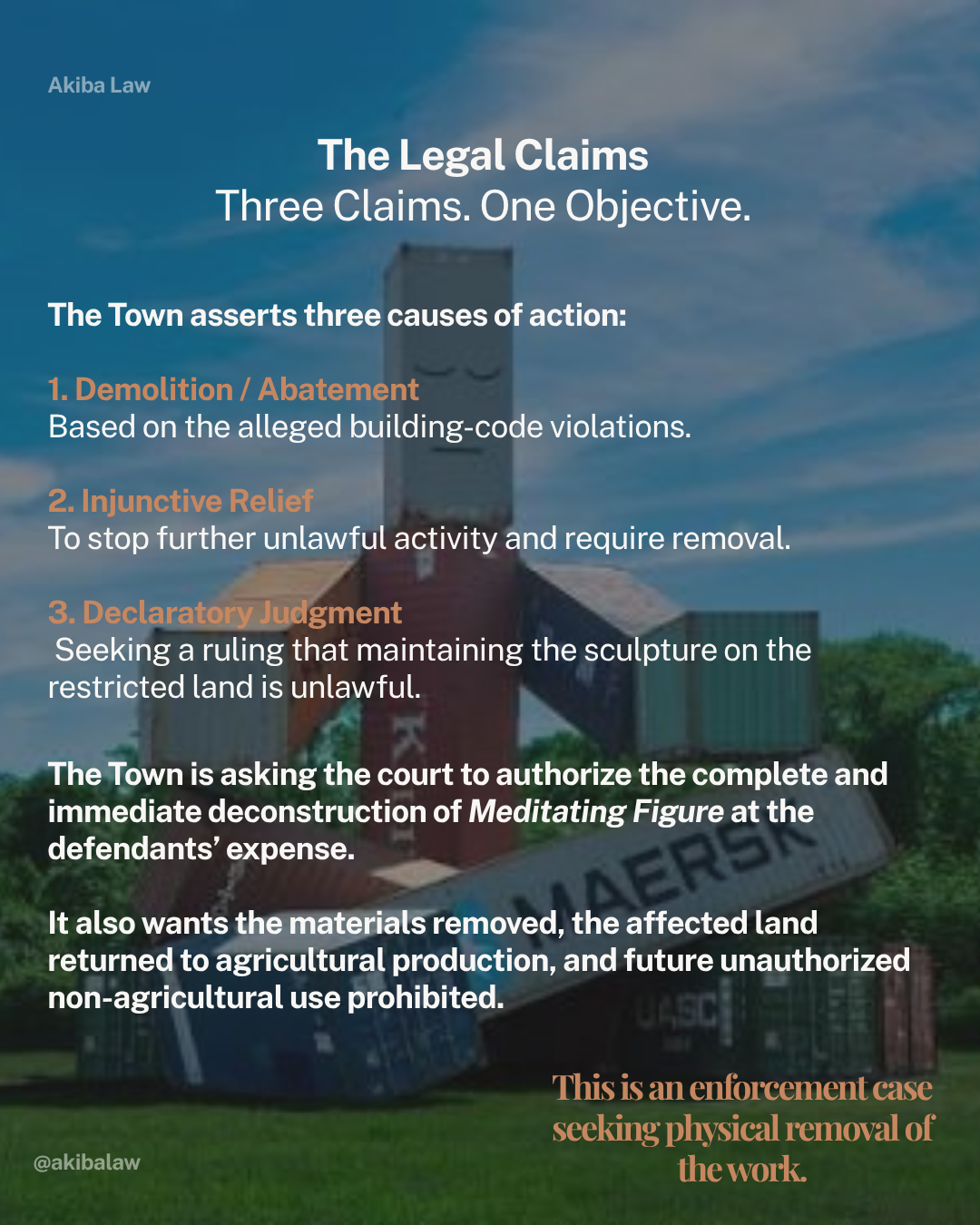
The Town seeks demolition or abatement, injunctive relief, and declaratory relief, all aimed at obtaining complete removal of the work and restoration of the affected land.
Those are serious remedies.
For a monumental installation, forced removal can involve major cost, engineering concerns, insurance implications, transportation logistics, and potential damage to the work itself. If the work is destroyed in the process, the consequences can extend beyond local code compliance.
That is one reason these disputes should never be viewed as minor permitting squabbles. The remedy being sought may effectively determine whether the artwork survives.
The VARA Issue Adds Another Layer
One of the most interesting features of this dispute is the potential VARA wrinkle.
The Visual Artists Rights Act protects certain works of visual art from intentional distortion, mutilation, or destruction, including destruction of a work of “recognized stature.” Not every work qualifies, and VARA analysis can be highly fact-specific. Even so, once a municipality seeks relief that could result in dismantling or destruction, VARA may enter the conversation.
That does not necessarily mean VARA blocks removal. It does mean the manner of removal, the nature of the work, and the factual record surrounding artistic significance may become relevant.
For artists and site hosts, the practical lesson is clear: when a work is large, site-specific, and difficult to move without damage, moral-rights analysis should be considered early.
Why This Case Matters
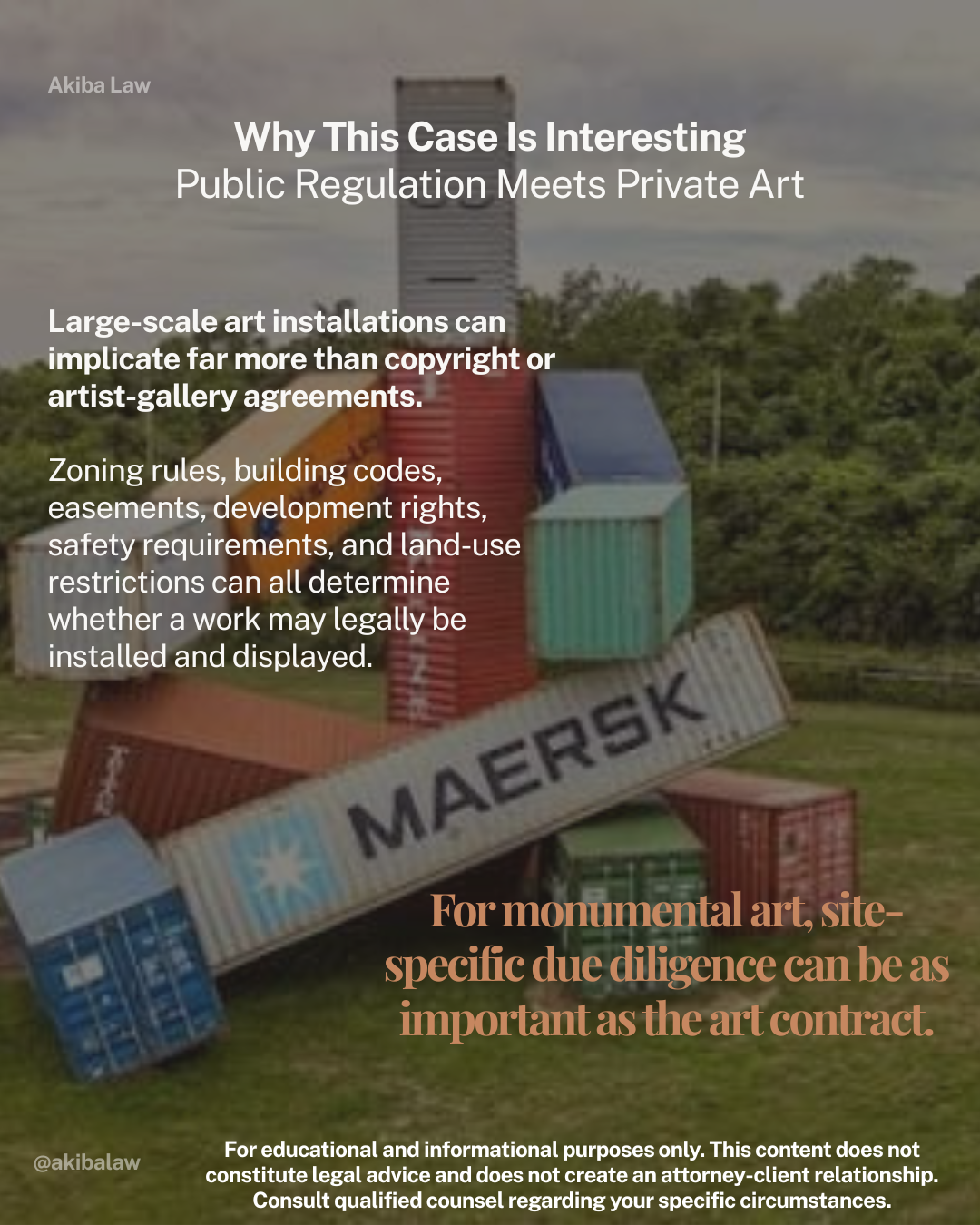
This case is interesting because it sits at the point where public regulation meets private art.
It reminds artists, landowners, curators, and dealers that a successful installation requires more than a strong concept and a willing site host. It also requires a legal review of the property, the local code, and the proposed method of installation.
For large-scale outdoor projects, the checklist should include:
- confirming who owns the land;
- reviewing deeds, easements, and use restrictions;
- checking zoning and code definitions;
- determining whether permits are required;
- assessing safety and engineering issues;
- allocating responsibility in written agreements; and
- considering removal rights and moral-rights implications in advance.
Practical Takeaway
For monumental art, site-specific due diligence can be just as important as the art contract.
A sophisticated installation agreement should not stop at the usual exhibition terms. It should also address the legal status of the site, permit responsibility, allocation of compliance obligations, risk of municipal enforcement, insurance, removal procedures, and what happens if the work cannot remain in place.
When the artwork is built at architectural scale, the law may treat it that way too.
Akiba Law assists artists, galleries, curators, collectors, and art businesses with contracts, consignment and exhibition issues, ownership disputes, copyright and moral-rights matters, and other legal issues affecting the display and sale of art. Interested in learning more? Visit the Art Law Lab at Akiba Law.
warning Disclaimer
This article is for general educational and informational purposes only and does not constitute legal advice. Reading this article does not create an attorney-client relationship with Akiba Law PLLC or any attorney. Florida law may apply differently depending on the specific facts, legal issues, and parties involved. Individuals and businesses should consult qualified legal counsel about their specific circumstances. For questions, concerns, or additional information, please contact Akiba Law PLLC to speak with a qualified attorney.
From a Real Estate Listing to Restitution: Argentina Orders Return of Nazi-Looted Old Master to Sole Remaining Heir of Jacques Goudstikker
More than eighty years after an Old Master painting disappeared during the Nazi era, an Argentine court has ordered its…

Case Update: Solar Drops Second Gang Starr Lawsuit After Judge Questions Prospect of Duplicative Litigation
When I first wrote about the latest chapter in the legal battle surrounding Gang Starr in September 2025, producer John…

Art Law in Florida: A Practitioner’s Handbook
Akiba Law PLLC is a Miami-based law firm advising artists, collectors, galleries, dealers, auction businesses, museums, and creative entrepreneurs on…

2 Live Crew Tried to Take Back Its Copyrights. A Decades-Old Bankruptcy Got in the Way.
Copyright ownership can last for decades, and the Copyright Act gives many creators an unusual second chance to revisit deals…
Eden Gallery Sues Collector Over Alleged $822,390 Unpaid Balance: Lessons for Art Sales on Credit
High-value art transactions are often built on relationships. A collector may purchase repeatedly from the same gallery, payments may be…
MoMA v. MOMACHA: Trademark Strength, Brand Similarity, and Consumer Confusion
A trademark dispute does not always begin with two businesses offering the same product. Confusion can arise when a newer…

When a $2.5 Million Art Loan Ends in Litigation: Lessons for Galleries, Curators, and Property Owners
Long-term art placements can benefit everyone involved. Galleries gain access to potential collectors, property owners enhance their spaces, and residents…

When a Gallery Sells Consigned Art but Does Not Pay the Artist: The Hole Lawsuit and New York’s Trust-Fund Rules
An artwork consignment is not simply an informal arrangement in which a gallery agrees to sell a work and pay…
Your Logo Is on the Shirt. Does That Count as Trademark Use?
Launching a clothing brand involves more than creating a name, designing a logo, and placing it on a garment. How…
45 Antiquities Seized from the Metropolitan Museum of Art: Provenance, Repatriation, and the Importance of Due Diligence
On July 8, 2026, the Manhattan District Attorney’s Office announced the return of 59 antiquities, collectively valued at more than…

Florida Interior Designers and Decorators: Are You Regulated? Do You Need a License?
Interior designers and decorators in Florida often face a practical question: am I subject to Florida regulation, and do I…
Jacques Goudstikker’s Stolen Collection Is Still Being Found and Returned
Restitution can’t undo the Holocaust but it can return what was taken and every returned work matters. A Nazi-looted painting…