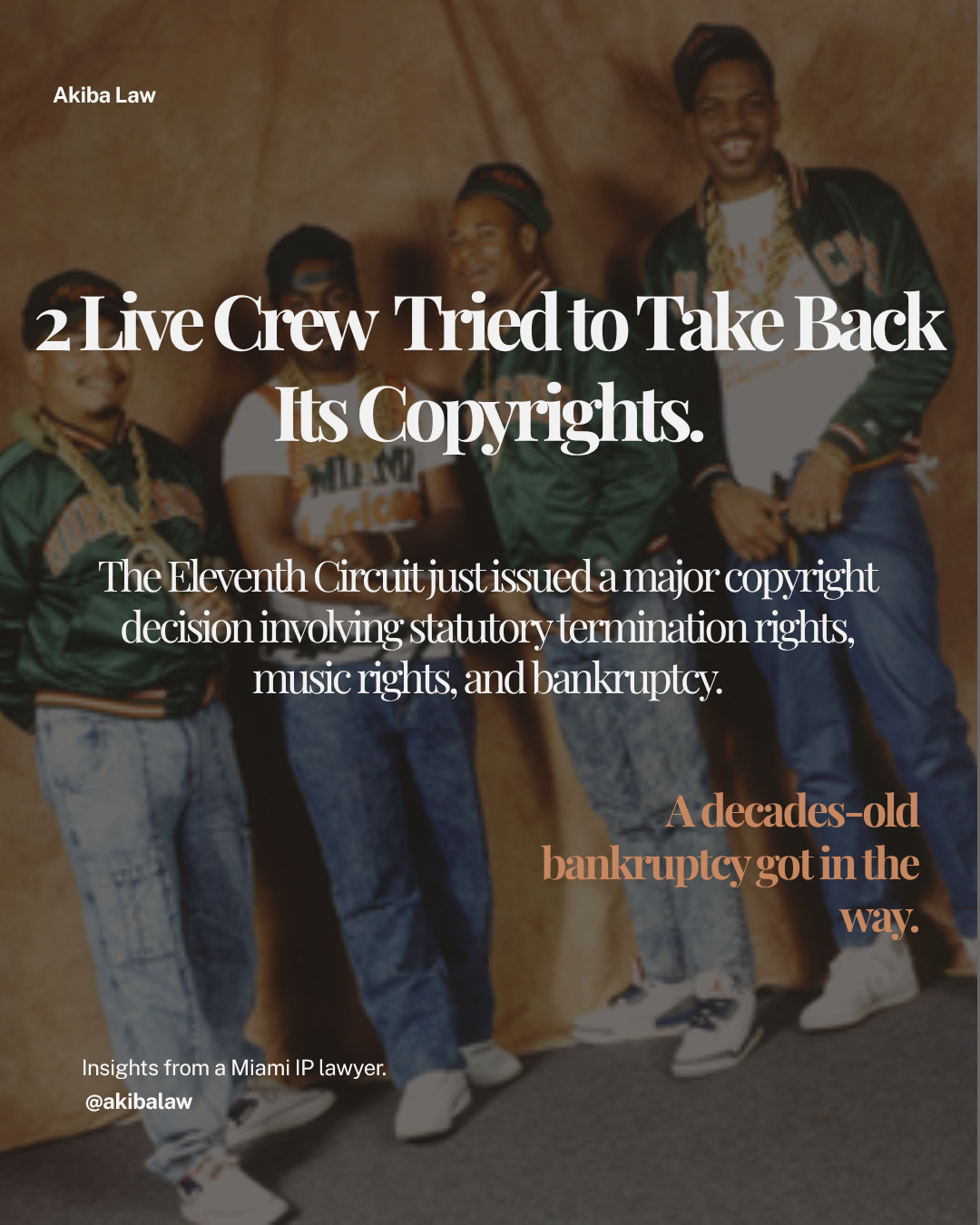
2 Live Crew Tried to Take Back Its Copyrights. A Decades-Old Bankruptcy Got in the Way.
Copyright ownership can last for decades, and the Copyright Act gives many creators an unusual second chance to revisit deals made early in their careers.
Under Section 203 of the Copyright Act, authors may, after a specified period, terminate certain earlier grants of copyright and reclaim the transferred rights. Congress designed the termination right to give creators another opportunity to benefit from works whose long-term value may have been impossible to predict when the original deal was made.
A recent Eleventh Circuit decision involving 2 Live Crew shows how complicated that right can become when copyright law intersects with bankruptcy law.
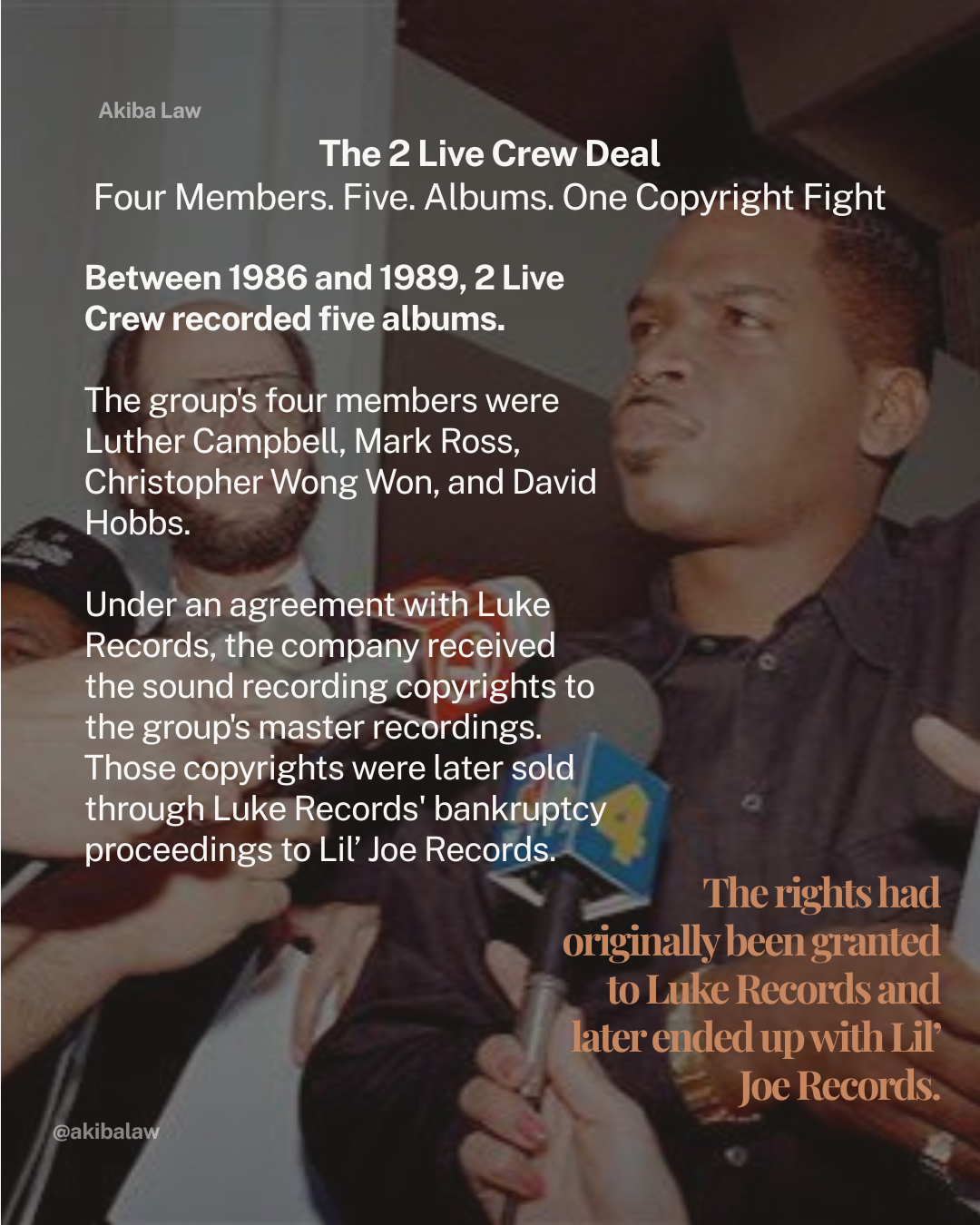
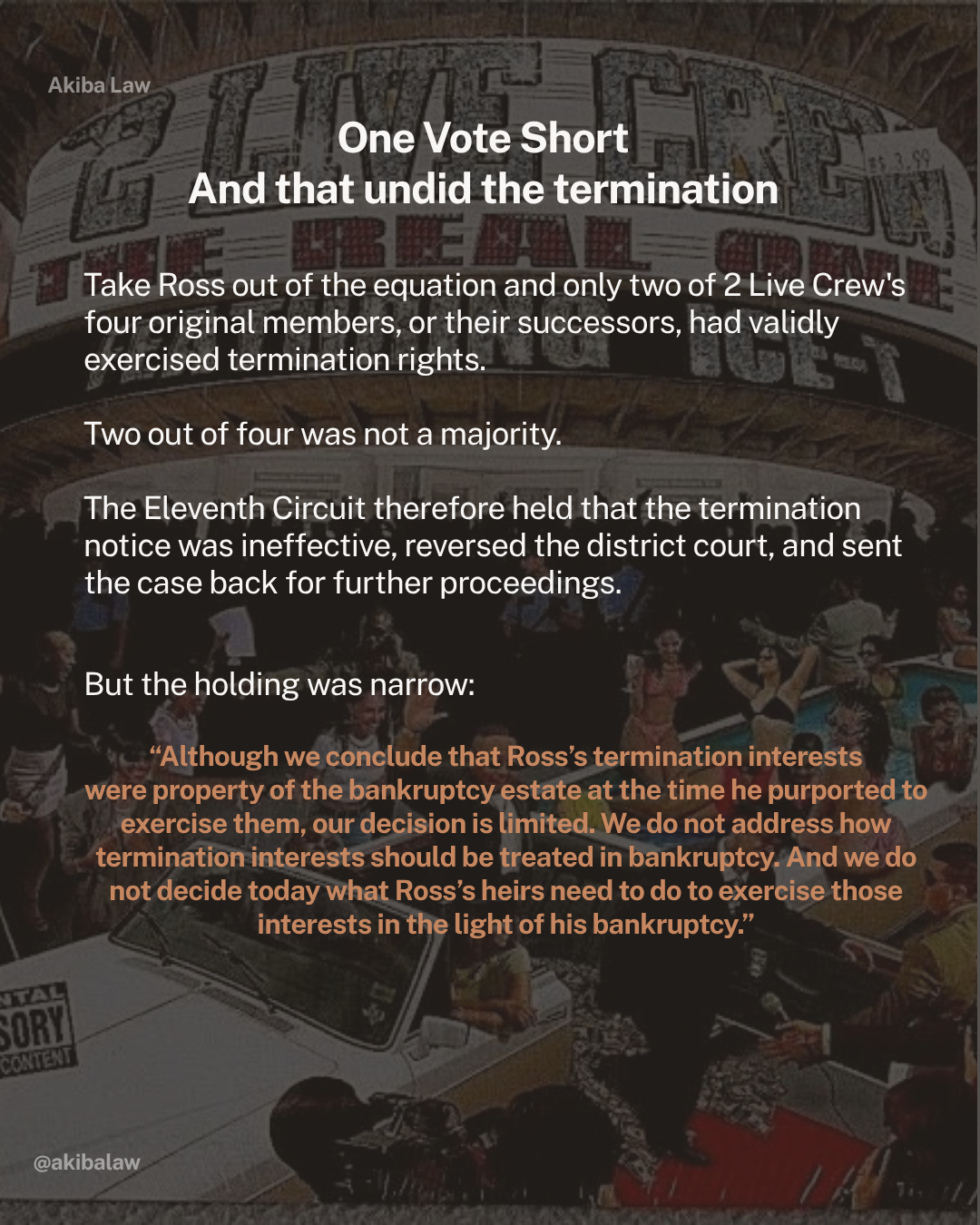
Between 1986 and 1989, the four members of 2 Live Crew recorded five albums. Rights in the group’s master recordings were transferred to Luke Records and later acquired by Lil’ Joe Records through Luke Records’ bankruptcy proceedings.
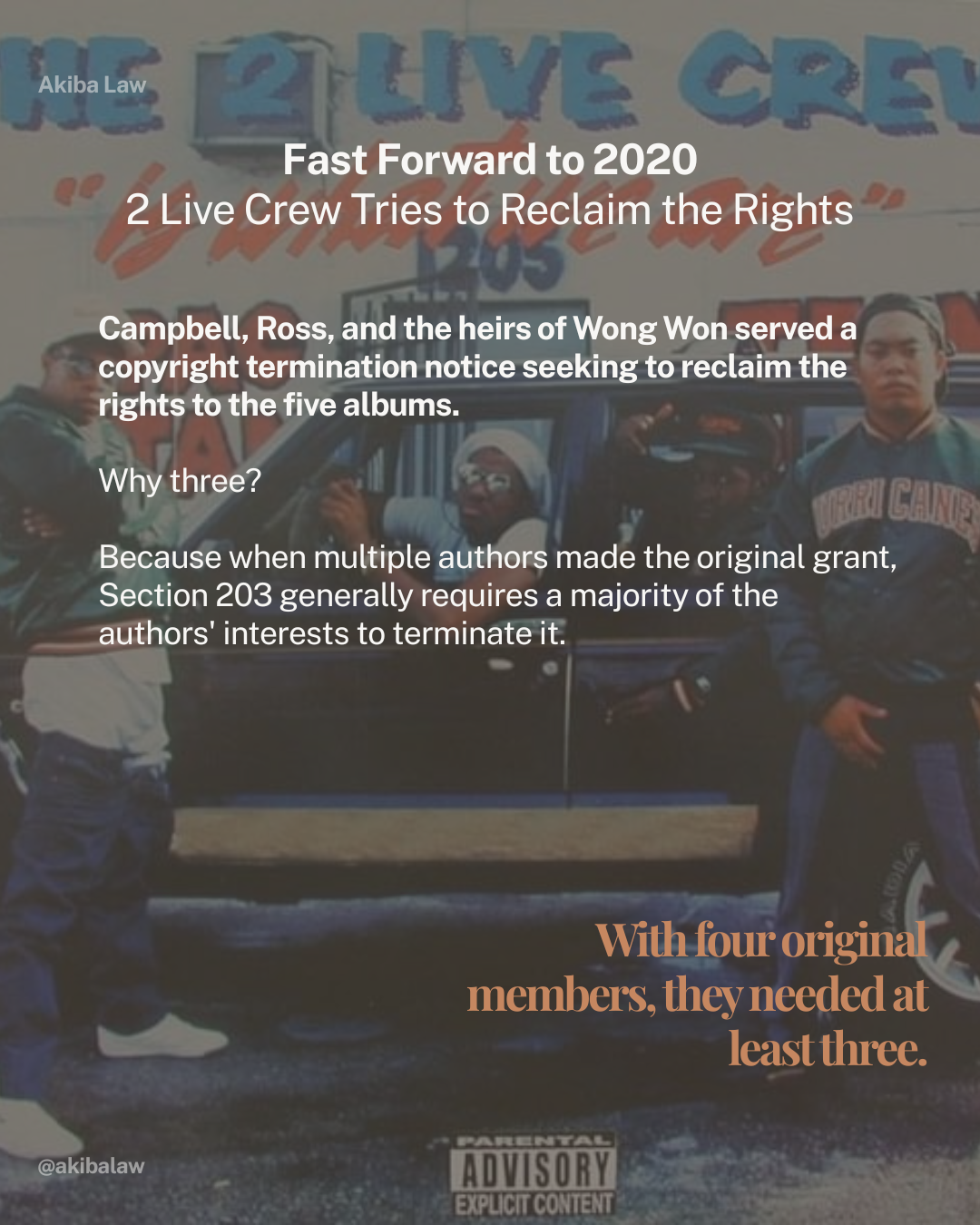
Decades later, three of the four relevant author interests sought to terminate the earlier grant under Section 203 and reclaim the copyrights. Ordinarily, that would have been enough. When multiple authors execute a grant, Section 203 generally permits termination by a majority of those who executed it.
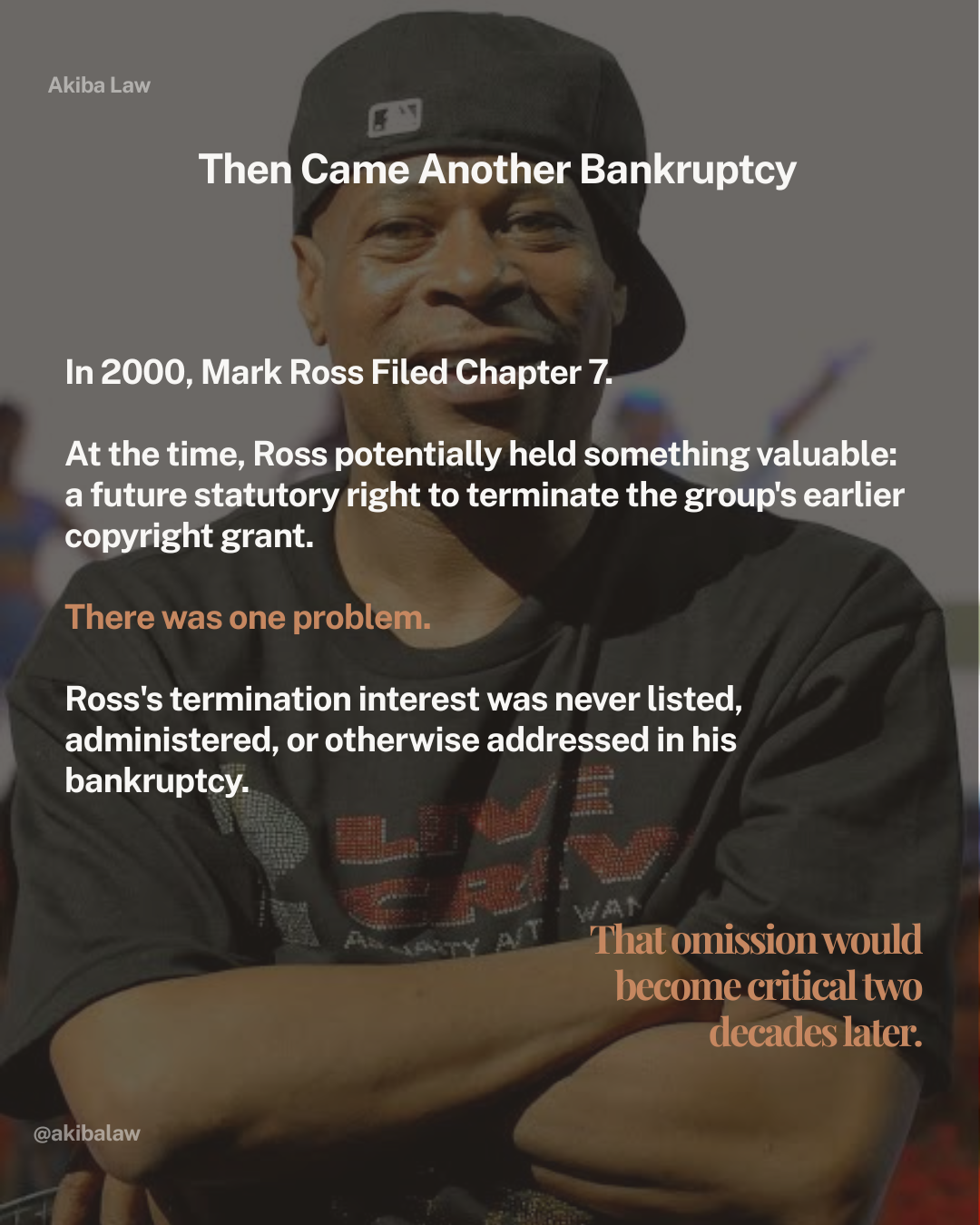
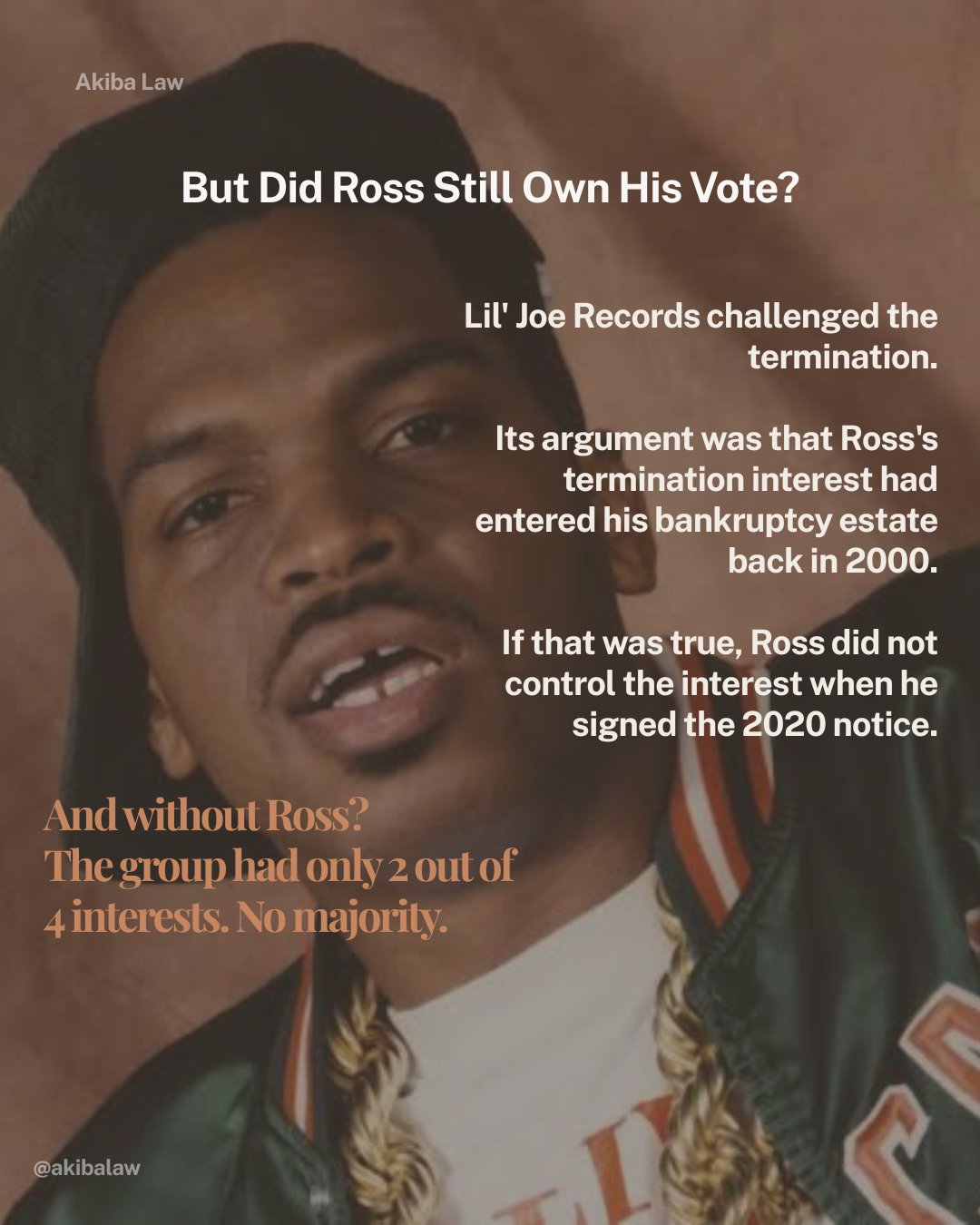
One of those three interests, however, belonged to 2 Live Crew member Mark Ross. Ross had filed for Chapter 7 bankruptcy in 2000, years before the termination notice was served. His future termination interest was never scheduled or administered in the bankruptcy case.
Lil’ Joe Records argued that the termination interest had become property of Ross’s bankruptcy estate and therefore was no longer Ross’s to exercise when he signed the termination notice approximately twenty years later.
The Eleventh Circuit agreed.
The following slides explain how a statutory copyright right designed to be difficult to transfer nevertheless became property of a bankruptcy estate, and why that conclusion ultimately left 2 Live Crew one vote short of a valid termination.
Copyright Termination Rights Are Different From Ordinary Contract Rights
Section 203 gives qualifying authors the ability to terminate certain copyright grants made on or after January 1, 1978.
The right is unusual because parties generally cannot eliminate it in advance simply by writing a contract saying that the transfer is perpetual or irrevocable. The statute provides that termination may operate notwithstanding an agreement to the contrary.
This feature reflects the policy behind termination rights. A creator may transfer valuable rights early in a career when the future commercial success of the work is unknown. Congress created a later opportunity for qualifying authors or their statutory successors to recapture those rights.
The right is powerful, but exercising it requires careful compliance with statutory timing, notice, authorship, and ownership requirements.
Joint Grants Create a Voting Requirement
The 2 Live Crew dispute also illustrates an important issue when multiple creators participate in the original grant.
Where two or more authors execute the grant, Section 203 generally requires termination by a majority of the authors who executed it.
For the five albums involved here, the relevant original group consisted of four members. That meant three qualifying interests were needed to form the majority required for termination.
Campbell, Ross, and the successors to Christopher Wong Won attempted to terminate the earlier grant.
The entire termination therefore depended, in part, on whether Ross still possessed the legal authority to exercise his statutory termination interest.
Bankruptcy Can Sweep Broadly
The Bankruptcy Code generally defines property of a bankruptcy estate very broadly. When an individual files bankruptcy, the estate can acquire legal and equitable interests belonging to the debtor at the commencement of the case.
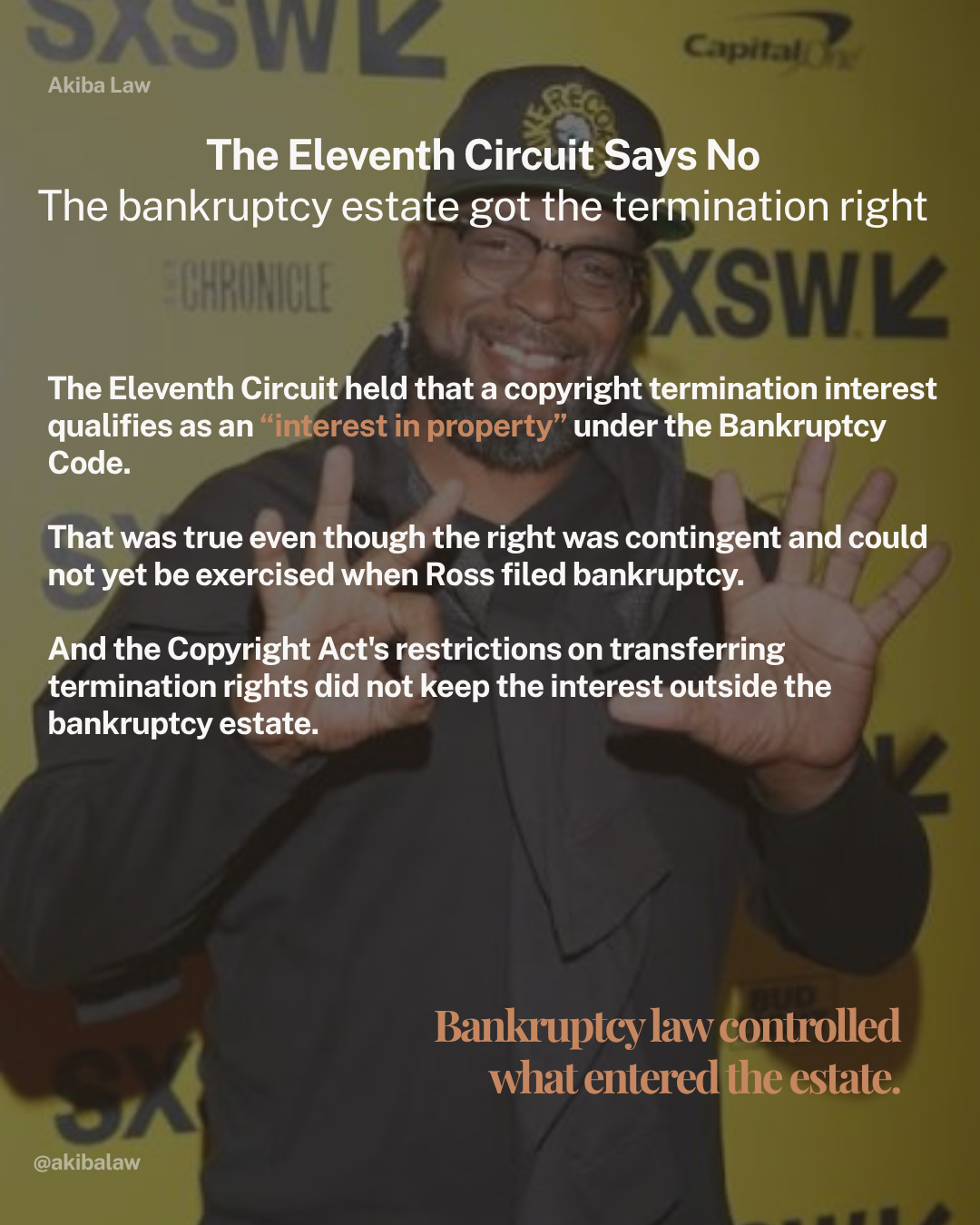
The key question before the Eleventh Circuit was whether Ross’s future termination right counted as an “interest in property” even though he could not yet exercise it when he filed bankruptcy in 2000.
The court concluded that it did.
The contingent nature of the right did not prevent it from entering the estate. Nor did the Copyright Act’s restrictions on transferring termination rights prevent bankruptcy law from treating the interest as estate property.
The decision therefore distinguishes between a voluntary contractual transfer of a termination right and the operation of federal bankruptcy law.
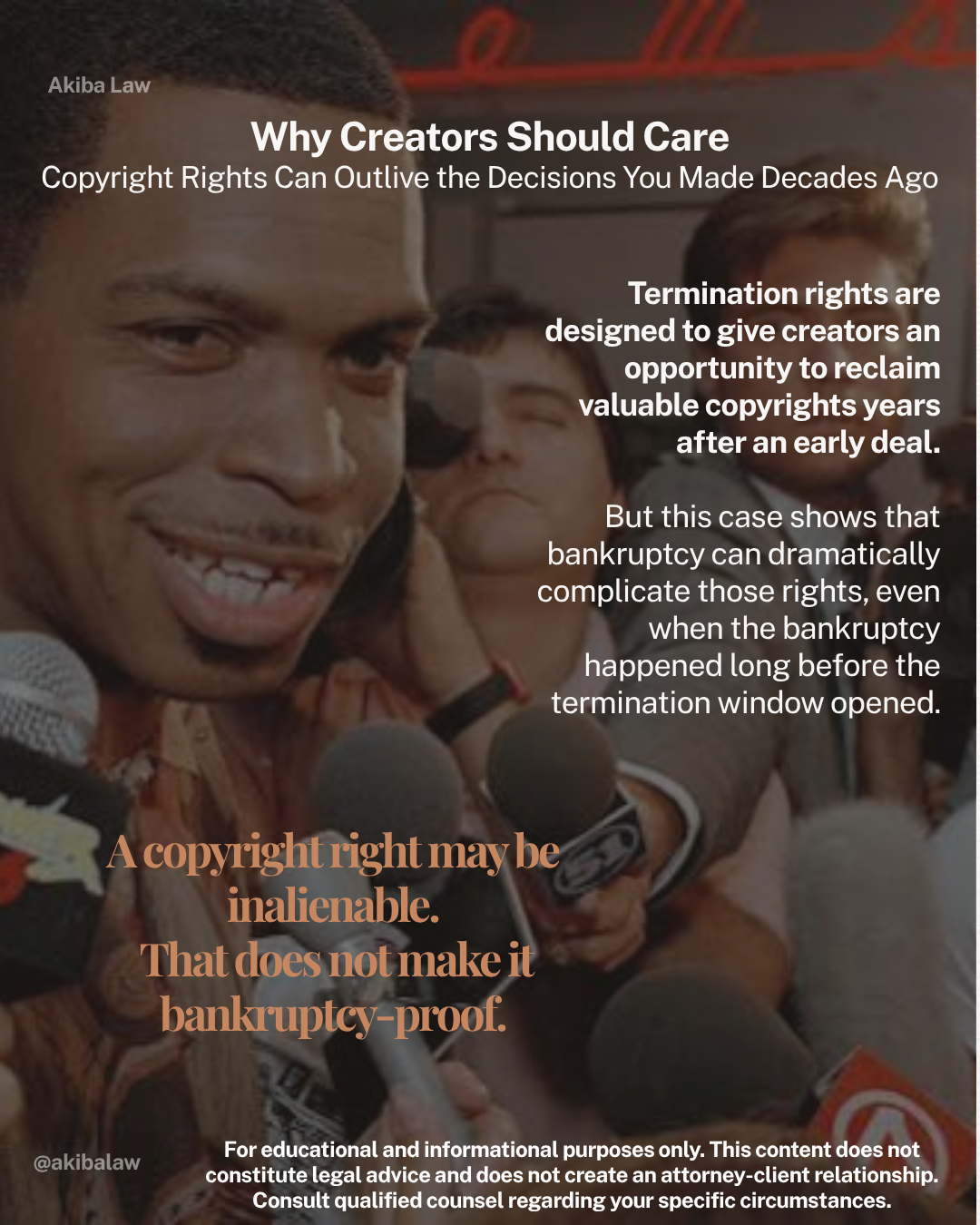
Inalienable Does Not Mean Bankruptcy-Proof
This is perhaps the most important conceptual point in the decision.
Copyright termination rights are sometimes described as “inalienable” because an author generally cannot contract them away in advance.
The Eleventh Circuit concluded that this does not mean the interest is categorically excluded from a bankruptcy estate.
A statutory restriction on voluntary transfer does not necessarily answer the separate question of what constitutes property under the Bankruptcy Code.
For creators, this means that the existence of special federal protections surrounding an intellectual property right does not automatically insulate that right from bankruptcy consequences.
The Scheduling Problem Became Critical
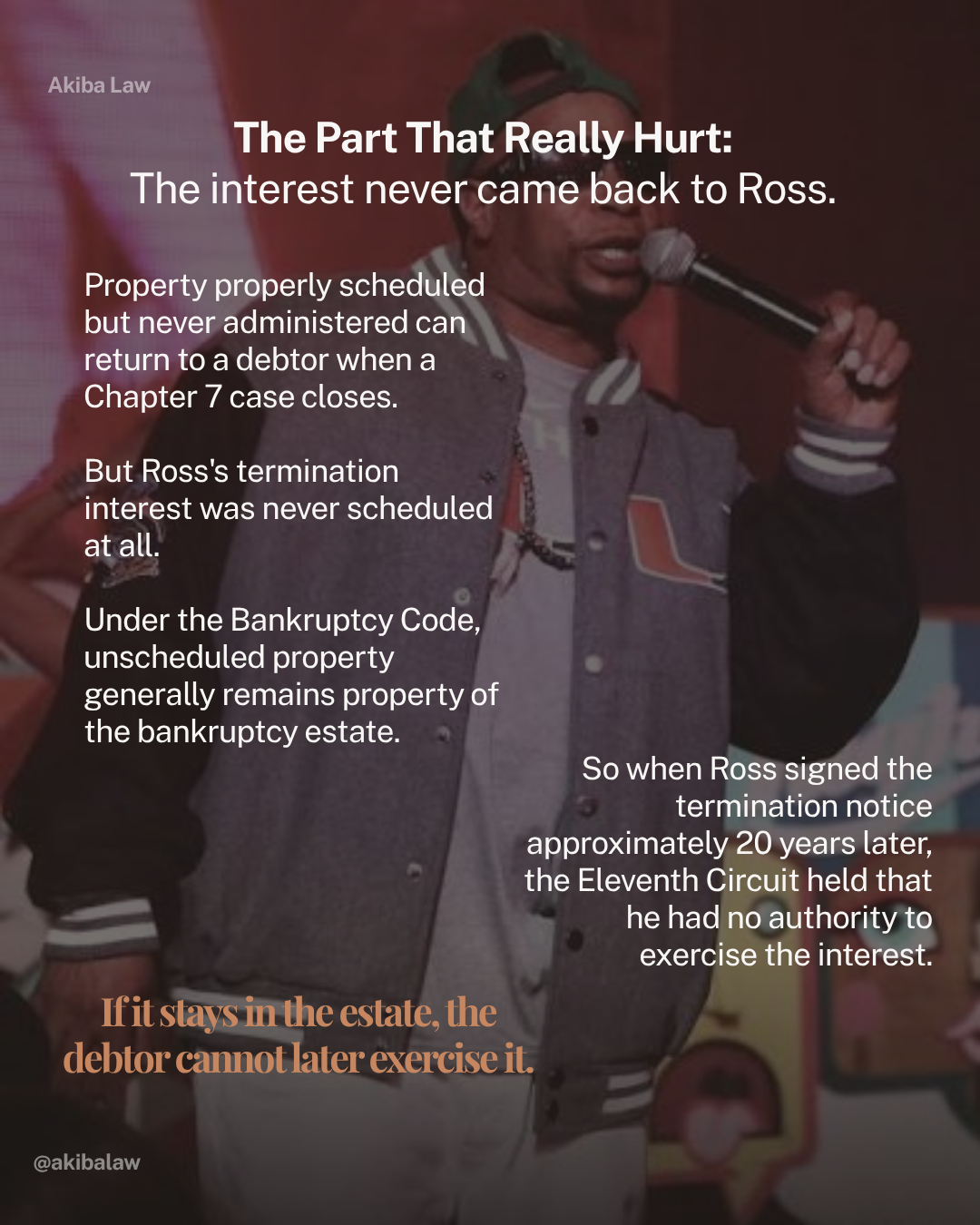
The outcome became particularly severe because Ross’s termination interest was never scheduled in his bankruptcy case.
In a Chapter 7 bankruptcy, certain scheduled property that the trustee does not administer may be abandoned back to the debtor when the case closes.
Unscheduled property is different. Property that remains part of the estate and is neither administered nor abandoned generally remains property of the bankruptcy estate after the case closes.
According to the Eleventh Circuit, that is what happened to Ross’s termination interest.
His bankruptcy ended, but the unscheduled interest did not simply revert to him. As a result, when Ross later signed the termination notice, the court held that he lacked authority to exercise that interest.
One Missing Interest Changed the Entire Copyright Result
The consequences extended beyond Ross individually.
Without Ross’s interest, only two of the four original author interests had validly participated in the termination.
Two out of four is not a majority.
The Eleventh Circuit therefore concluded that the termination notice was ineffective and reversed the district court’s contrary judgment.
A bankruptcy filing from approximately twenty years earlier ultimately affected whether the group could reclaim copyrights created in the 1980s.
The Court Left Important Questions Open
The Eleventh Circuit emphasized that its decision was limited.
It determined that Ross’s termination interests were property of the bankruptcy estate when he purported to exercise them. The court did not comprehensively decide how copyright termination interests should be administered in bankruptcy.
It also did not decide what Ross’s heirs or successors might now be able to do in light of the bankruptcy history.
“Although we conclude that Ross’s termination interests were property of the bankruptcy estate at the time he purported to exercise them, our decision is limited. We do not address how termination interests should be treated in bankruptcy. And we do not decide today what Ross’s heirs need to do to exercise those interests in the light of his bankruptcy.”
Those unresolved questions could become important in future disputes involving creators whose statutory termination windows arise years or decades after a bankruptcy case has closed.
Creators Should Identify Intellectual Property Rights During Bankruptcy
A creator entering bankruptcy may own more than presently valuable copyrights, trademarks, royalties, or contractual payment rights.
Future or contingent intellectual property interests may also require careful analysis.
Depending on the circumstances, a creator may need to consider:
- Existing copyrights and copyright registrations
- Royalty and licensing rights
- Publishing interests
- Master-recording interests
- Claims for unpaid royalties
- Rights under existing licenses
- Reversionary interests
- Future termination rights under Sections 203 or 304
- Rights belonging jointly with collaborators
- Intellectual property held through business entities
Failing to identify an asset because it cannot yet be exercised or has uncertain value can create consequences long after the bankruptcy itself appears finished.
Termination Planning Should Begin Years Before the Window Opens
Copyright termination is not something creators should begin analyzing when they are finally ready to send the notice.
The process may require reconstructing transactions that occurred decades earlier. Counsel may need to determine who authored the work, who executed the original grant, whether the work was made for hire, which statutory termination provision applies, who currently owns the termination interests, whether any authors have died, and whether prior divorces, estates, assignments, or bankruptcies affect those rights.
The 2 Live Crew decision adds another item to that diligence list: the bankruptcy history of every person whose interest is necessary to achieve the required statutory majority.
For works involving multiple authors, one person’s ownership problem can affect everyone.
The Practical Lesson
Termination rights can create extraordinary value for musicians, artists, writers, photographers, and other creators whose works become commercially successful after the original transfer.
Those rights also exist within a much larger legal system.
Copyright law, bankruptcy law, probate law, family law, and contract law can all affect who possesses the statutory authority to reclaim a copyright decades later.
The 2 Live Crew decision is a striking example. A right created by Congress to give authors another opportunity at copyright ownership became entangled with a bankruptcy filed approximately twenty years before the right was exercised.
For creators and rights holders, the lesson is straightforward: a copyright termination right may be difficult to sign away, but it is not necessarily bankruptcy-proof.
Akiba Law assists creators, artists, musicians, businesses, and rights holders with copyright ownership, licensing, transfers, intellectual property agreements, and disputes involving creative rights.
warning Disclaimer
This article is for general educational and informational purposes only and does not constitute legal advice. Reading this article does not create an attorney-client relationship with Akiba Law PLLC or any attorney. Florida law may apply differently depending on the specific facts, legal issues, and parties involved. Individuals and businesses should consult qualified legal counsel about their specific circumstances. For questions, concerns, or additional information, please contact Akiba Law PLLC to speak with a qualified attorney.

From a Real Estate Listing to Restitution: Argentina Orders Return of Nazi-Looted Old Master to Sole Remaining Heir of Jacques Goudstikker
More than eighty years after an Old Master painting disappeared during the Nazi era, an Argentine court has ordered its…
Case Update: Solar Drops Second Gang Starr Lawsuit After Judge Questions Prospect of Duplicative Litigation
When I first wrote about the latest chapter in the legal battle surrounding Gang Starr in September 2025, producer John…

Art Law in Florida: A Practitioner’s Handbook
Akiba Law PLLC is a Miami-based law firm advising artists, collectors, galleries, dealers, auction businesses, museums, and creative entrepreneurs on…
When Does a Sculpture Become a Building? East Hampton’s Lawsuit Over Matt Johnson’s Meditating Figure
Large-scale public and private art installations can raise issues well beyond copyright, contracts, and exhibition agreements. Once an artwork reaches…
Eden Gallery Sues Collector Over Alleged $822,390 Unpaid Balance: Lessons for Art Sales on Credit
High-value art transactions are often built on relationships. A collector may purchase repeatedly from the same gallery, payments may be…
MoMA v. MOMACHA: Trademark Strength, Brand Similarity, and Consumer Confusion
A trademark dispute does not always begin with two businesses offering the same product. Confusion can arise when a newer…

When a $2.5 Million Art Loan Ends in Litigation: Lessons for Galleries, Curators, and Property Owners
Long-term art placements can benefit everyone involved. Galleries gain access to potential collectors, property owners enhance their spaces, and residents…

When a Gallery Sells Consigned Art but Does Not Pay the Artist: The Hole Lawsuit and New York’s Trust-Fund Rules
An artwork consignment is not simply an informal arrangement in which a gallery agrees to sell a work and pay…
Your Logo Is on the Shirt. Does That Count as Trademark Use?
Launching a clothing brand involves more than creating a name, designing a logo, and placing it on a garment. How…

45 Antiquities Seized from the Metropolitan Museum of Art: Provenance, Repatriation, and the Importance of Due Diligence
On July 8, 2026, the Manhattan District Attorney’s Office announced the return of 59 antiquities, collectively valued at more than…

Florida Interior Designers and Decorators: Are You Regulated? Do You Need a License?
Interior designers and decorators in Florida often face a practical question: am I subject to Florida regulation, and do I…
Jacques Goudstikker’s Stolen Collection Is Still Being Found and Returned
Restitution can’t undo the Holocaust but it can return what was taken and every returned work matters. A Nazi-looted painting…