Eden Gallery Sues Collector Over Alleged $822,390 Unpaid Balance: Lessons for Art Sales on Credit
High-value art transactions are often built on relationships. A collector may purchase repeatedly from the same gallery, payments may be made in installments, and the parties may become comfortable completing later transactions with considerably less formality than they would have accepted at the beginning of the relationship.
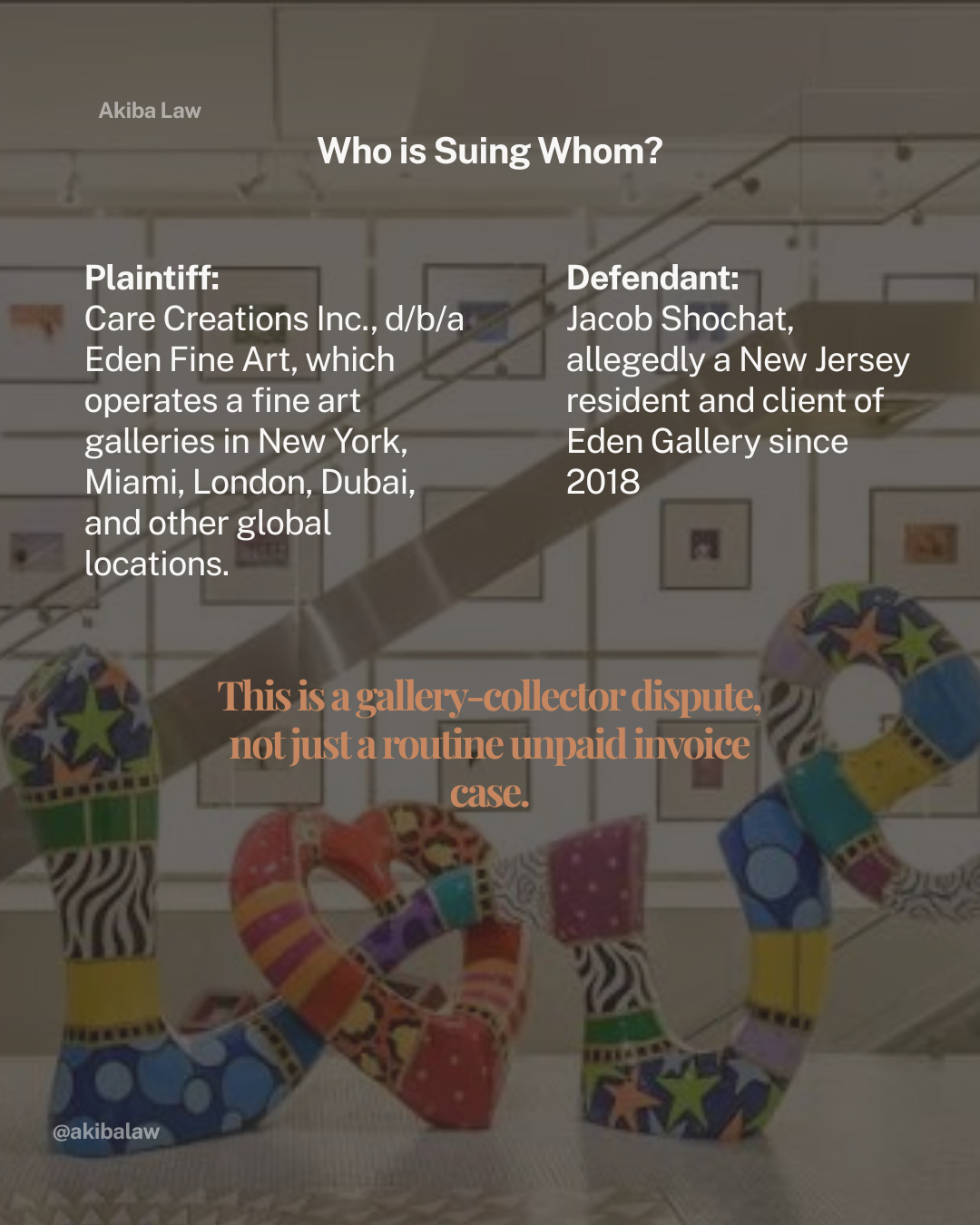
A recently filed federal lawsuit involving Eden Fine Art illustrates the risk of allowing that informality to scale with the size of the transactions. Care Creations Inc., doing business as Eden Fine Art, filed suit against collector Jacob Shochat in the U.S. District Court for the District of New Jersey on July 24, 2026. The case is pleaded as a diversity contract action.
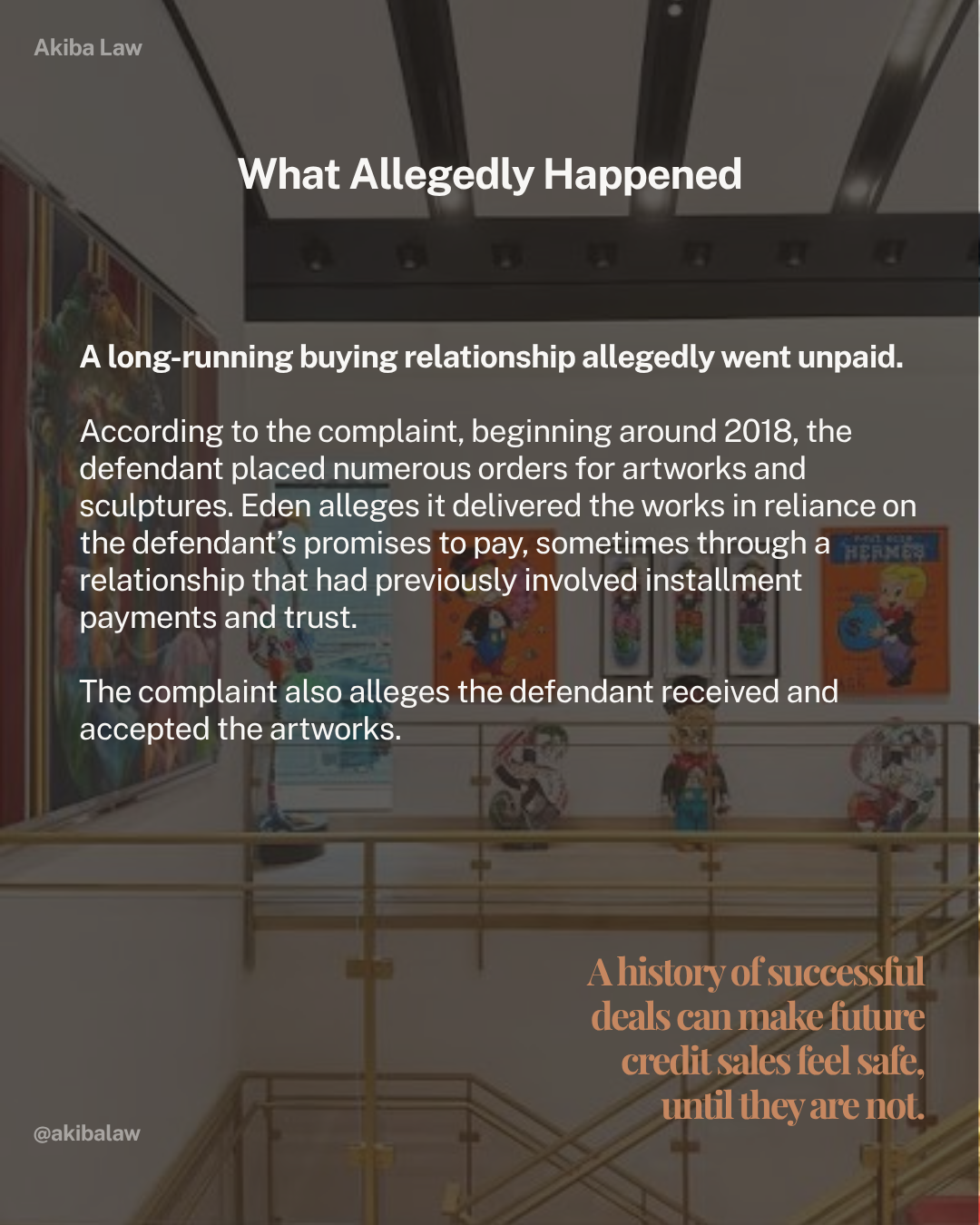
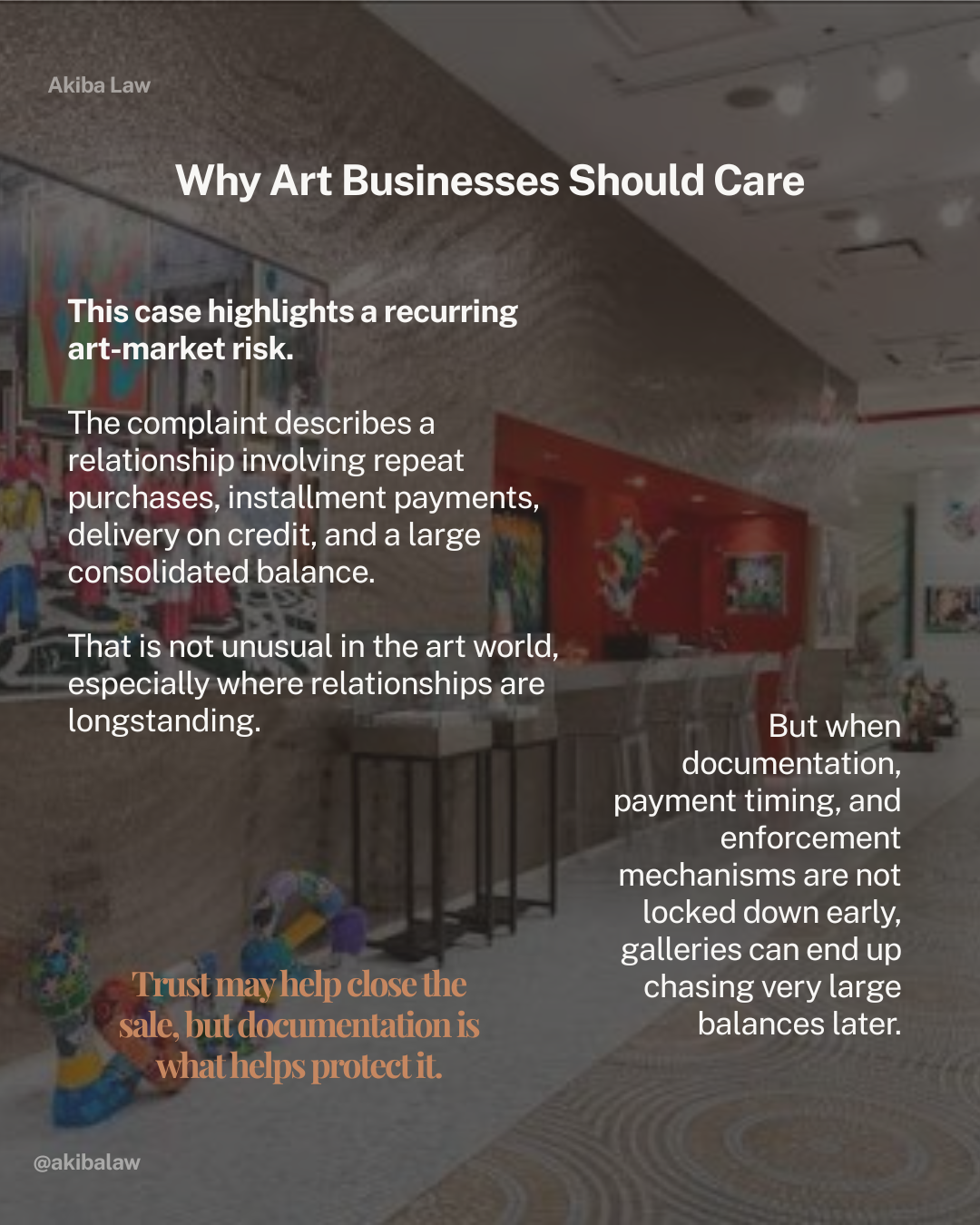
According to the complaint, Eden and Shochat had done business since approximately 2018. Eden alleges that Shochat repeatedly ordered artworks and sculptures, that the gallery delivered the works in reliance on his promises to pay, and that the parties developed a course of dealing involving installment payments and an ongoing account.
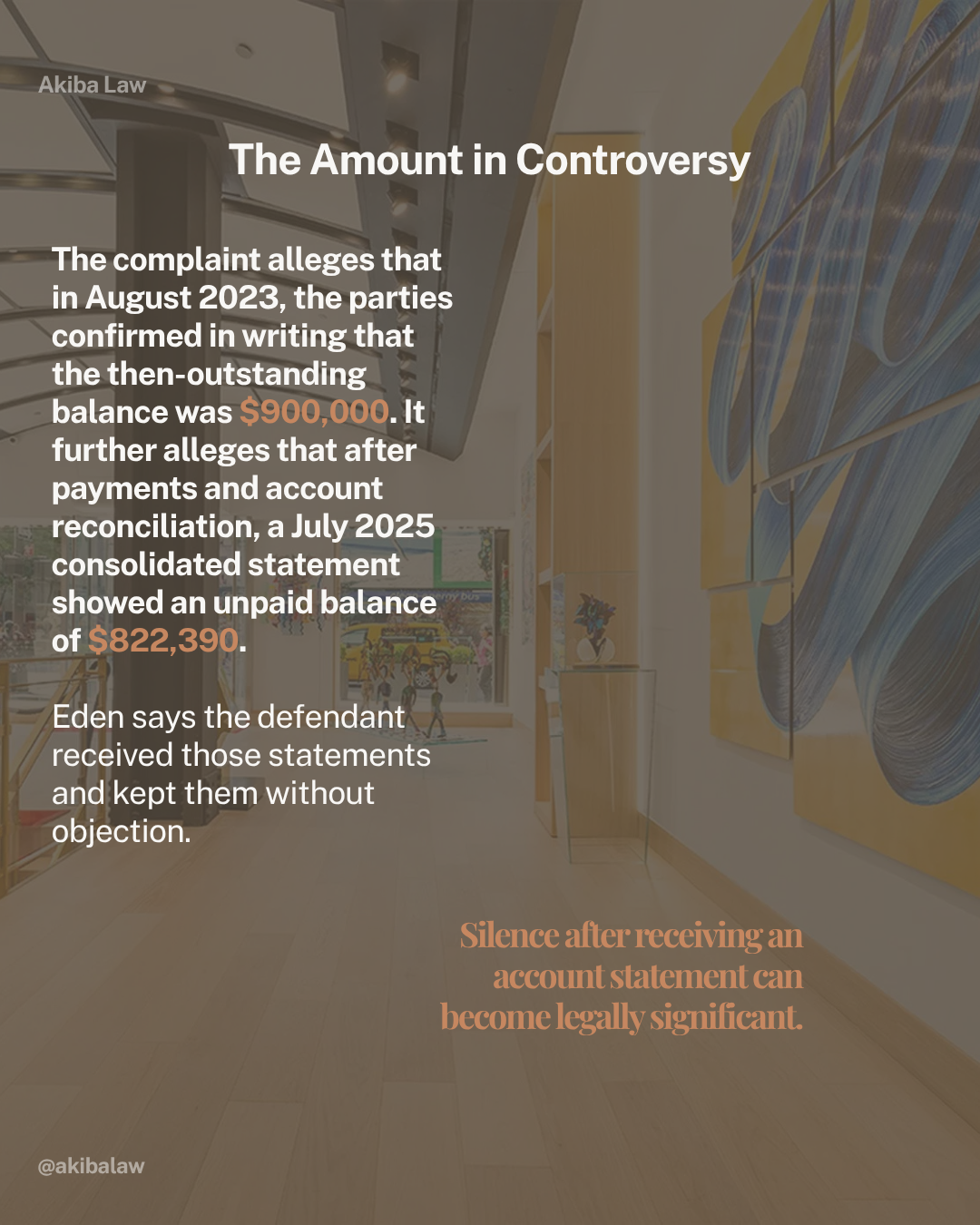
The dispute concerns a substantial alleged balance. Eden claims that the parties confirmed an outstanding balance of $900,000 in August 2023 and that, after subsequent payments and reconciliation, a July 2025 consolidated statement reflected $822,390 still due. According to Eden, the collector received the statements without objecting to the balance.
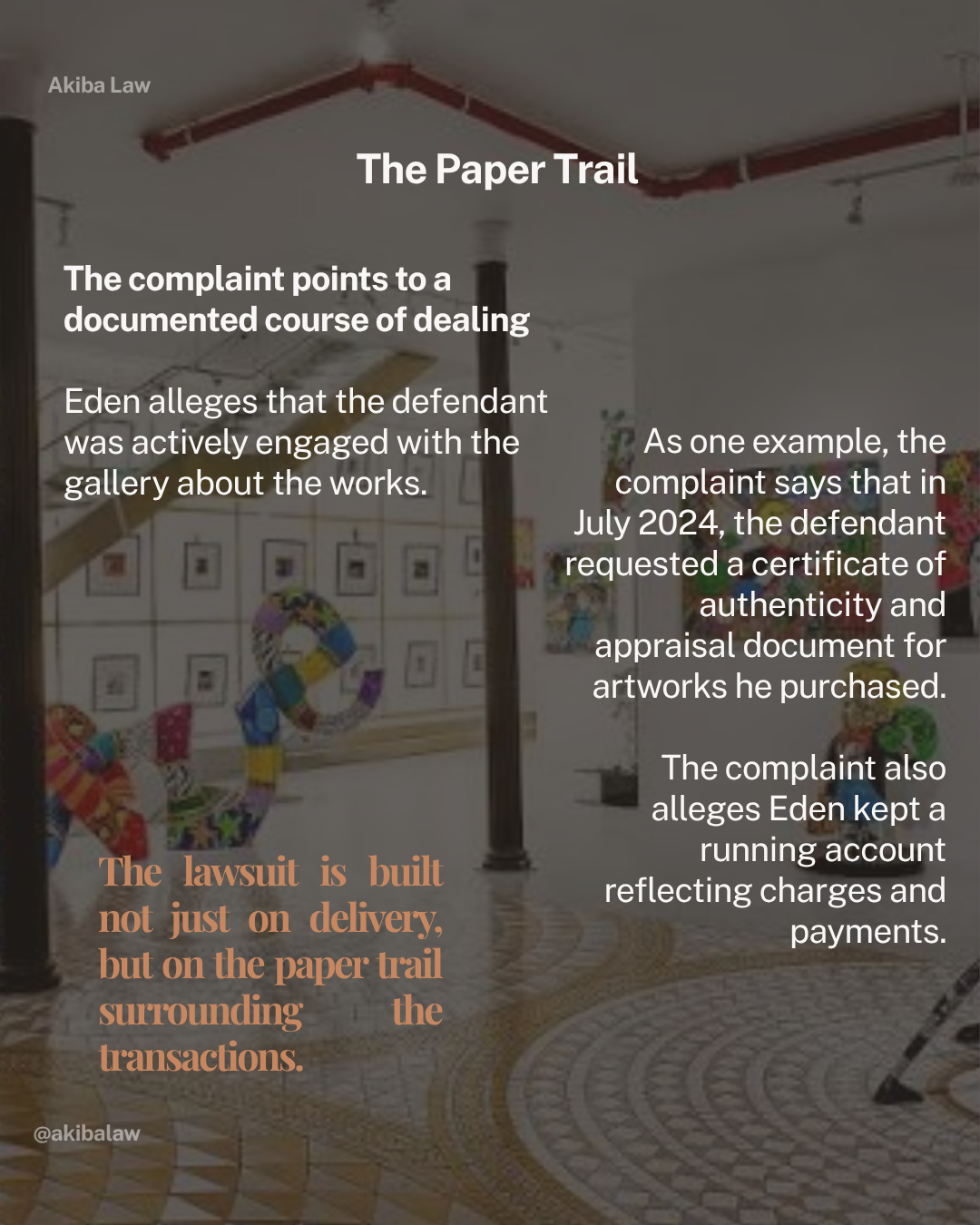
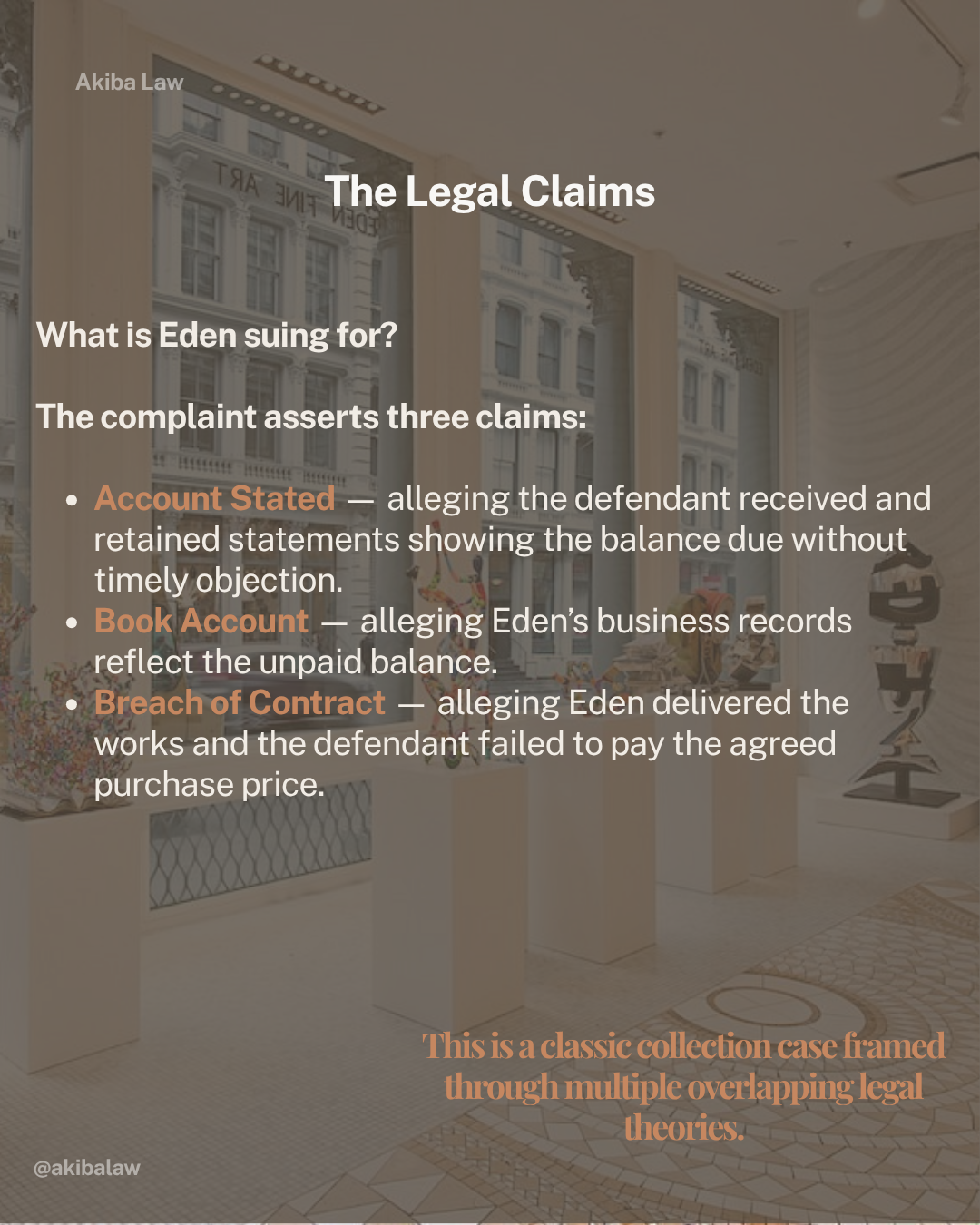
That detail matters because the lawsuit is not framed solely as a straightforward breach-of-contract case. Eden also asserts claims based on an account stated and a book account, placing the parties’ invoices, statements, payment history, correspondence, and other records at the center of the dispute.
The allegations have not been proven, and the defendant will have the opportunity to contest Eden’s version of the transactions.
The following slides summarize the allegations and explain why documentation becomes increasingly important when galleries extend substantial informal credit to repeat collectors.

A Longstanding Relationship Is Not a Substitute for Transaction Documents
Repeat collectors are valuable to galleries, and commercial relationships naturally become more efficient over time. A buyer who has completed ten successful transactions may not be treated like a first-time customer.
The problem arises when the value of the credit being extended increases while the documentation becomes less formal.
For every significant sale, a gallery should be able to establish what was purchased, the agreed price, any discount, the payment schedule, the amount already received, the remaining balance, when title passes, and when the artwork may be delivered.
That documentation does not necessarily require a lengthy bespoke agreement for every transaction. Depending on the circumstances, invoices, signed purchase confirmations, emails, installment agreements, account statements, and payment records may collectively create a strong documentary history.
The key is that the records should tell the same story.
Credit Terms Should Be Established Before the Artwork Leaves
One of the most consequential decisions in an art transaction is whether the artwork will be delivered before the gallery receives full payment.
Where a gallery agrees to an installment sale, the agreement should address:
- The purchase price and required deposit
- The amount and due date of each installment
- Whether the artwork remains with the gallery until payment is complete
- When title passes to the buyer
- Responsibility for insurance while payments remain outstanding
- What constitutes a default
- Whether late charges or interest apply
- The gallery’s remedies if the collector stops paying
The greater the unpaid balance, the more important those provisions become.
Allowing a trusted collector to take possession before payment may make commercial sense in some relationships. It should nevertheless be a deliberate credit decision rather than something that happens simply because prior transactions worked out.
Account Statements Can Become Important Evidence
One of the more interesting claims in the Eden lawsuit is account stated.
In some jurisdictions, assent to an account may sometimes be inferred from the parties’ conduct. Courts have recognized that retaining a statement of account without objecting for an unreasonable period can constitute evidence that the recipient accepted the correctness of the stated balance. Whether an account stated actually exists remains dependent on the applicable law, the facts, and the parties’ dealings.
That makes routine accounting communications potentially important litigation evidence.
Suppose a gallery sends a collector a statement saying:
Previous balance: $900,000
Payments received: $77,610
Balance due: $822,390
If the collector believes the balance is wrong, disputing it promptly and in writing can be important. Conversely, a gallery attempting to establish the amount owed may benefit from regularly sending clear statements rather than allowing years of transactions to accumulate without reconciliation.
Silence is not automatically an admission of every invoice. But a history of sending statements, receiving payments against those statements, and receiving no contemporaneous objection may become relevant evidence if litigation follows.
A Book Account Depends on the Quality of the Records
A book account is essentially a business record reflecting debits, credits, payments, and the resulting balance between the parties. Some jurisdictions may find recognized properly supported business records as evidence in actions concerning book accounts.
For an art gallery, the underlying records should allow each transaction to be reconstructed.
A collector account should ideally show the particular artwork, artist, inventory number, invoice date, sale price, discount, applicable taxes or shipping charges, deposits received, later payments, credits, and remaining balance.
A single spreadsheet containing an unexplained number at the bottom is substantially less useful than records that can trace the balance back to individual transactions.
Preserve the Communications Around the Artwork
The artwork itself is only part of the evidence.
The complaint reportedly relies on communications showing the collector remained engaged with the gallery regarding works that had been purchased. One example identified in the slides is a request for certificates of authenticity and appraisal materials.
Those types of communications may become relevant because they can help establish which works were ordered, whether the buyer accepted them, whether the transaction was treated as complete, and how the parties understood their relationship.
Galleries should preserve:
- Purchase confirmations
- Emails and text messages concerning orders
- Invoices
- Payment instructions
- Wire confirmations and credit-card receipts
- Shipping and delivery records
- Certificates of authenticity
- Appraisal requests
- Installation communications
- Account statements
- Communications concerning extensions or missed payments
The objective is to be able to reconstruct the transaction several years later without depending on anyone’s memory.
Do Not Allow the Outstanding Balance to Become Invisible
Longstanding accounts can create a particular problem: new purchases are added while older balances remain open.
A $30,000 balance becomes $100,000. Another purchase is delivered. Payments arrive intermittently. Credits are applied. Another work is added. Eventually, neither side can easily identify which payment corresponds to which artwork. Sound familiar?
Regular reconciliation can prevent that.
Once an account reaches a predetermined threshold, the gallery might require the collector to pay down the existing balance before taking possession of additional works. The appropriate threshold will depend on the gallery, collector, transaction history, and value of the works involved.
The important point is to establish the rule before a problem develops.
Informal Credit Should Still Have an Enforcement Plan
If a gallery sells artwork on credit, it should decide in advance what happens when an installment is missed.
Waiting indefinitely can make matters worse. Additional artwork may be delivered, the balance may increase, records may become harder to reconcile, and communications may become less precise as employees or gallery representatives change.
An internal credit policy can establish when the gallery sends a reminder, when management must approve an extension, when additional purchases are suspended, when a formal demand is required, and when counsel becomes involved.
A valuable collector relationship may justify flexibility. Flexibility works better when it operates within a documented system.
The Practical Lesson for Galleries, Dealers, and Advisors
The Eden dispute highlights a familiar tension in the art market. Relationships and trust facilitate transactions, particularly where collectors and galleries have worked together successfully for years.
Those relationships should be supported by documentation capable of surviving a dispute.
For substantial transactions, the seller should know exactly what was sold, what remains unpaid, what the buyer has acknowledged, where the artwork is located, and what remedies are available if payment stops.
Trust may help close the transaction. The paper trail is what protects it afterward.
Akiba Law assists galleries, collectors, art advisors, artists, and other art-market participants with purchase and sale agreements, installment transactions, consignments, collection matters, payment disputes, and litigation involving works of art.
For more information, visit the Art Law Lab or read Akiba Law’s free resource: Art Law in Florida: A Practitioner’s Handbook.
warning Disclaimer
This article is for general educational and informational purposes only and does not constitute legal advice. Reading this article does not create an attorney-client relationship with Akiba Law PLLC or any attorney. Florida law may apply differently depending on the specific facts, legal issues, and parties involved. Individuals and businesses should consult qualified legal counsel about their specific circumstances. For questions, concerns, or additional information, please contact Akiba Law PLLC to speak with a qualified attorney.

From a Real Estate Listing to Restitution: Argentina Orders Return of Nazi-Looted Old Master to Sole Remaining Heir of Jacques Goudstikker
More than eighty years after an Old Master painting disappeared during the Nazi era, an Argentine court has ordered its…

Case Update: Solar Drops Second Gang Starr Lawsuit After Judge Questions Prospect of Duplicative Litigation
When I first wrote about the latest chapter in the legal battle surrounding Gang Starr in September 2025, producer John…

Art Law in Florida: A Practitioner’s Handbook
Akiba Law PLLC is a Miami-based law firm advising artists, collectors, galleries, dealers, auction businesses, museums, and creative entrepreneurs on…

2 Live Crew Tried to Take Back Its Copyrights. A Decades-Old Bankruptcy Got in the Way.
Copyright ownership can last for decades, and the Copyright Act gives many creators an unusual second chance to revisit deals…

When Does a Sculpture Become a Building? East Hampton’s Lawsuit Over Matt Johnson’s Meditating Figure
Large-scale public and private art installations can raise issues well beyond copyright, contracts, and exhibition agreements. Once an artwork reaches…
MoMA v. MOMACHA: Trademark Strength, Brand Similarity, and Consumer Confusion
A trademark dispute does not always begin with two businesses offering the same product. Confusion can arise when a newer…

When a $2.5 Million Art Loan Ends in Litigation: Lessons for Galleries, Curators, and Property Owners
Long-term art placements can benefit everyone involved. Galleries gain access to potential collectors, property owners enhance their spaces, and residents…

When a Gallery Sells Consigned Art but Does Not Pay the Artist: The Hole Lawsuit and New York’s Trust-Fund Rules
An artwork consignment is not simply an informal arrangement in which a gallery agrees to sell a work and pay…

Your Logo Is on the Shirt. Does That Count as Trademark Use?
Launching a clothing brand involves more than creating a name, designing a logo, and placing it on a garment. How…

45 Antiquities Seized from the Metropolitan Museum of Art: Provenance, Repatriation, and the Importance of Due Diligence
On July 8, 2026, the Manhattan District Attorney’s Office announced the return of 59 antiquities, collectively valued at more than…

Florida Interior Designers and Decorators: Are You Regulated? Do You Need a License?
Interior designers and decorators in Florida often face a practical question: am I subject to Florida regulation, and do I…
Jacques Goudstikker’s Stolen Collection Is Still Being Found and Returned
Restitution can’t undo the Holocaust but it can return what was taken and every returned work matters. A Nazi-looted painting…