MoMA v. MOMACHA: Trademark Strength, Brand Similarity, and Consumer Confusion
A trademark dispute does not always begin with two businesses offering the same product. Confusion can arise when a newer business adopts a name, logo, or visual identity that resembles an established brand and operates in a related commercial space.
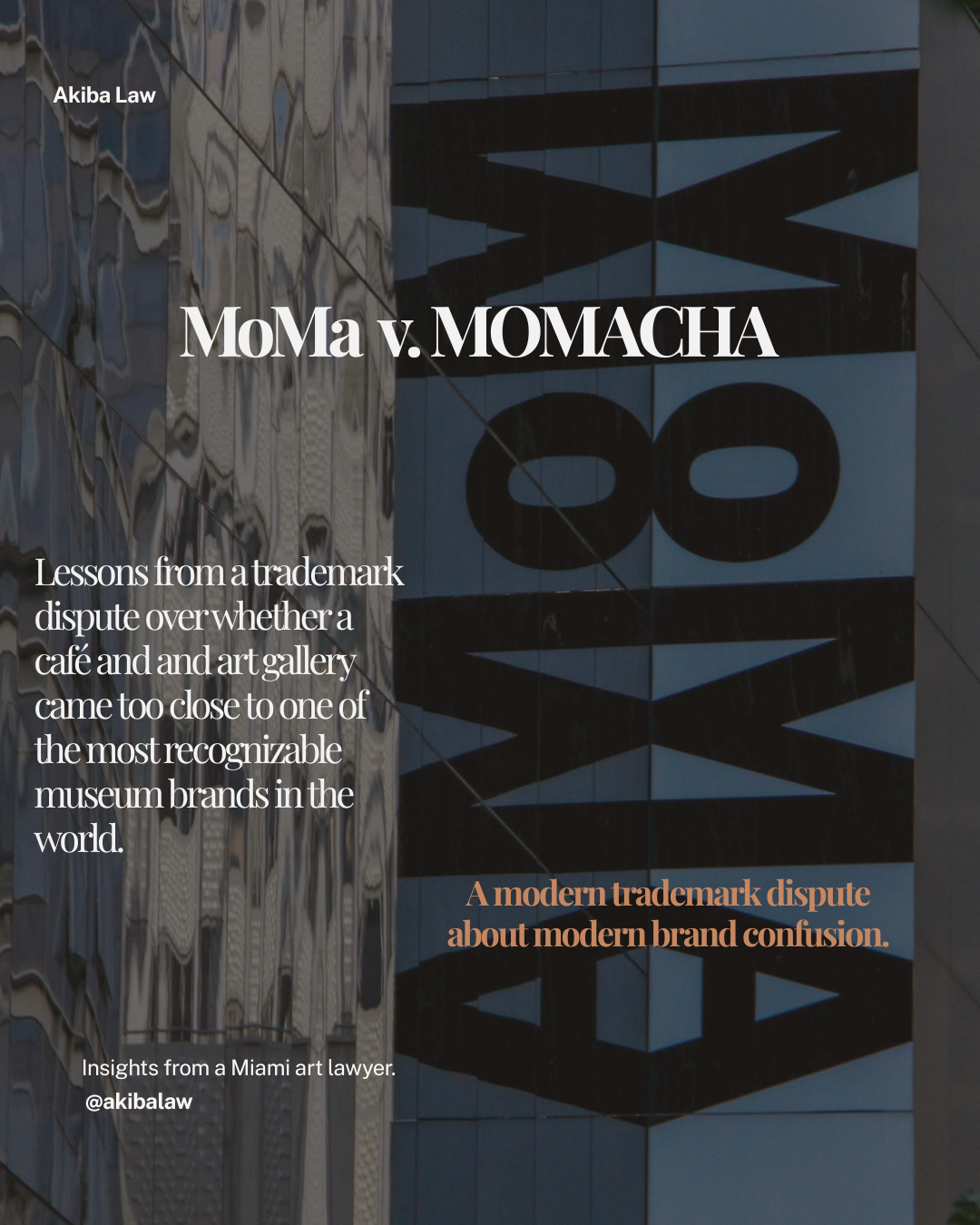
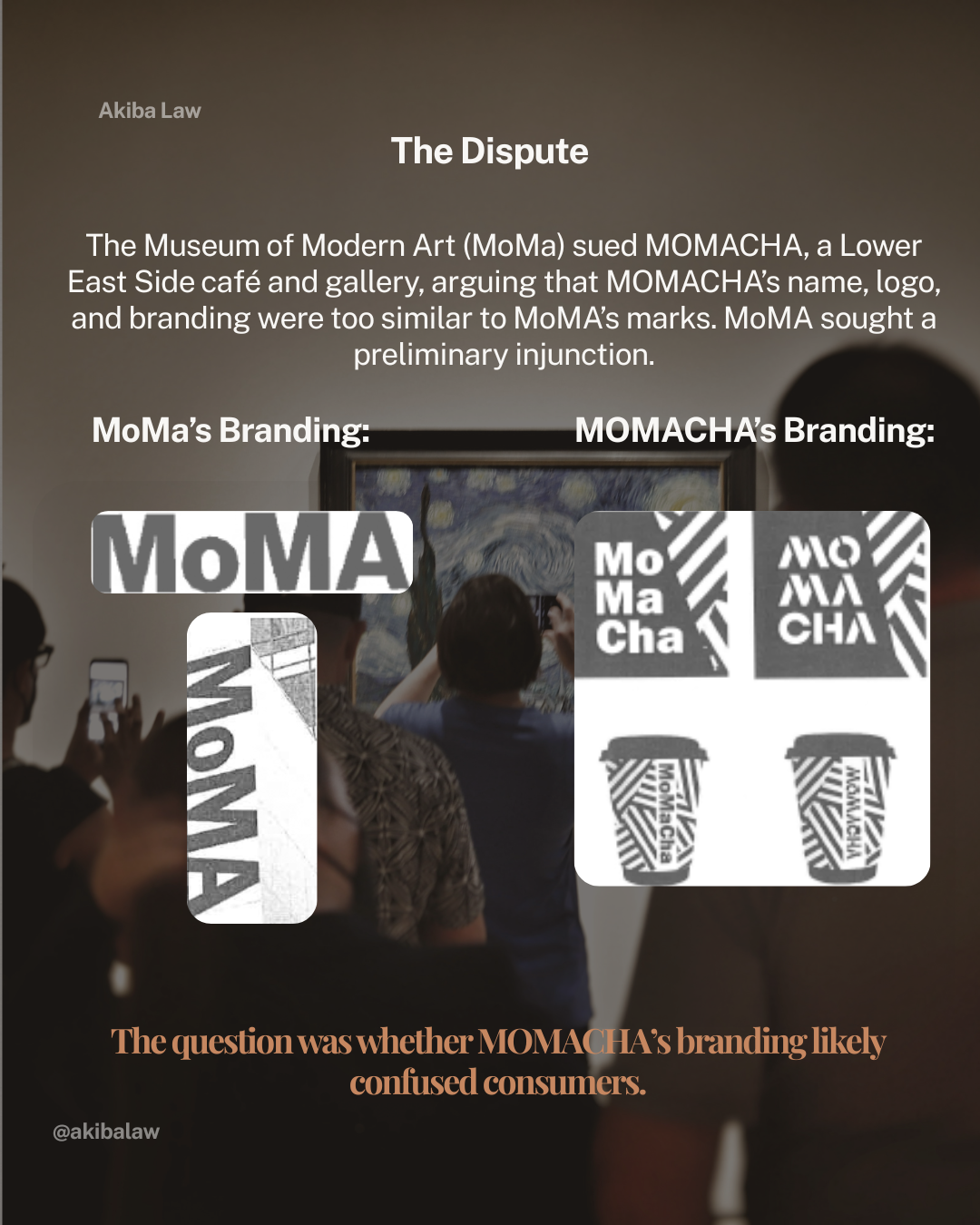
That issue was central to the dispute between the Museum of Modern Art and MOMACHA, a Lower East Side café and art gallery. MoMA alleged that MOMACHA’s name, typography, black-and-white presentation, and overall branding came too close to MoMA’s well-known marks. MoMA sought a preliminary injunction restricting MOMACHA’s continued use of the challenged branding.
The case required the court to consider two related questions. First, how strong and protectable were MoMA’s marks? Second, were the parties’ names, branding, services, and marketplace presentation sufficiently similar to create a likelihood of consumer confusion?
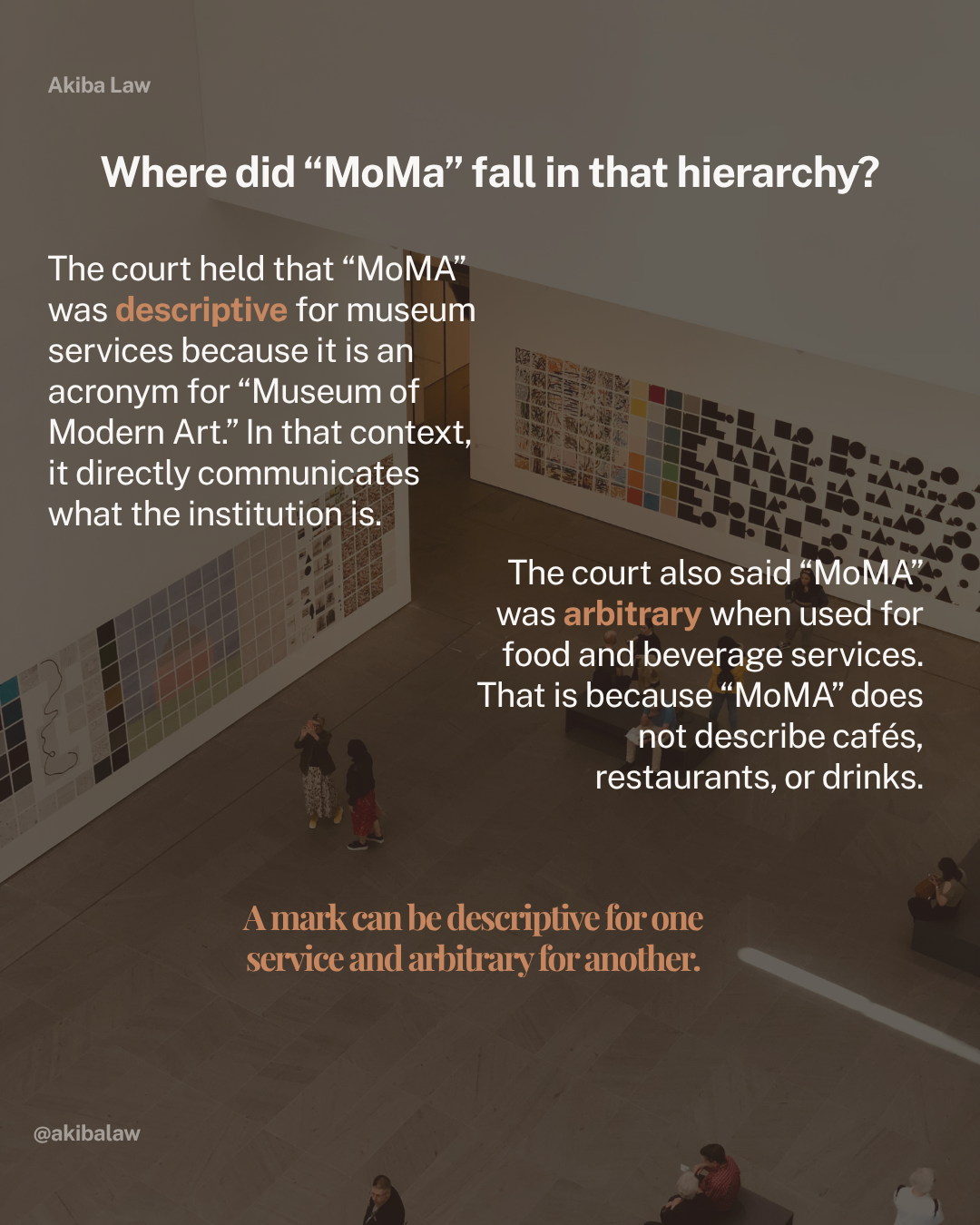
The court concluded that “MoMA” was descriptive when used for museum services because it abbreviates “Museum of Modern Art.” That classification did not end the analysis. Decades of use, advertising, publicity, media recognition, and public association supported a finding that the mark had acquired substantial secondary meaning.
The court also considered MoMA’s use of the mark beyond museum services. For restaurant, café, and beverage-related offerings, “MoMA” did not describe the services and could receive stronger protection. The case therefore illustrates how the same term may occupy a different position on the trademark spectrum depending on the goods or services involved.
The following slides explain the dispute, the hierarchy of trademark strength, the likelihood-of-confusion analysis, and the evidence that supported MoMA’s request for preliminary relief.
Trademark Strength Depends on the Mark and the Services
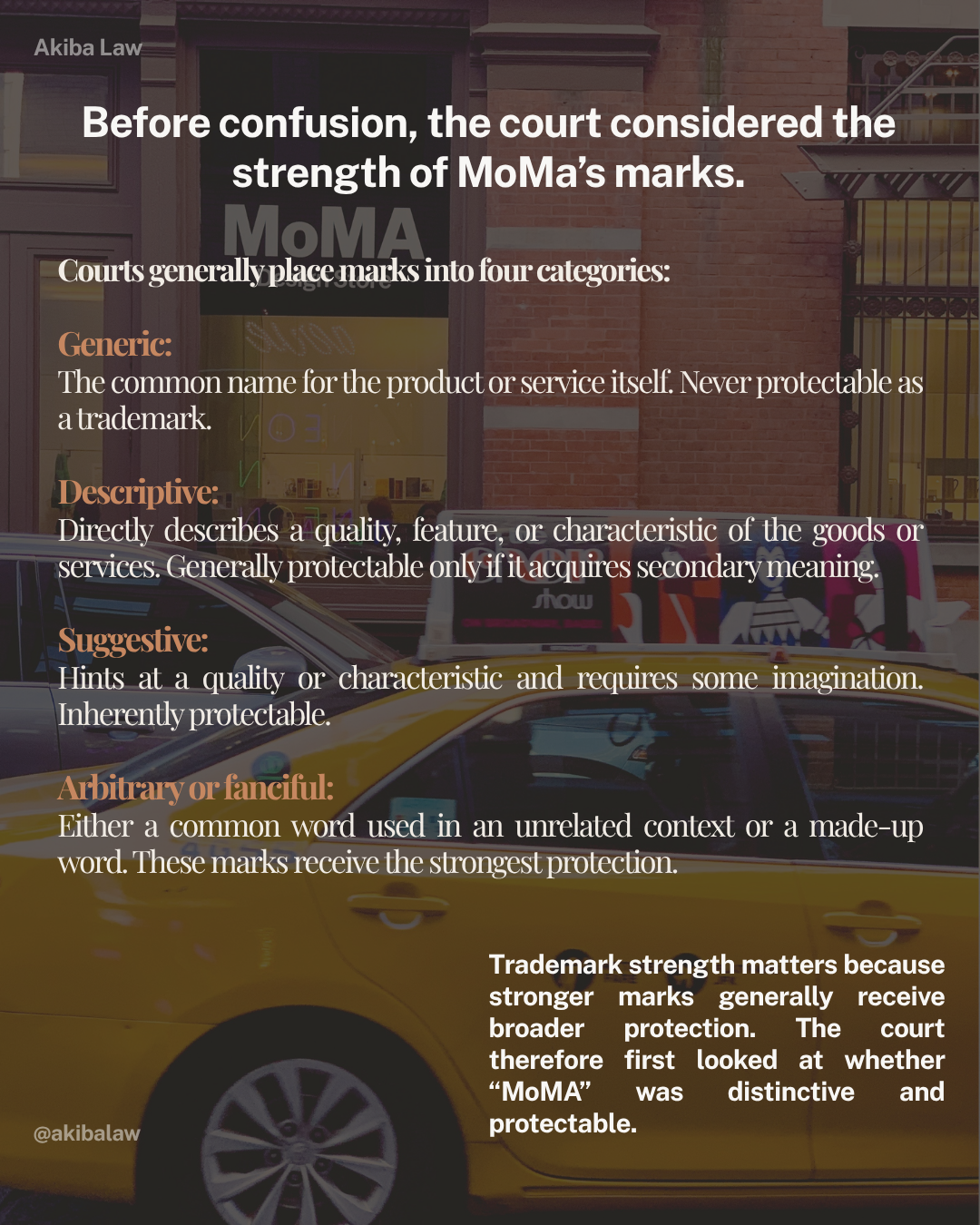
Courts often evaluate word marks along a spectrum ranging from generic to descriptive, suggestive, arbitrary, and fanciful. A mark’s placement on that spectrum affects whether it is protectable and the breadth of protection it may receive.
Generic terms name the relevant product or service and generally cannot function as trademarks. Descriptive marks directly communicate a characteristic, quality, function, or feature of the goods or services. They ordinarily require proof of acquired distinctiveness, also known as secondary meaning, before receiving protection.
Suggestive, arbitrary, and fanciful marks are considered inherently distinctive. Suggestive marks require some imagination to connect the term to the product. Arbitrary marks use an existing word in an unrelated context, while fanciful marks are invented terms.
The classification is tied to the particular goods or services. A term may be descriptive in one context and arbitrary in another. In the MoMA dispute, the court treated the acronym as descriptive for museum services but arbitrary in connection with food and beverage services.
Descriptive Does Not Necessarily Mean Weak
A descriptive mark may become commercially powerful when consumers come to associate it with a single source. That association is secondary meaning.
Courts may consider the duration and exclusivity of use, advertising expenditures, media coverage, consumer recognition, sales success, unsolicited publicity, attempts by others to imitate the mark, and other evidence showing that the public identifies the term with one business.
MoMA’s longstanding use and extensive public recognition were important to the court’s analysis. The case demonstrates why a descriptive classification does not automatically make a mark commercially insignificant or legally unenforceable.
A mark that has developed substantial secondary meaning may receive meaningful protection against later branding that creates a similar commercial impression.
Likelihood of Confusion Is a Multi-Factor Inquiry
Trademark infringement does not require proof that every customer was actually confused. Courts generally examine whether confusion is likely under the circumstances.
Some jurisdictions, like the 2nd Circuit in the MoMa case, apply the Polaroid factors, which include:
- The strength of the senior user’s mark
- The similarity between the parties’ marks
- The proximity of their goods or services
- The likelihood that the senior user will enter the junior user’s market
- Evidence of actual confusion
- The junior user’s good faith
- The quality of the junior user’s offerings
- The sophistication of the relevant consumers.
No single factor automatically resolves the case. The court evaluates how the factors interact and whether the parties’ overall marketplace presentations are likely to cause consumers to believe that they are affiliated, sponsored, approved, or connected.
Courts Compare the Overall Commercial Impression
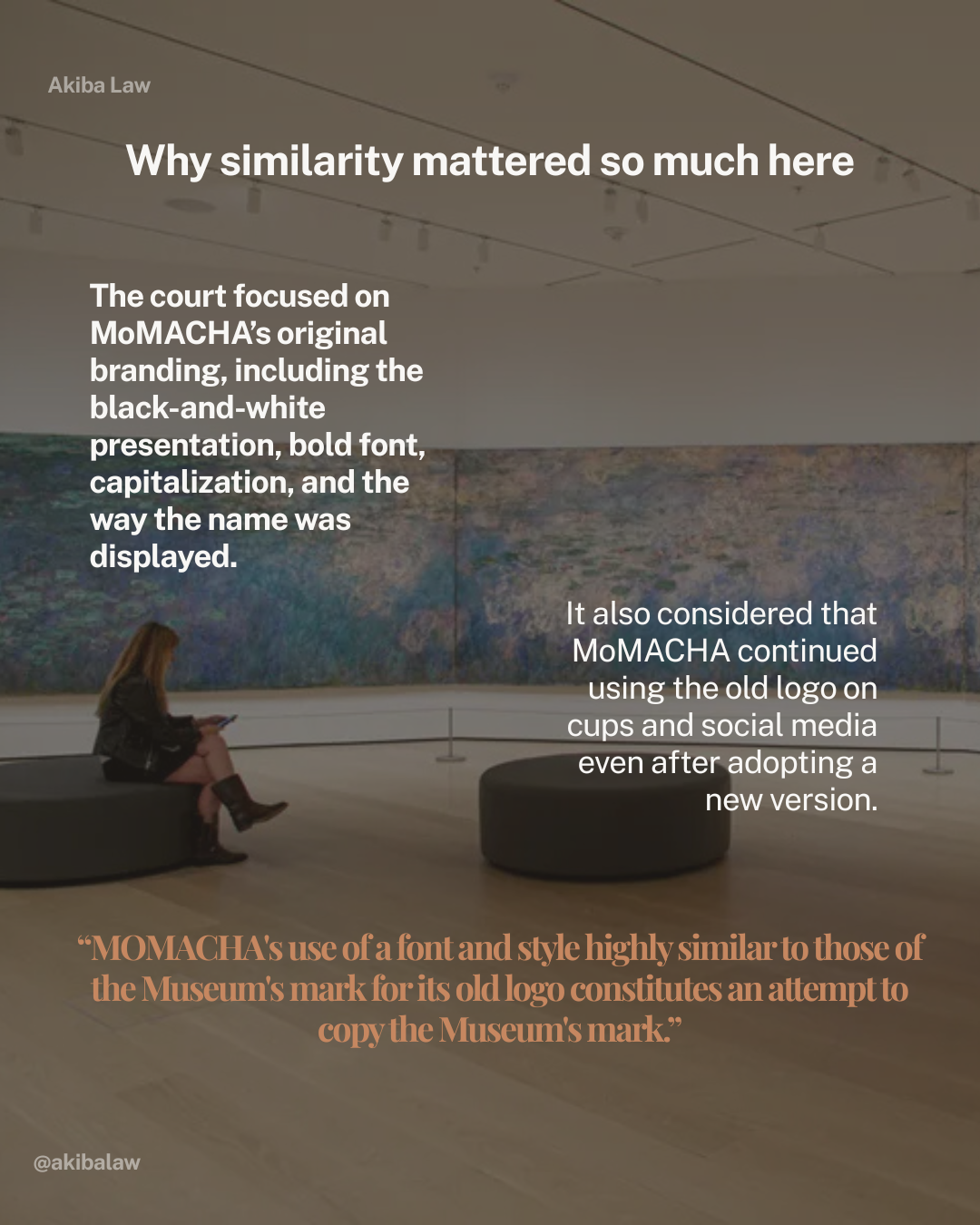
Trademark similarity is not limited to whether two names are spelled identically. Courts may examine pronunciation, appearance, typography, capitalization, color, layout, logo structure, packaging, signage, and the context in which customers encounter the marks.
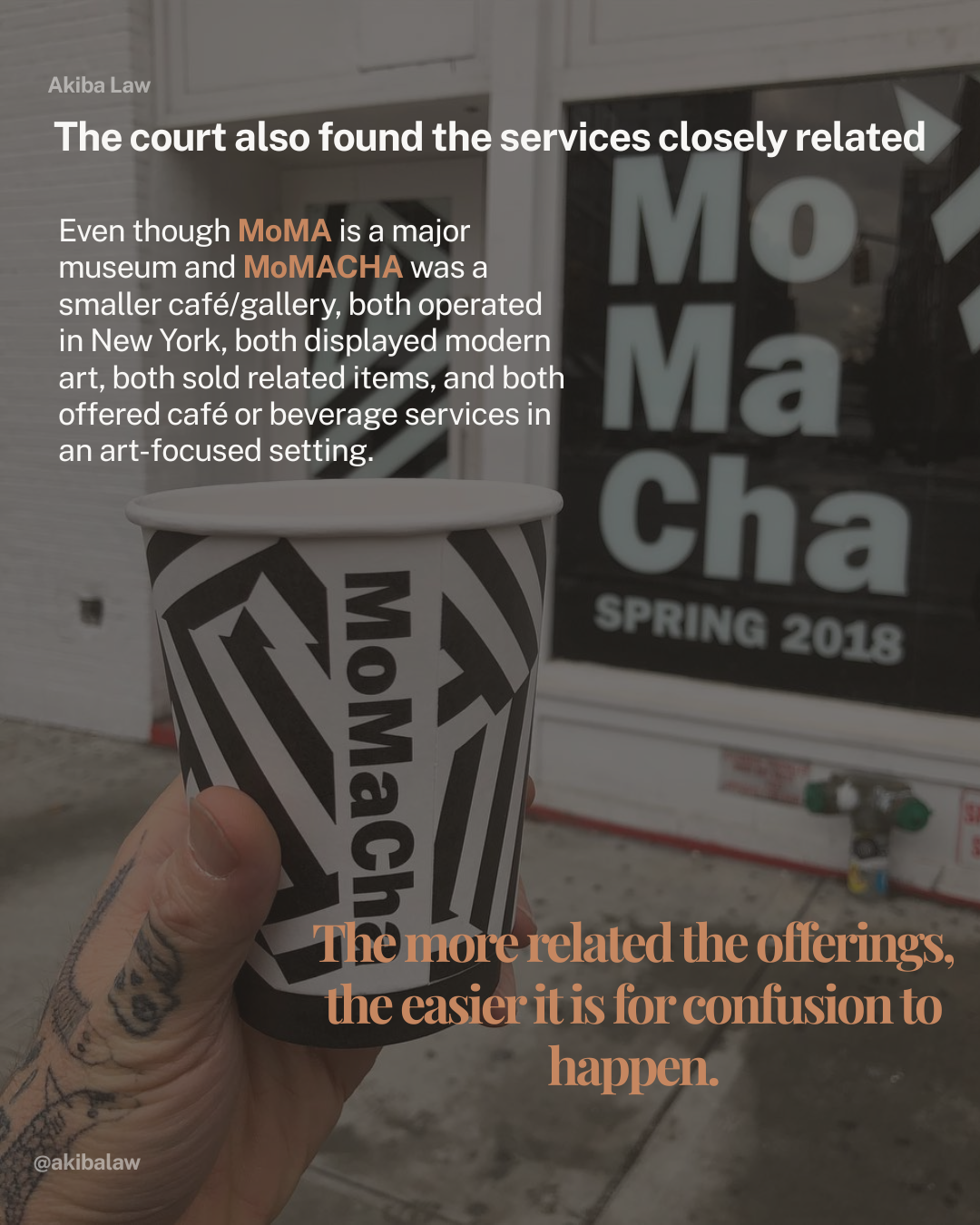
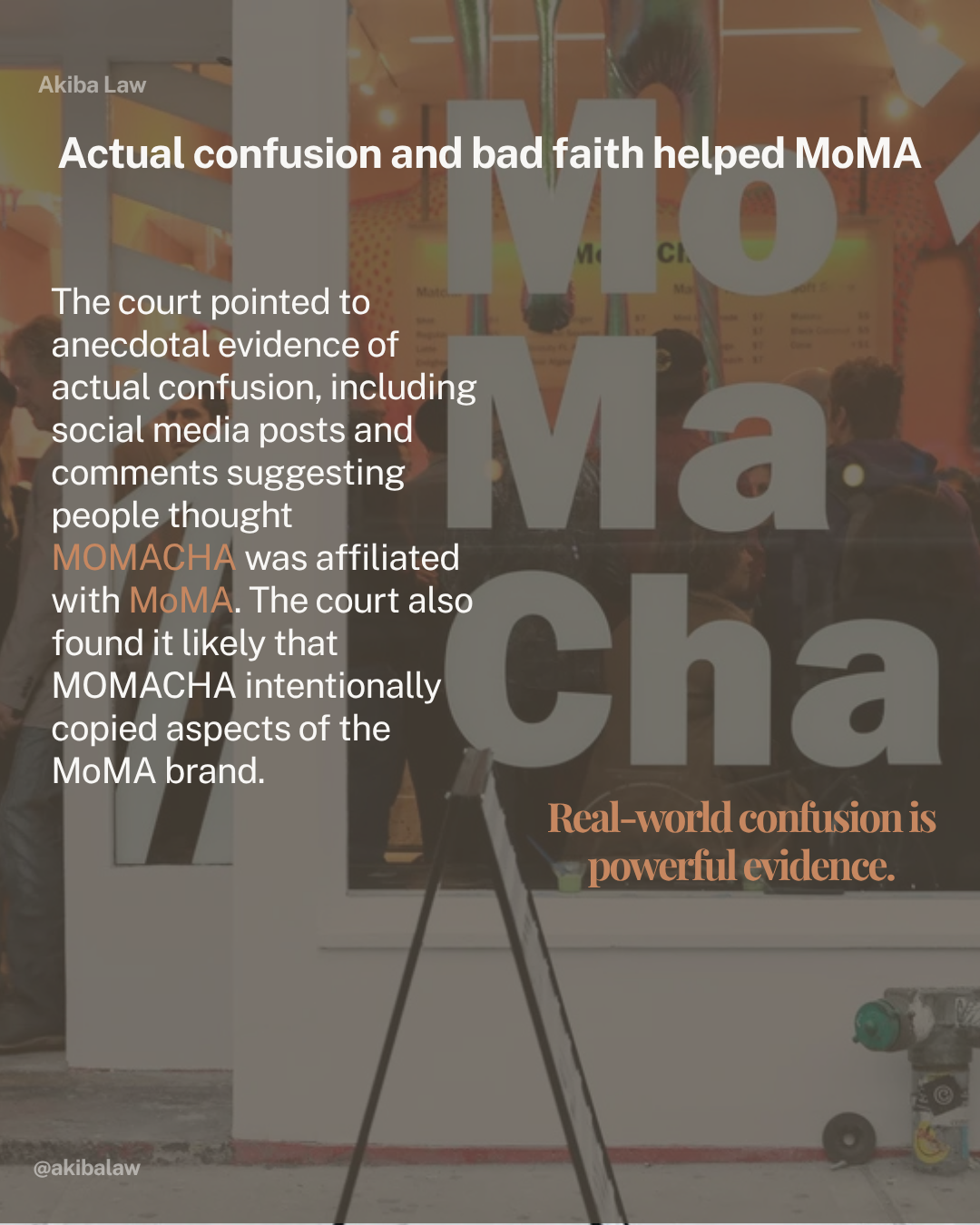
MOMACHA did not merely contain the letters “MoMA.” The court also considered its original black-and-white branding, bold typography, capitalization, logo arrangements, and use on items such as cups and social-media materials.
A business may reduce risk by changing one element of its design, but a partial redesign may not be enough when older materials remain in circulation. Websites, social accounts, packaging, merchandise, signage, and previously distributed promotional materials should all be reviewed when a brand adopts a new identity.
Related Services Can Increase the Risk of Confusion
The parties do not need to provide identical services for confusion to occur. The inquiry includes whether consumers may reasonably believe that the businesses are connected or that one has expanded into the other’s field.
MoMA operated a major museum, while MOMACHA operated a smaller café and gallery. Even so, both were located in New York, both operated in art-focused environments, both displayed modern art, and both offered or sold related products and food or beverage services.
Those points of overlap made a perceived affiliation more plausible. A consumer encountering MOMACHA could potentially believe that the café and gallery was sponsored by, associated with, or licensed by MoMA.
Businesses should therefore consider more than direct competitors during trademark clearance. A museum, hotel, fashion house, entertainment company, or other recognized brand may have enforceable rights extending into adjacent merchandise, hospitality, retail, educational, or experiential services.
Actual Confusion Can Be Powerful Evidence
Actual confusion is not always required, but evidence that consumers genuinely believed two businesses were affiliated can materially strengthen an infringement claim.
Relevant evidence may include:
- Misaddressed communications or inquiries
- Customer comments or reviews
- Social-media posts suggesting an affiliation
- Requests for information intended for the other business
- Survey evidence
- Testimony from consumers, employees, or business partners
- Online discussions comparing or connecting the brands.
Social-media reactions can be particularly useful because they may document consumer perceptions in real time. Businesses should preserve posts, comments, messages, screenshots, dates, URLs, and account information when confusion begins to appear online.
Evidence of Copying Can Affect the Good-Faith Analysis
A court may also examine whether the later user selected its branding independently or attempted to benefit from the recognition associated with the senior mark.
Similarity by itself does not always prove bad faith. The analysis becomes more serious when the junior user adopts several recognizable elements of the established brand, has prior awareness of the senior mark, or continues using challenged branding after receiving notice.
Internal drafts, design instructions, emails, mood boards, reference materials, and communications with branding professionals may become relevant. Businesses should be able to explain how a name and visual identity were selected and should avoid instructing designers to imitate the appearance of an established brand.
Trademark Clearance Should Include Visual Branding
A traditional trademark search often begins with names and pending or registered marks. That review should also consider the proposed logo, typography, packaging, color treatment, store design, website presentation, social-media identity, and the markets in which the brand will operate.
A proposed name may appear distinguishable in plain text but create a different impression once paired with similar design choices. The risk increases when the parties offer related products or services, target overlapping customers, or operate in the same geographic market.
Before launch, some questions a business should ask include:
- Does the name resemble an existing brand in sound, appearance, or meaning?
- Does the visual identity imitate recognizable elements of another business?
- Are the parties’ products, services, or customer experiences related?
- Could consumers assume sponsorship, affiliation, or approval?
- Has the established brand expanded into adjacent commercial categories?
- Are there practical alternatives that would create greater distance?
Making those changes before opening, manufacturing packaging, or building an online following is generally easier than rebranding after a dispute begins.
The Practical Lesson
The MoMA dispute illustrates how trademark rights develop through both legal distinctiveness and marketplace recognition. A descriptive mark may acquire substantial strength through longstanding use and public association. A later business can face significant exposure when it adopts a similar name and presentation in a related commercial setting.
Businesses should evaluate the full commercial impression of a proposed brand, preserve evidence of independent development, and take potential confusion seriously before investing in signage, packaging, websites, social-media accounts, or promotional campaigns.
Akiba Law assists businesses, artists, galleries, fashion brands, cultural institutions, and creative entrepreneurs with trademark clearance, applications, licensing, brand enforcement, and intellectual property disputes.
warning Disclaimer
This article is for general educational and informational purposes only and does not constitute legal advice. Reading this article does not create an attorney-client relationship with Akiba Law PLLC or any attorney. Florida law may apply differently depending on the specific facts, legal issues, and parties involved. Individuals and businesses should consult qualified legal counsel about their specific circumstances. For questions, concerns, or additional information, please contact Akiba Law PLLC to speak with a qualified attorney.

Case Update: Solar Drops Second Gang Starr Lawsuit After Judge Questions Prospect of Duplicative Litigation
When I first wrote about the latest chapter in the legal battle surrounding Gang Starr in September 2025, producer John…

Art Law in Florida: A Practitioner’s Handbook
Akiba Law PLLC is a Miami-based law firm advising artists, collectors, galleries, dealers, auction businesses, museums, and creative entrepreneurs on…

2 Live Crew Tried to Take Back Its Copyrights. A Decades-Old Bankruptcy Got in the Way.
Copyright ownership can last for decades, and the Copyright Act gives many creators an unusual second chance to revisit deals…
When Does a Sculpture Become a Building? East Hampton’s Lawsuit Over Matt Johnson’s Meditating Figure
Large-scale public and private art installations can raise issues well beyond copyright, contracts, and exhibition agreements. Once an artwork reaches…
Eden Gallery Sues Collector Over Alleged $822,390 Unpaid Balance: Lessons for Art Sales on Credit
High-value art transactions are often built on relationships. A collector may purchase repeatedly from the same gallery, payments may be…

When a $2.5 Million Art Loan Ends in Litigation: Lessons for Galleries, Curators, and Property Owners
Long-term art placements can benefit everyone involved. Galleries gain access to potential collectors, property owners enhance their spaces, and residents…

When a Gallery Sells Consigned Art but Does Not Pay the Artist: The Hole Lawsuit and New York’s Trust-Fund Rules
An artwork consignment is not simply an informal arrangement in which a gallery agrees to sell a work and pay…
Your Logo Is on the Shirt. Does That Count as Trademark Use?
Launching a clothing brand involves more than creating a name, designing a logo, and placing it on a garment. How…

45 Antiquities Seized from the Metropolitan Museum of Art: Provenance, Repatriation, and the Importance of Due Diligence
On July 8, 2026, the Manhattan District Attorney’s Office announced the return of 59 antiquities, collectively valued at more than…

Florida Interior Designers and Decorators: Are You Regulated? Do You Need a License?
Interior designers and decorators in Florida often face a practical question: am I subject to Florida regulation, and do I…

Jacques Goudstikker’s Stolen Collection Is Still Being Found and Returned
Restitution can’t undo the Holocaust but it can return what was taken and every returned work matters. A Nazi-looted painting…

Van Gogh’s “Sunflowers” Returns to Federal Court: Why Personal Jurisdiction May Bar the Claims Again
The Facts. The heirs of German-Jewish banker and art collector Paul von Mendelssohn-Bartholdy have filed a new lawsuit in the…