Outkast and “ATLiens”: Why Common Law Trademark Rights Matter
Federal trademark registration is important. But it is not the whole story.
In the United States, trademark rights can arise from use. That means a business, artist, band, creator, or brand may have enforceable trademark rights even before a federal registration issues, so long as the name or symbol is being used as a source identifier in commerce.
That point was at the center of the trademark dispute between High Schoolers, LLC, the trademark holding company associated with Outkast, and ATLiens Touring, Inc., the company associated with the EDM duo ATLiens.
The case has since been resolved through settlement, so it did not produce a final merits ruling. But it remains a useful reminder: when choosing a name, clearing only the federal register is not enough.
Common law rights can still matter.
In High Schoolers, LLC v. ATLiens Touring, Inc., the dispute was not simply about who had a federal registration first.
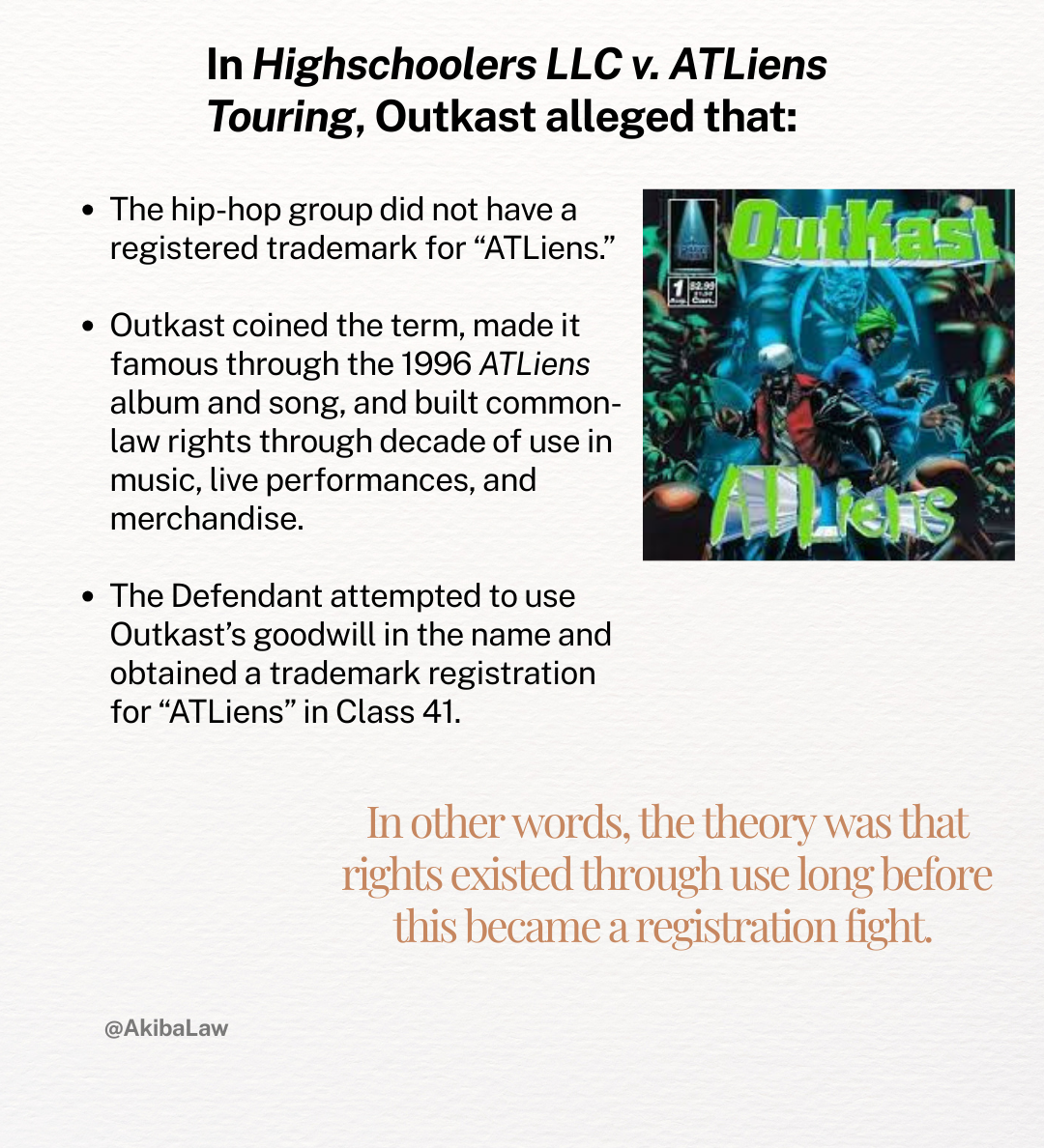
Outkast alleged that it coined the term ATLiens, made it famous through the 1996 ATLiens album and song, and built trademark rights through decades of use in music, live performances, merchandise, and related brand activity.
The defendant, ATLiens Touring, had obtained a federal trademark registration for ATLiens in Class 41 for entertainment services. Outkast’s theory was that its rights existed through earlier use long before the dispute became a registration fight.
That is the key lesson: trademark priority is not always determined by who got to the USPTO first.
Trademark law is not just about who filed first.
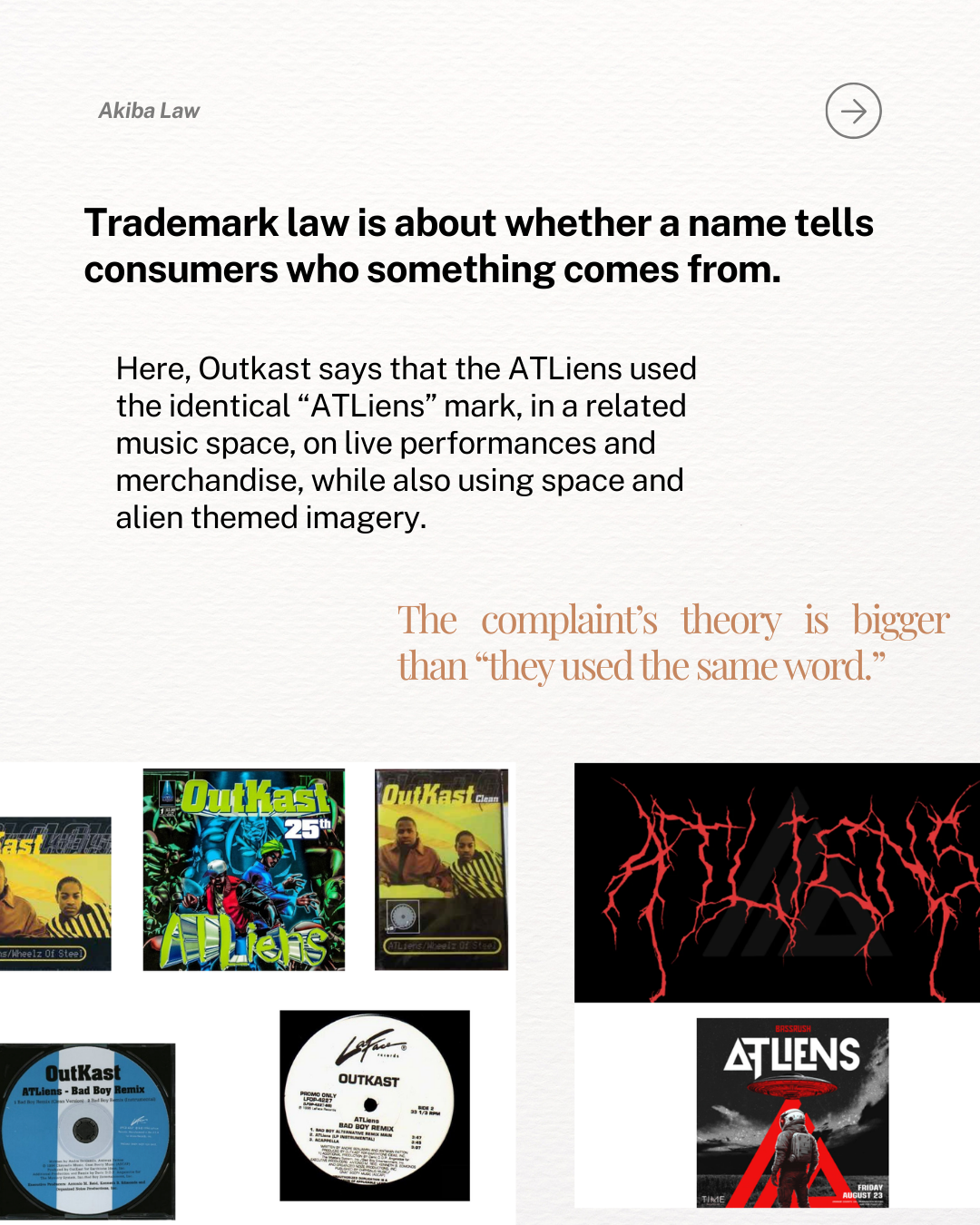
Trademark law is about whether a name, phrase, logo, or other source indicator tells consumers where goods or services come from.
In this dispute, Outkast alleged that the EDM act used the identical ATLiens name in a related music space, including live performances and merchandise, while also using space and alien-themed imagery. That made the theory bigger than “they used the same word.”
The issue was source confusion. Would consumers think the later use was connected to, approved by, sponsored by, or affiliated with Outkast?
That is the kind of question trademark law is designed to address.
The danger is assuming that registration equals clearance.
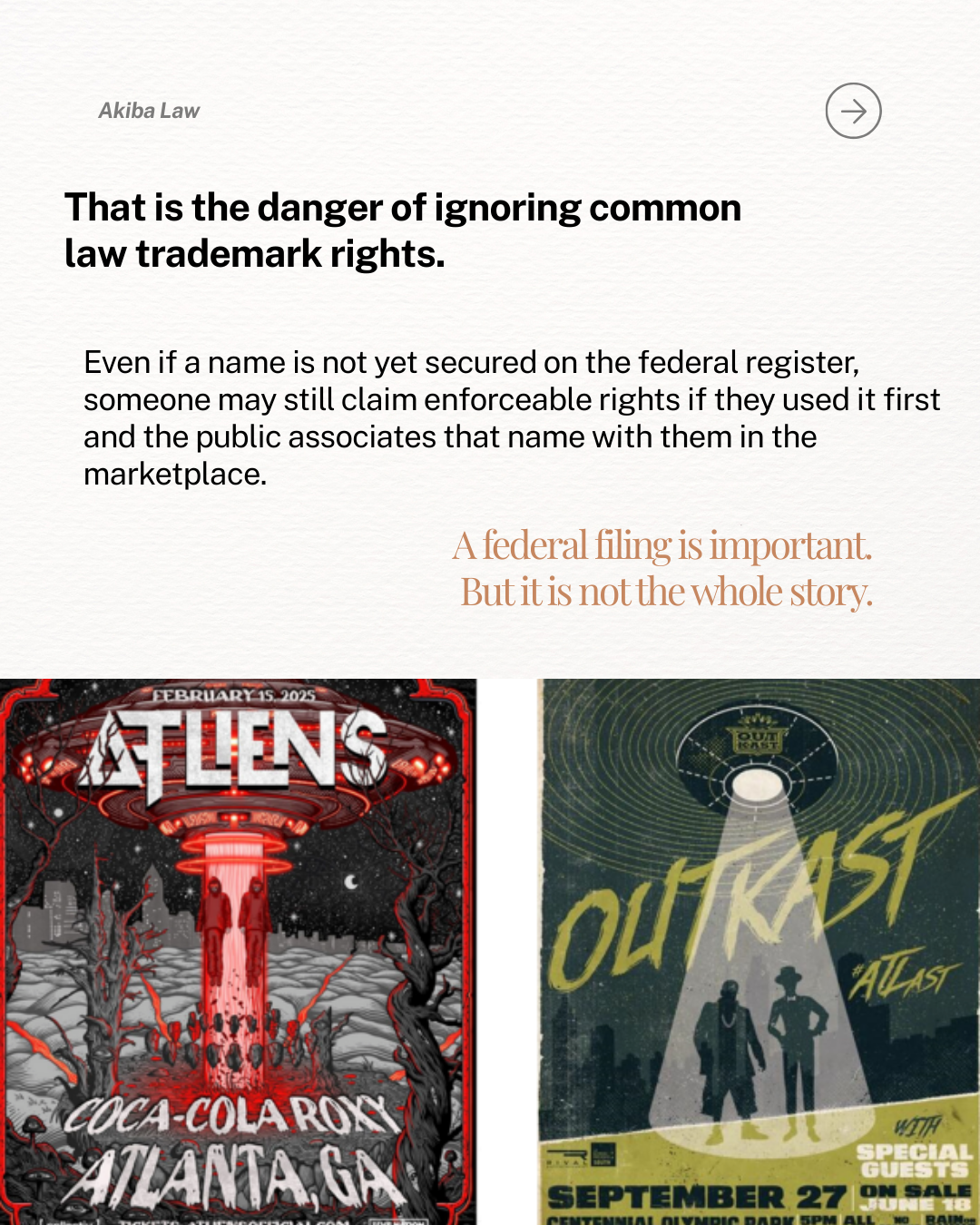
A federal trademark search may show who has applied for or registered a mark with the USPTO. But that search may not reveal every person or company using a similar mark in the marketplace.
That matters because trademark rights can arise from use, even without registration. A senior user may be able to claim priority if it used the mark first and the public associates that mark with that user’s goods or services.
Federal registration can provide powerful benefits, including nationwide presumptions and public notice. But registration does not erase earlier rights that may already exist.
A clearance search should therefore look beyond the USPTO database. It should consider marketplace use, social media, websites, business names, domain names, industry usage, press coverage, state trademark records, and related goods or services.
The case was dismissed after the parties reached a settlement framework.
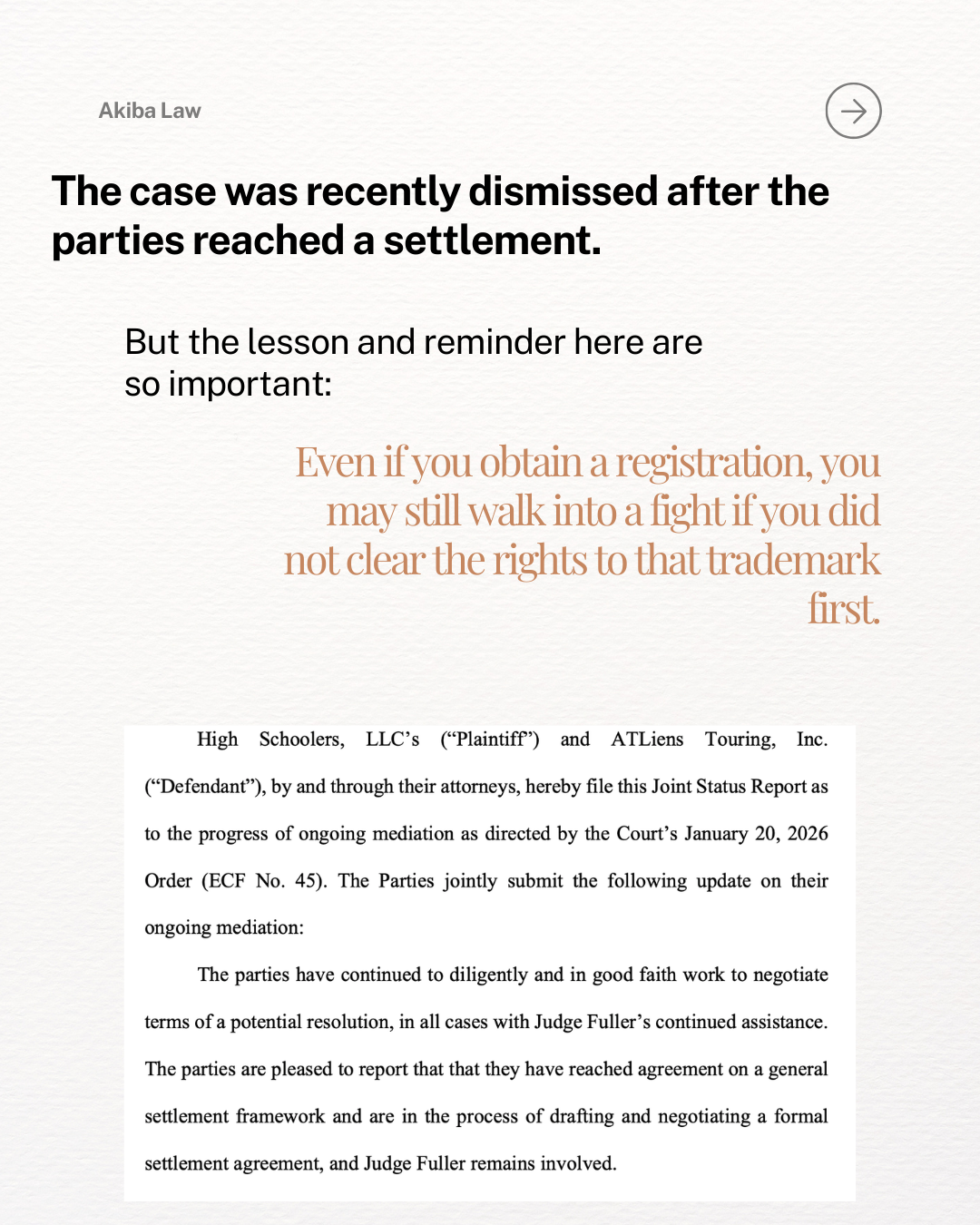
That means the court did not issue a final ruling deciding who ultimately had superior rights in ATLiens. But the dispute remains a useful cautionary example.
Even if a business obtains a registration, it may still walk into a fight if it did not clear the mark first. Clearance is not just checking whether the exact name is available in the USPTO database. It also means looking for earlier marketplace use, related goods or services, similar branding, adjacent industries, and names that may create consumer confusion.
That step can feel tedious at the beginning. It is much cheaper than litigating later.
The Outkast and ATLiens dispute is a reminder that trademark rights are built in the marketplace.
A federal registration is valuable. It can strengthen rights, expand enforcement options, and create important legal presumptions. But trademark rights often begin with use. A party that has been using a mark in commerce may have enforceable rights even without a federal registration.
For brand owners, the practical takeaway is simple: do not treat a USPTO search as the entire clearance process.
A real trademark clearance review should consider federal applications and registrations, state filings, business names, domain names, social media handles, marketplace use, industry use, press coverage, merchandise, event promotion, and related commercial activity.
That is especially important where the mark is connected to music, entertainment, art, fashion, hospitality, or creator-led brands, where cultural recognition can develop long before formal registration.
Registration matters. But priority, use, goodwill, and consumer perception matter too.
This article is for general educational and informational purposes only and does not constitute legal advice.
Akiba Law PLLC is a boutique law firm based in Miami, Florida. The firm represents artists, creators, brands, entrepreneurs, collectors, galleries, and businesses in matters involving art law, intellectual property, trademark protection, copyright, contracts, business disputes, and brand enforcement.
warning Disclaimer
This article is for general educational and informational purposes only and does not constitute legal advice. Reading this article does not create an attorney-client relationship with Akiba Law PLLC or any attorney. Florida law may apply differently depending on the specific facts, legal issues, and parties involved. Individuals and businesses should consult qualified legal counsel about their specific circumstances. For questions, concerns, or additional information, please contact Akiba Law PLLC to speak with a qualified attorney.

Case Update: Solar Drops Second Gang Starr Lawsuit After Judge Questions Prospect of Duplicative Litigation
When I first wrote about the latest chapter in the legal battle surrounding Gang Starr in September 2025, producer John…

Art Law in Florida: A Practitioner’s Handbook
Akiba Law PLLC is a Miami-based law firm advising artists, collectors, galleries, dealers, auction businesses, museums, and creative entrepreneurs on…

2 Live Crew Tried to Take Back Its Copyrights. A Decades-Old Bankruptcy Got in the Way.
Copyright ownership can last for decades, and the Copyright Act gives many creators an unusual second chance to revisit deals…
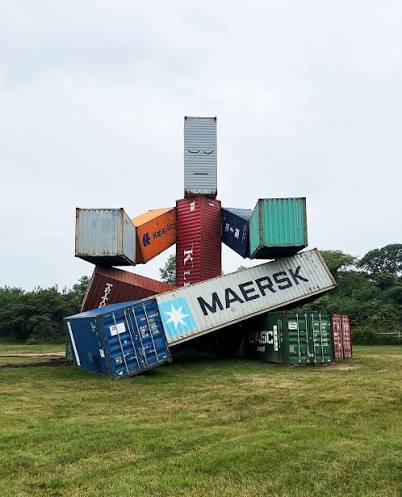
When Does a Sculpture Become a Building? East Hampton’s Lawsuit Over Matt Johnson’s Meditating Figure
Large-scale public and private art installations can raise issues well beyond copyright, contracts, and exhibition agreements. Once an artwork reaches…
Eden Gallery Sues Collector Over Alleged $822,390 Unpaid Balance: Lessons for Art Sales on Credit
High-value art transactions are often built on relationships. A collector may purchase repeatedly from the same gallery, payments may be…
MoMA v. MOMACHA: Trademark Strength, Brand Similarity, and Consumer Confusion
A trademark dispute does not always begin with two businesses offering the same product. Confusion can arise when a newer…

When a $2.5 Million Art Loan Ends in Litigation: Lessons for Galleries, Curators, and Property Owners
Long-term art placements can benefit everyone involved. Galleries gain access to potential collectors, property owners enhance their spaces, and residents…

When a Gallery Sells Consigned Art but Does Not Pay the Artist: The Hole Lawsuit and New York’s Trust-Fund Rules
An artwork consignment is not simply an informal arrangement in which a gallery agrees to sell a work and pay…
Your Logo Is on the Shirt. Does That Count as Trademark Use?
Launching a clothing brand involves more than creating a name, designing a logo, and placing it on a garment. How…

45 Antiquities Seized from the Metropolitan Museum of Art: Provenance, Repatriation, and the Importance of Due Diligence
On July 8, 2026, the Manhattan District Attorney’s Office announced the return of 59 antiquities, collectively valued at more than…

Florida Interior Designers and Decorators: Are You Regulated? Do You Need a License?
Interior designers and decorators in Florida often face a practical question: am I subject to Florida regulation, and do I…

Jacques Goudstikker’s Stolen Collection Is Still Being Found and Returned
Restitution can’t undo the Holocaust but it can return what was taken and every returned work matters. A Nazi-looted painting…