Florida Judgment Liens: When Art, Collectibles, and Other Personal Property May Matter After Judgment
Winning a money judgment is important. Collecting on that judgment is often the harder part.
In Florida, a judgment creditor may be able to pursue the judgment debtor’s non-exempt personal property, including movable assets such as artwork, antiques, jewelry, collectibles, and other valuable property. But the process is not automatic. For personal property, Florida’s Chapter 55 judgment lien system generally requires the creditor to file a judgment lien certificate with the Florida Department of State.
That filing can matter because it affects notice, priority, timing, and collection strategy. A money judgment does not always end the dispute. In many cases, the real work begins after judgment, when the creditor has to identify assets and use the proper collection tools.
For debtors who own valuable personal property, collection strategy may include looking at movable assets such as art, antiques, jewelry, collectibles, vehicles, or other non-exempt property. The key is that the creditor must follow the proper enforcement process. A judgment alone does not automatically put cash in the creditor’s hands.
Movable artwork can generally be treated as personal property. That matters because Florida allows a judgment lien to attach to a judgment debtor’s interest in personal property in this state that is subject to execution.
In practice, that means paintings, sculptures, collectibles, and similar assets may become part of a creditor’s enforcement strategy. But the details matter. The property must be subject to execution, the lien must be properly acquired, and the creditor still must use judicial process to enforce the lien.
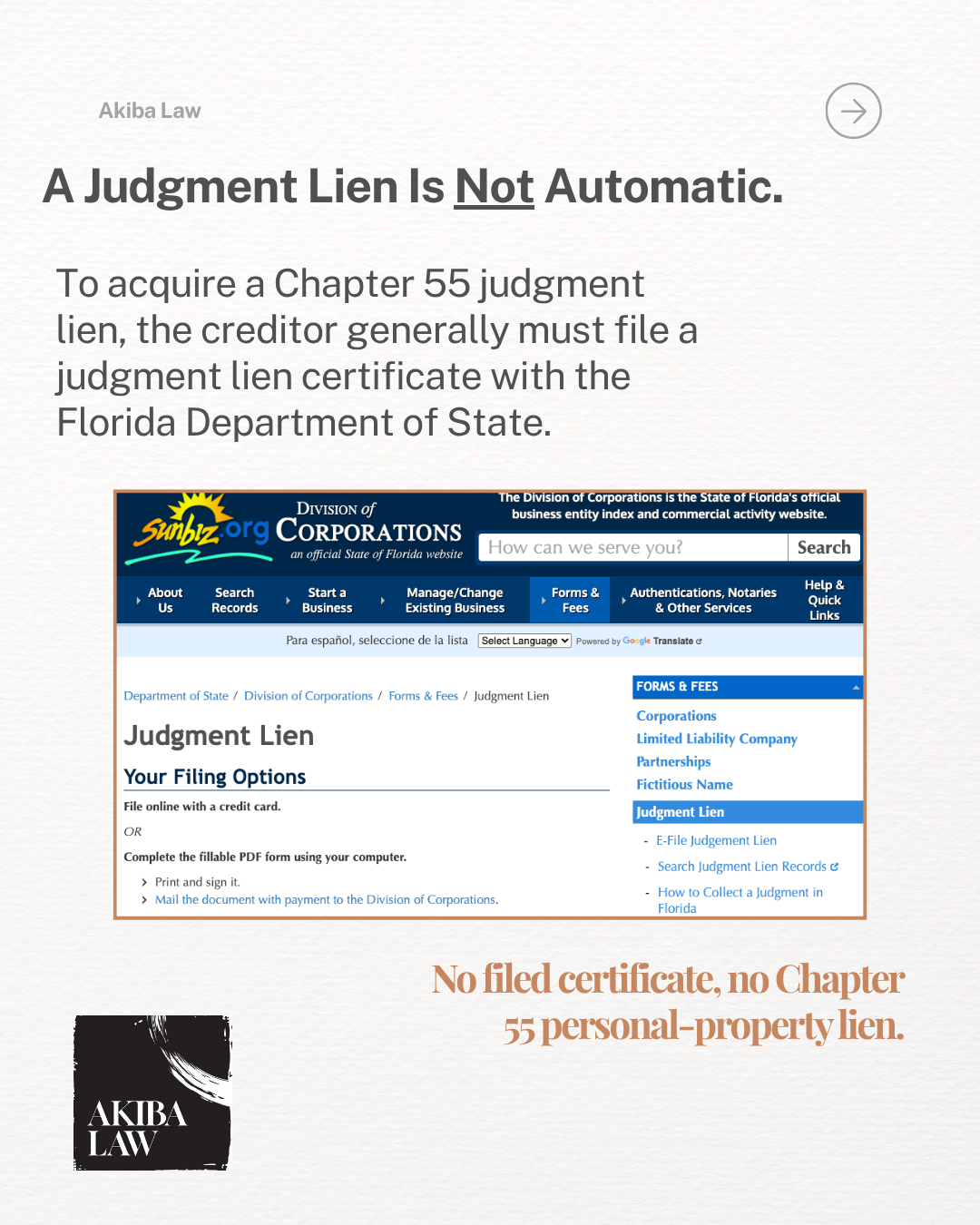
A Florida judgment lien on personal property is not automatic. To acquire a Chapter 55 judgment lien, the creditor generally must file a judgment lien certificate with the Florida Department of State. Section 55.202 states that the lien is acquired by filing the certificate in accordance with Section 55.203.
Out-of-state judgments can matter too. Under Florida’s Enforcement of Foreign Judgments Act, a certified copy of a foreign judgment may be recorded with the clerk of the circuit court of any Florida county. Once properly recorded, it generally has the same effect and may be enforced like a Florida circuit or county court judgment.
There are procedural steps. The creditor must record an affidavit with identifying information for the judgment debtor and creditor, and enforcement generally cannot issue until 30 days after the clerk mails notice. A foreign judgment also does not operate as a lien until 30 days after that mailing.
Details matter when filing a judgment lien certificate. Section 55.203 requires the certificate to identify, among other things, the legal name of each judgment debtor, certain identifying information, the legal name of the judgment creditor, the court, case number, judgment date, amount due, interest rate, and signature.
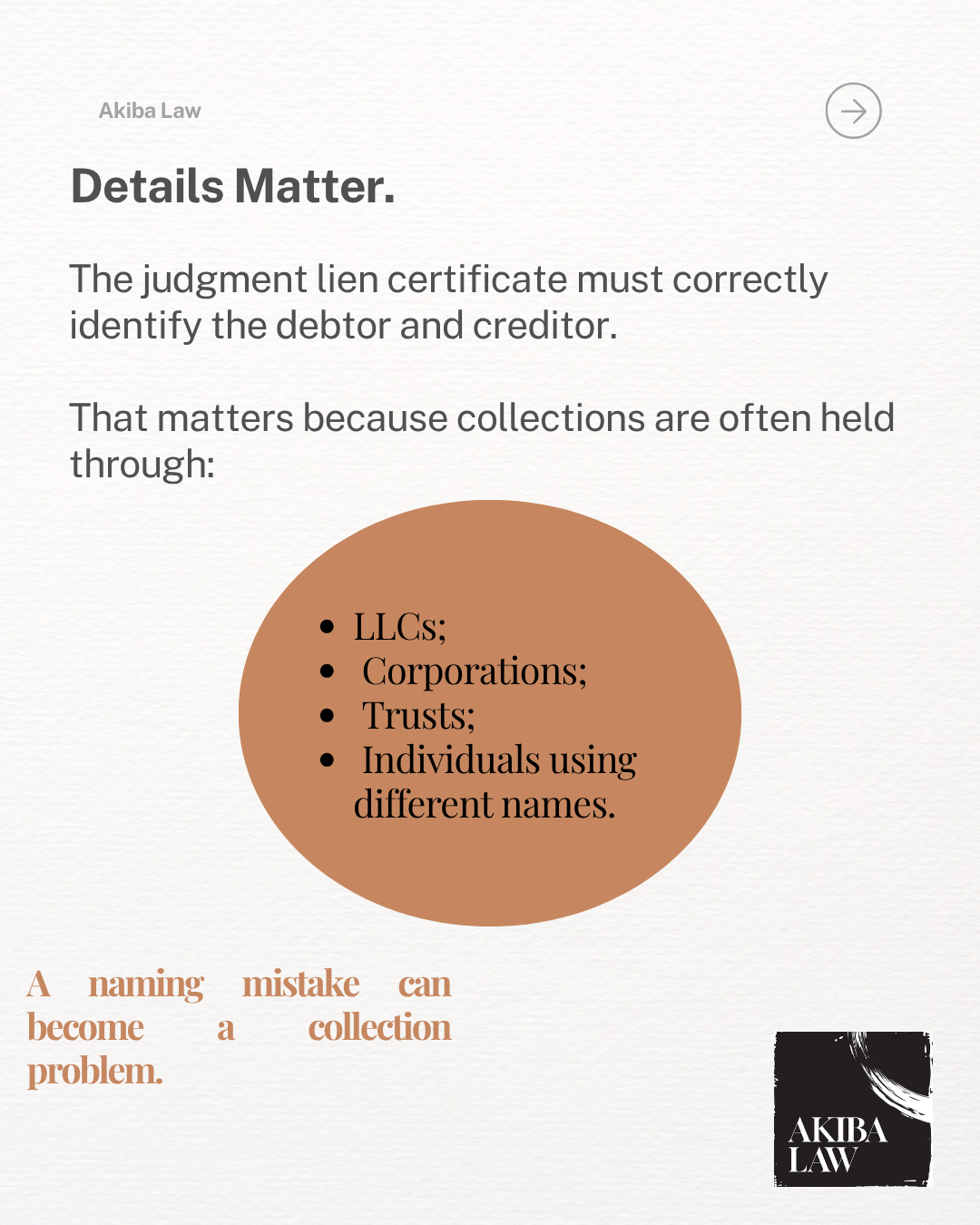
That is why naming issues can become collection issues. If the debtor is an LLC, corporation, trust, or individual using different names, the creditor should be careful to identify the debtor correctly. A collection strategy can fail or become more expensive if the lien filing does not match the proper debtor.
Priority can become a race. Under Section 55.202, the effective date of a judgment lien is generally the date and time the judgment lien certificate is filed. Priority among competing judgment liens is determined in order of filing date and time.
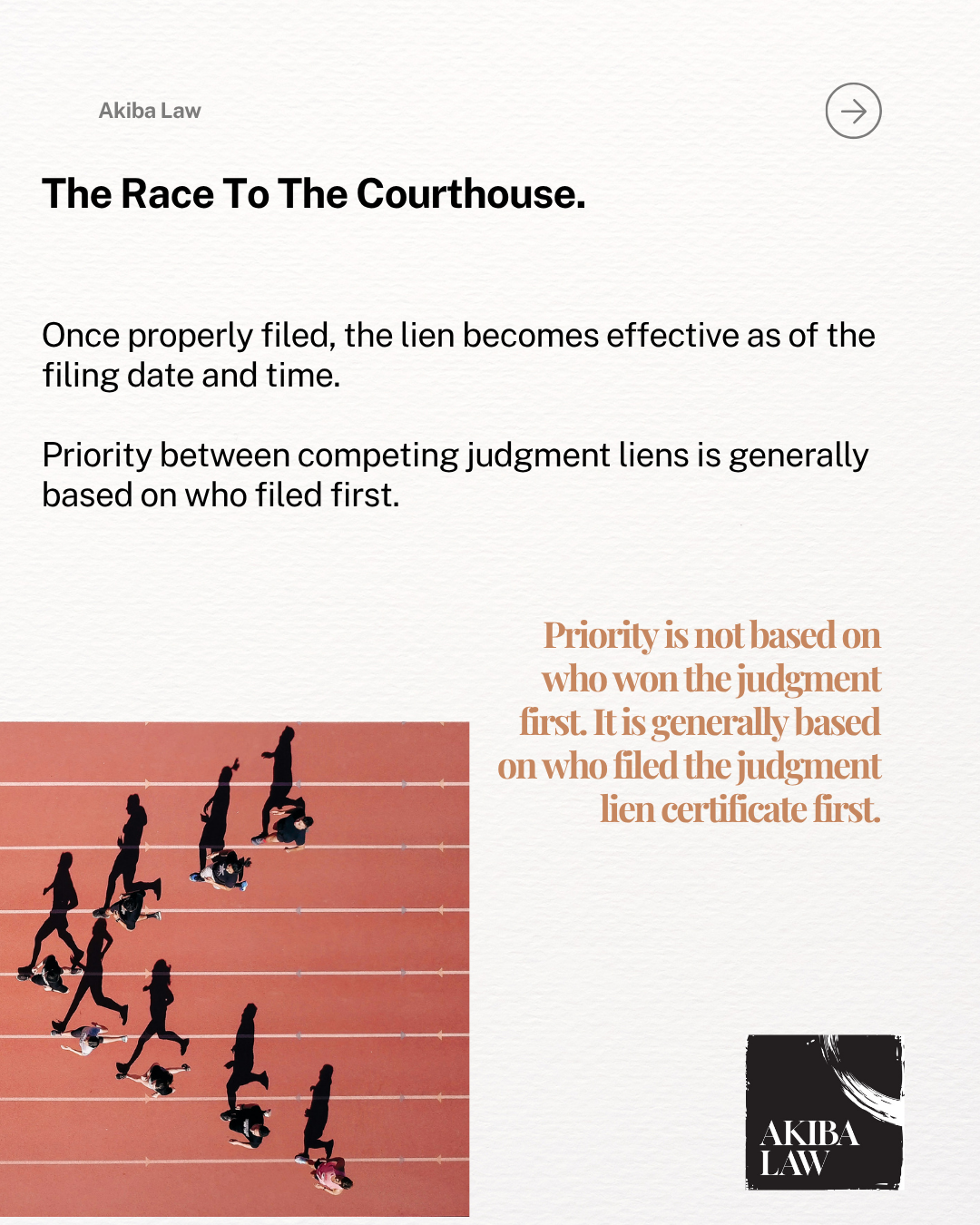
That means the creditor who won first is not necessarily the creditor who gets priority first. For personal property judgment liens, the filing date and time can be critical. Delay can change the creditor’s position.
A Florida judgment lien on personal property does not last forever. Section 55.204 provides that, except as otherwise provided in that section, a judgment lien acquired under Section 55.202 lapses and becomes invalid five years after the judgment lien certificate is filed.
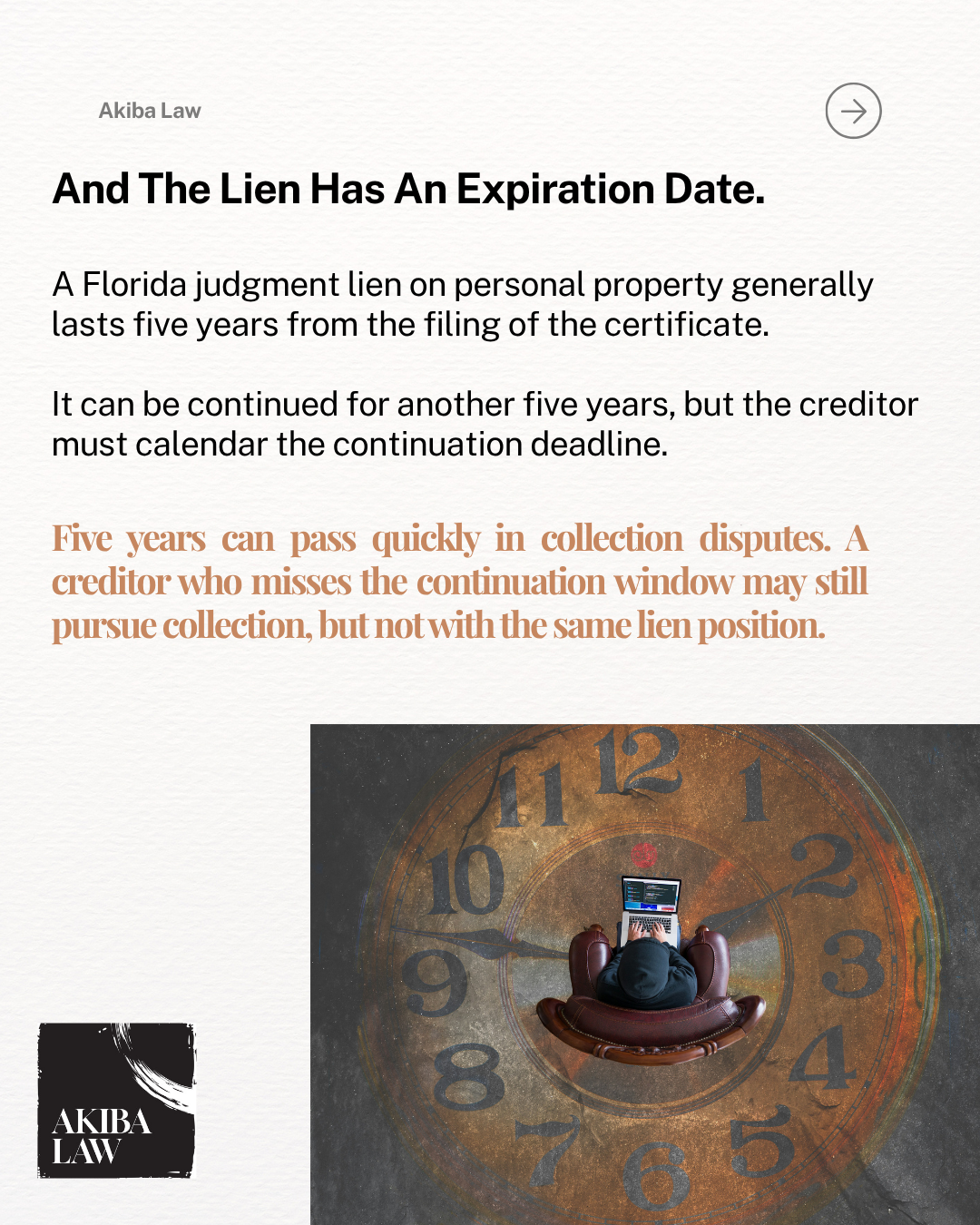
The statute allows a creditor to acquire a second judgment lien by filing a new judgment lien certificate within six months before or six months after the scheduled lapse. But that second lien is a new lien, not a continuation of the original lien, and its effective date is the date and time the second certificate is filed.
A lapsed lien does not necessarily end collection. Section 55.205 provides that a creditor who has not acquired a judgment lien, or whose lien has lapsed, may still proceed against the debtor’s property through appropriate judicial process.
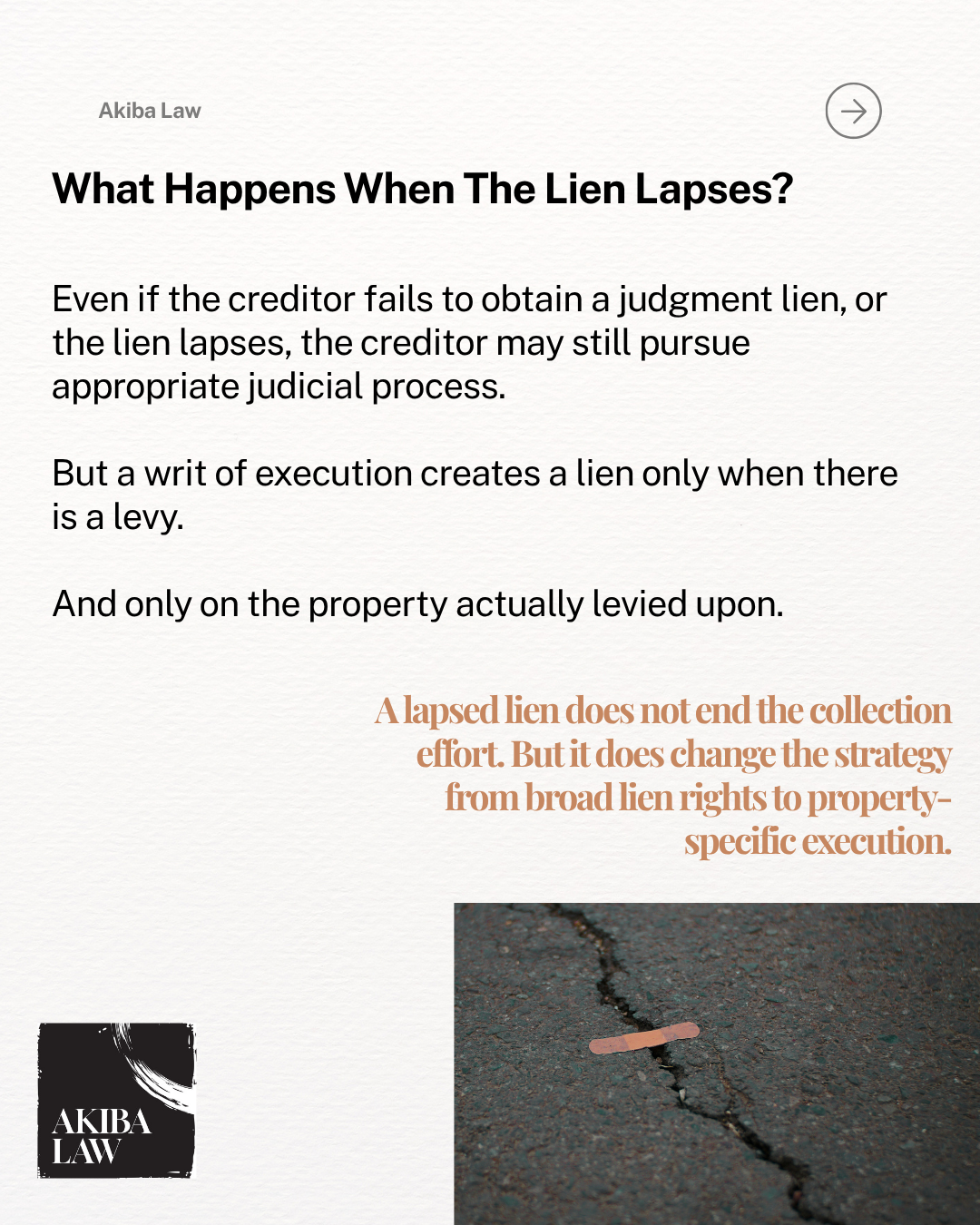
But the strategy changes. A creditor proceeding by writ of execution acquires a lien only as of the time of levy and only on the property actually levied upon. That is a narrower position than having a properly filed Chapter 55 personal-property judgment lien.
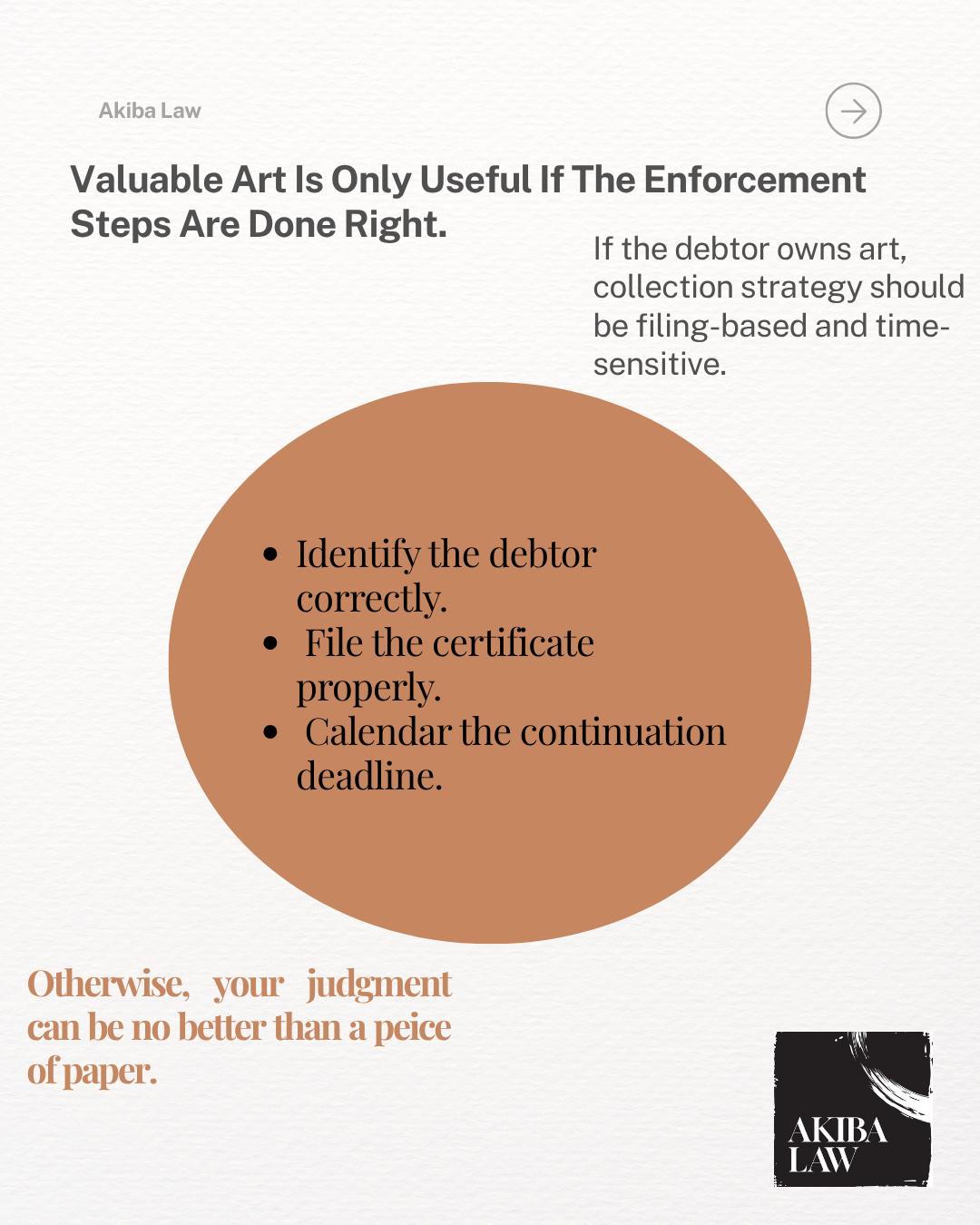
When valuable art or collectibles are involved, the enforcement steps matter. The creditor should identify the debtor correctly, file the judgment lien certificate properly, calendar the five-year lapse date, and evaluate whether a second judgment lien certificate should be filed within the statutory window.
The broader lesson is simple: valuable property is only useful if the creditor can reach it. A judgment may establish liability, but collection often depends on timing, filing, priority, and the correct use of judicial process.
Florida’s judgment lien statutes are technical, but the practical point is straightforward. If a judgment debtor owns valuable personal property, the creditor should not assume that the judgment itself is enough. For personal property, the creditor generally needs to consider the Chapter 55 judgment lien process, the Department of State filing, priority rules, expiration dates, and available execution procedures.
That is especially important where the assets are movable, valuable, or difficult to locate, such as art, antiques, jewelry, and collectibles. In those situations, collection strategy should be both filing-based and time-sensitive. Otherwise, the creditor may have a judgment on paper, but no effective path to recovery.
This article is for general educational and informational purposes only and does not constitute legal advice.
Akiba Law PLLC is a boutique law firm based in Miami, Florida. The firm represents artists, creators, brands, entrepreneurs, collectors, galleries, and businesses in matters involving art law, intellectual property, trademark protection, copyright, contracts, business disputes, and brand enforcement.
warning Disclaimer
This article is for general educational and informational purposes only and does not constitute legal advice. Reading this article does not create an attorney-client relationship with Akiba Law PLLC or any attorney. Florida law may apply differently depending on the specific facts, legal issues, and parties involved. Individuals and businesses should consult qualified legal counsel about their specific circumstances. For questions, concerns, or additional information, please contact Akiba Law PLLC to speak with a qualified attorney.

From a Real Estate Listing to Restitution: Argentina Orders Return of Nazi-Looted Old Master to Sole Remaining Heir of Jacques Goudstikker
More than eighty years after an Old Master painting disappeared during the Nazi era, an Argentine court has ordered its…

Case Update: Solar Drops Second Gang Starr Lawsuit After Judge Questions Prospect of Duplicative Litigation
When I first wrote about the latest chapter in the legal battle surrounding Gang Starr in September 2025, producer John…

Art Law in Florida: A Practitioner’s Handbook
Akiba Law PLLC is a Miami-based law firm advising artists, collectors, galleries, dealers, auction businesses, museums, and creative entrepreneurs on…

2 Live Crew Tried to Take Back Its Copyrights. A Decades-Old Bankruptcy Got in the Way.
Copyright ownership can last for decades, and the Copyright Act gives many creators an unusual second chance to revisit deals…

When Does a Sculpture Become a Building? East Hampton’s Lawsuit Over Matt Johnson’s Meditating Figure
Large-scale public and private art installations can raise issues well beyond copyright, contracts, and exhibition agreements. Once an artwork reaches…

Eden Gallery Sues Collector Over Alleged $822,390 Unpaid Balance: Lessons for Art Sales on Credit
High-value art transactions are often built on relationships. A collector may purchase repeatedly from the same gallery, payments may be…

MoMA v. MOMACHA: Trademark Strength, Brand Similarity, and Consumer Confusion
A trademark dispute does not always begin with two businesses offering the same product. Confusion can arise when a newer…

When a $2.5 Million Art Loan Ends in Litigation: Lessons for Galleries, Curators, and Property Owners
Long-term art placements can benefit everyone involved. Galleries gain access to potential collectors, property owners enhance their spaces, and residents…

When a Gallery Sells Consigned Art but Does Not Pay the Artist: The Hole Lawsuit and New York’s Trust-Fund Rules
An artwork consignment is not simply an informal arrangement in which a gallery agrees to sell a work and pay…

Your Logo Is on the Shirt. Does That Count as Trademark Use?
Launching a clothing brand involves more than creating a name, designing a logo, and placing it on a garment. How…

45 Antiquities Seized from the Metropolitan Museum of Art: Provenance, Repatriation, and the Importance of Due Diligence
On July 8, 2026, the Manhattan District Attorney’s Office announced the return of 59 antiquities, collectively valued at more than…

Florida Interior Designers and Decorators: Are You Regulated? Do You Need a License?
Interior designers and decorators in Florida often face a practical question: am I subject to Florida regulation, and do I…