What Is VARA? A Practical Overview of the Visual Artists Rights Act
The Visual Artists Rights Act, commonly known as VARA, is an important federal statute for visual artists, collectors, galleries, developers, property owners, and businesses that commission, display, move, alter, or remove artwork.
Unlike copyright law, VARA is not mainly about who can reproduce, distribute, license, or sell copies of a work. VARA protects a narrower set of rights often referred to as moral rights. These rights focus on the artist’s relationship to the work itself, including attribution, reputation, and the integrity of certain qualifying works of visual art.
But VARA is also narrower than many people assume. It does not apply to every painting, photograph, mural, sculpture, poster, design, or creative work. It applies only to works that fit the statutory definition of a “work of visual art,” and the statute includes several important exclusions, exceptions, and waiver rules.
VARA is the Visual Artists Rights Act, codified at 17 U.S.C. § 106A.
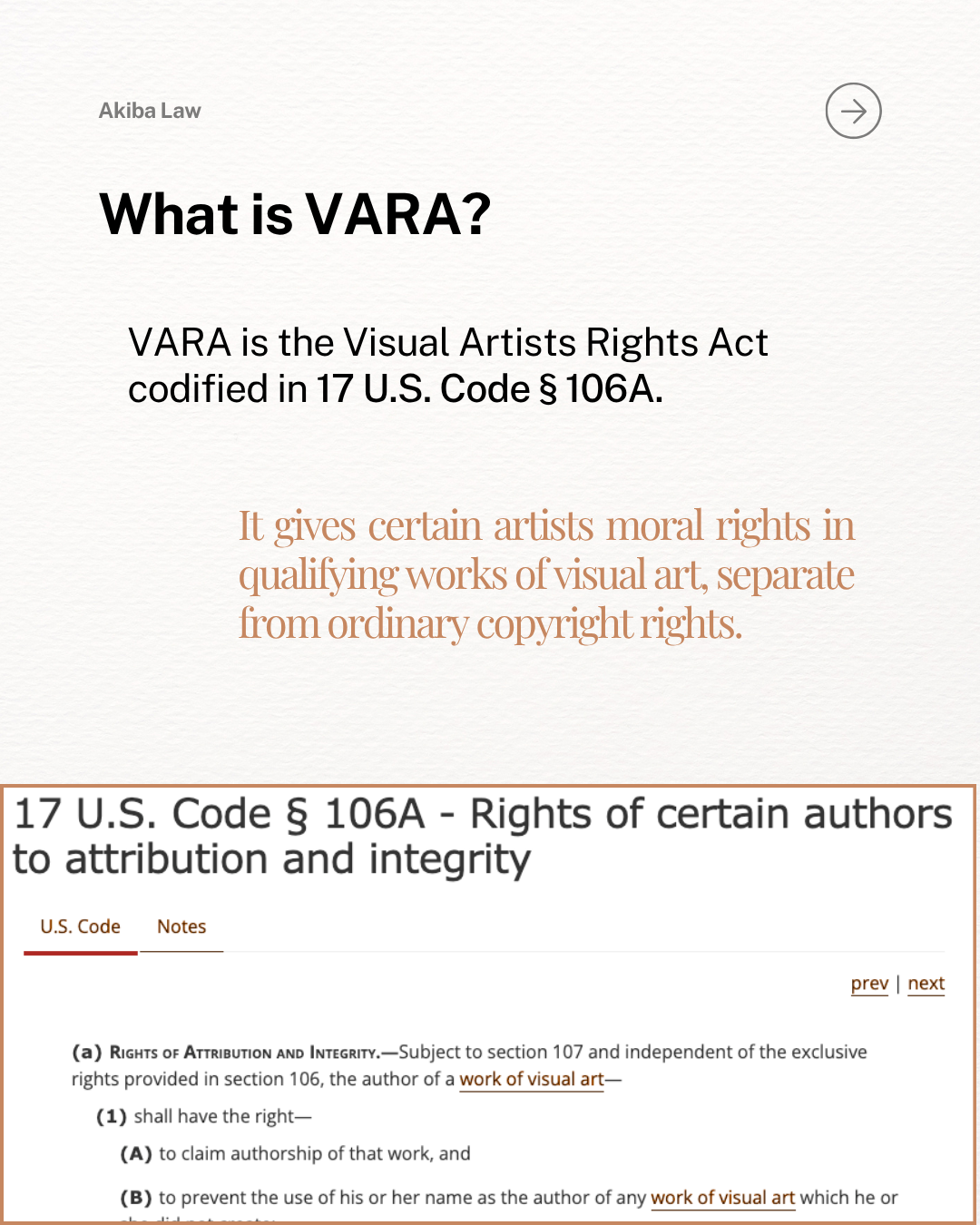
The statute gives the author of a qualifying work of visual art certain rights of attribution and integrity. These rights are separate from the ordinary economic rights granted under copyright law, such as the rights to reproduce, distribute, display, or prepare derivative works.
That distinction matters. A copyright dispute may focus on unauthorized copying or licensing. A VARA dispute may focus on whether the artist’s name was misused, whether the work was distorted or mutilated, or whether a work of recognized stature was destroyed.
VARA protects certain attribution rights.
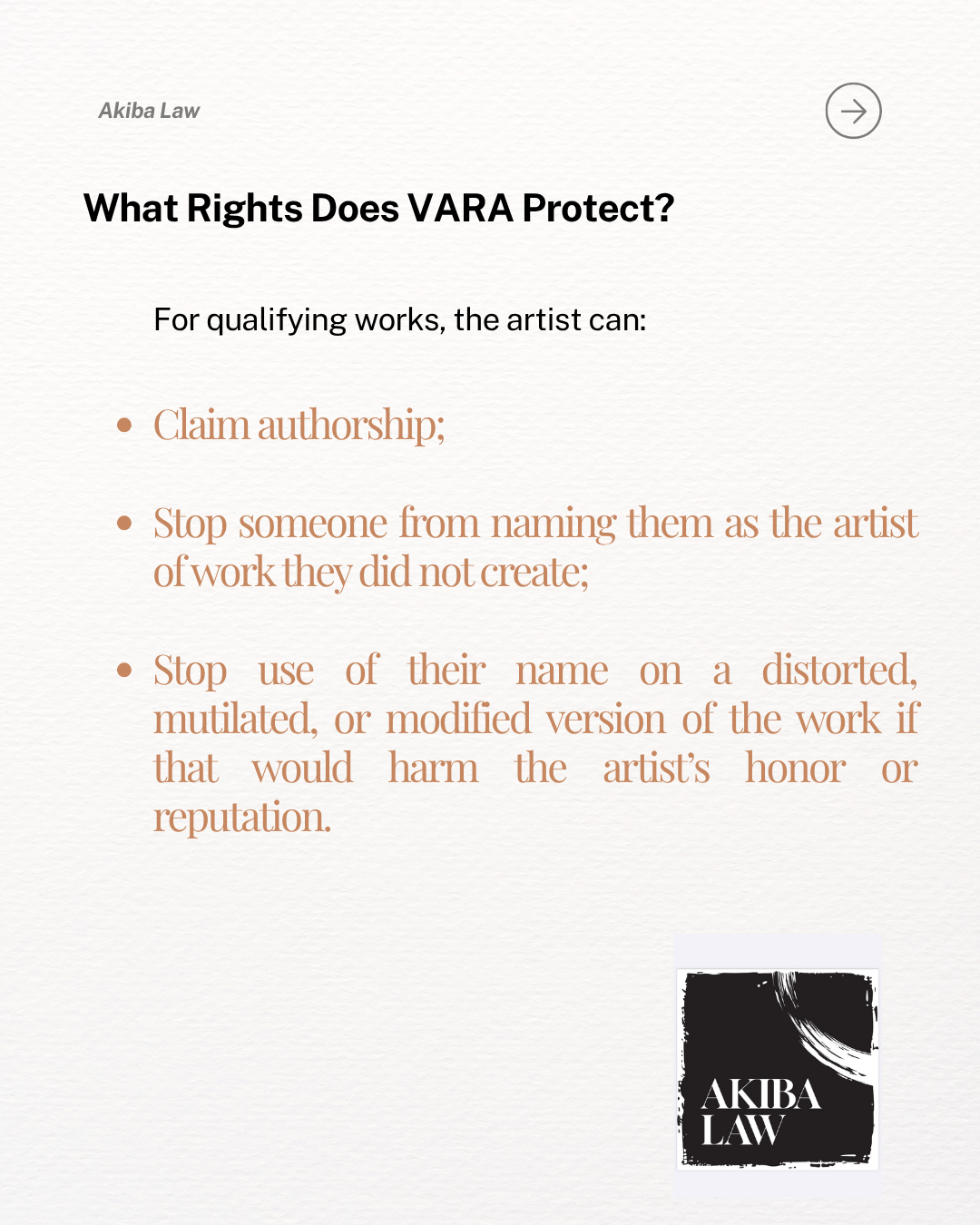
For qualifying works, the artist has the right to claim authorship of the work. The artist can also prevent someone from falsely identifying them as the author of a work they did not create.
VARA also protects against a more subtle attribution problem: use of the artist’s name in connection with a distorted, mutilated, or modified version of the work when that use would prejudice the artist’s honor or reputation.
In practical terms, VARA recognizes that an artist’s name carries professional meaning. Misattribution or attribution tied to a damaged version of the work can affect the artist’s reputation in the market.
VARA can also protect the artwork itself.
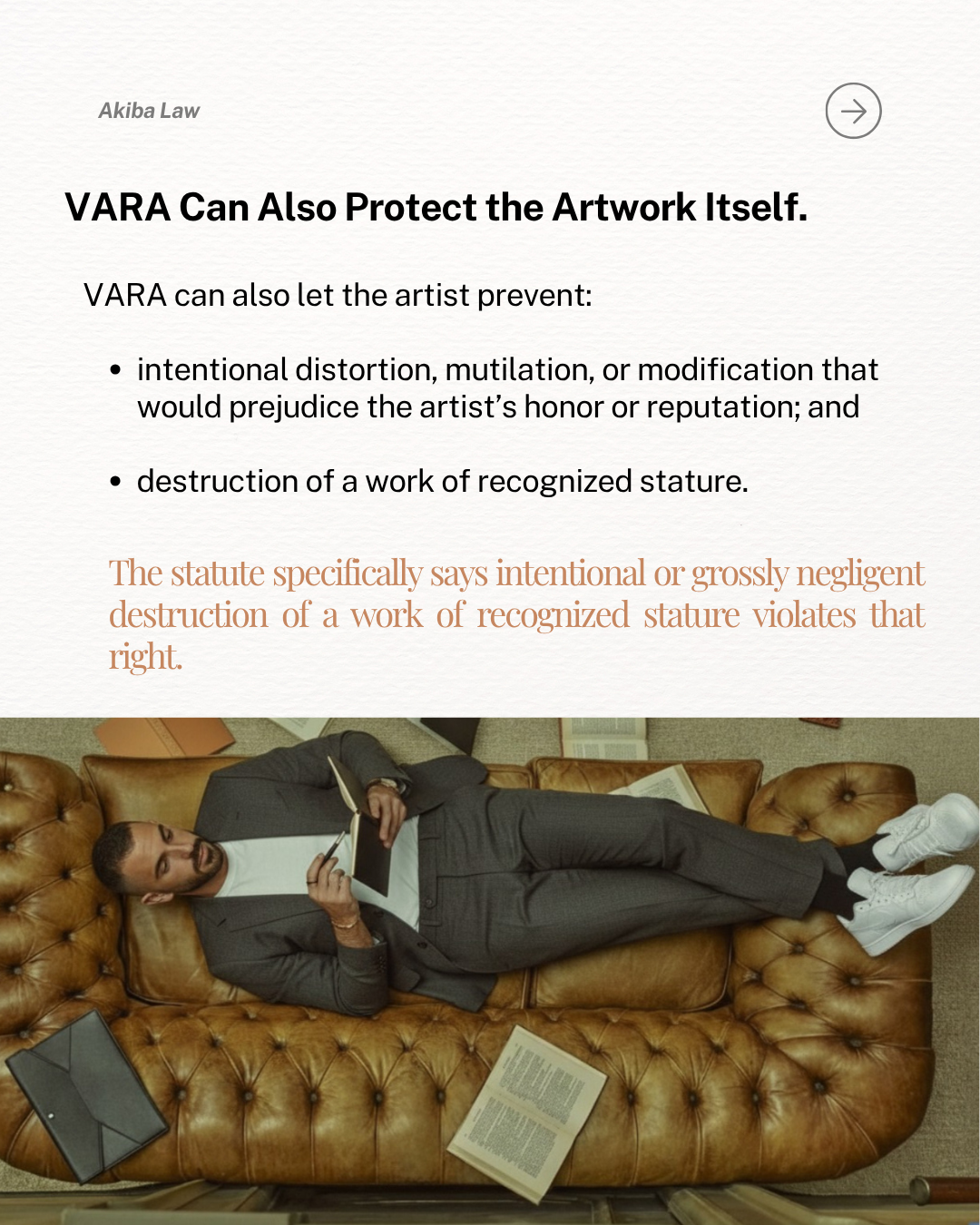
The statute gives the artist certain integrity rights in qualifying works of visual art. For example, the artist may prevent intentional distortion, mutilation, or modification of the work if that alteration would prejudice the artist’s honor or reputation.
VARA also gives protection against destruction of a work of recognized stature. That phrase matters. The statute does not prohibit destruction of every work of visual art in every circumstance. The work must qualify under VARA, and for destruction claims, the work must have recognized stature.
That issue can become heavily fact-specific. Courts may look at whether the work has artistic merit and whether that merit has been recognized by art experts, the artistic community, collectors, curators, critics, or other relevant evidence.
VARA rights belong to the author of the qualifying work.
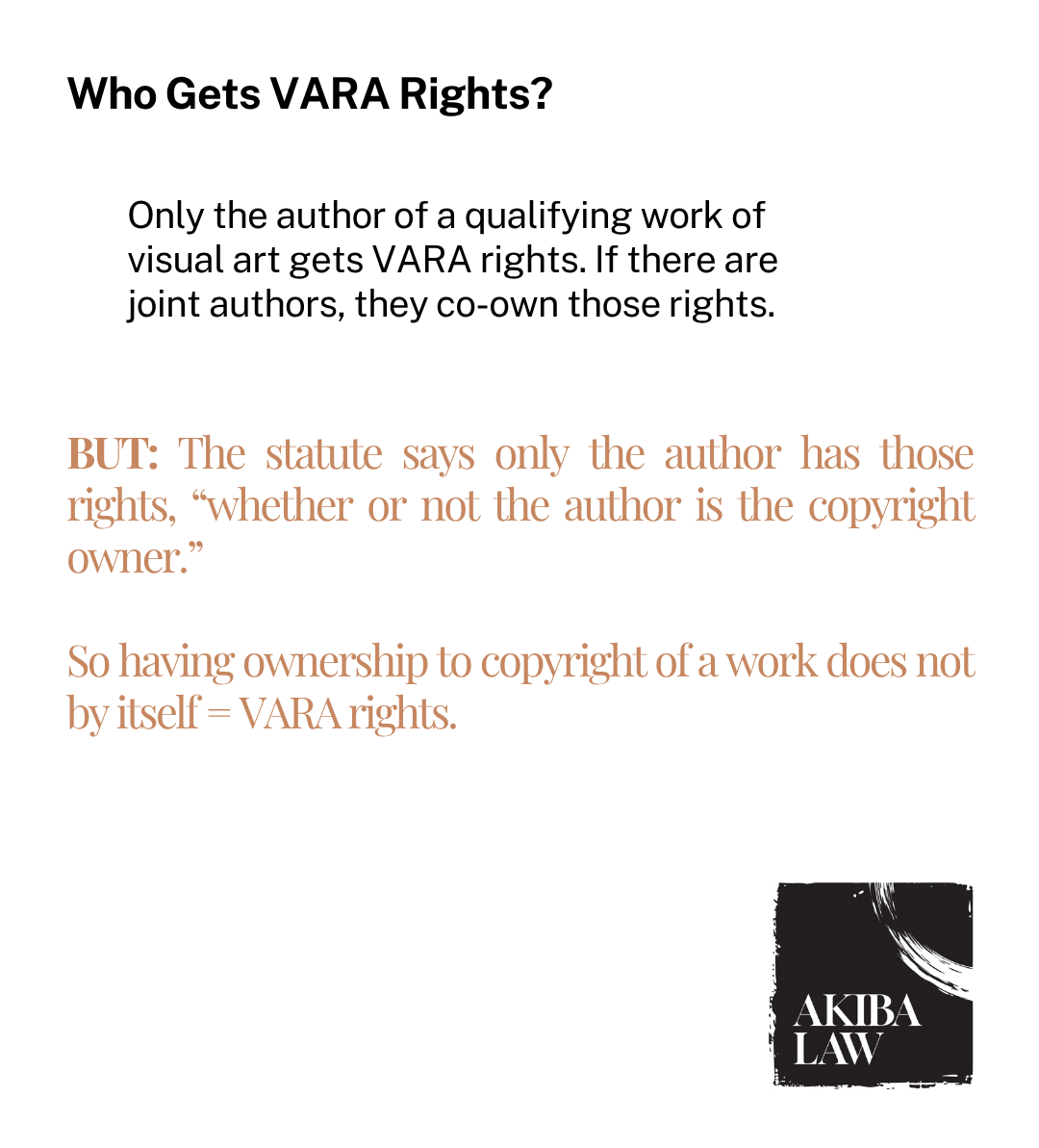
This is one of the most important parts of the statute. VARA rights belong to the author of the work of visual art, whether or not the author owns the copyright.
That means ownership of the physical work is not the same as ownership of VARA rights. Buying a painting, sculpture, or other qualifying work does not automatically give the buyer the right to distort, mutilate, destroy, or misuse the artist’s name in connection with the work.
It also means that owning the copyright is not necessarily the same thing as owning VARA rights. The statute treats those rights separately.
VARA applies only to a statutory “work of visual art.”
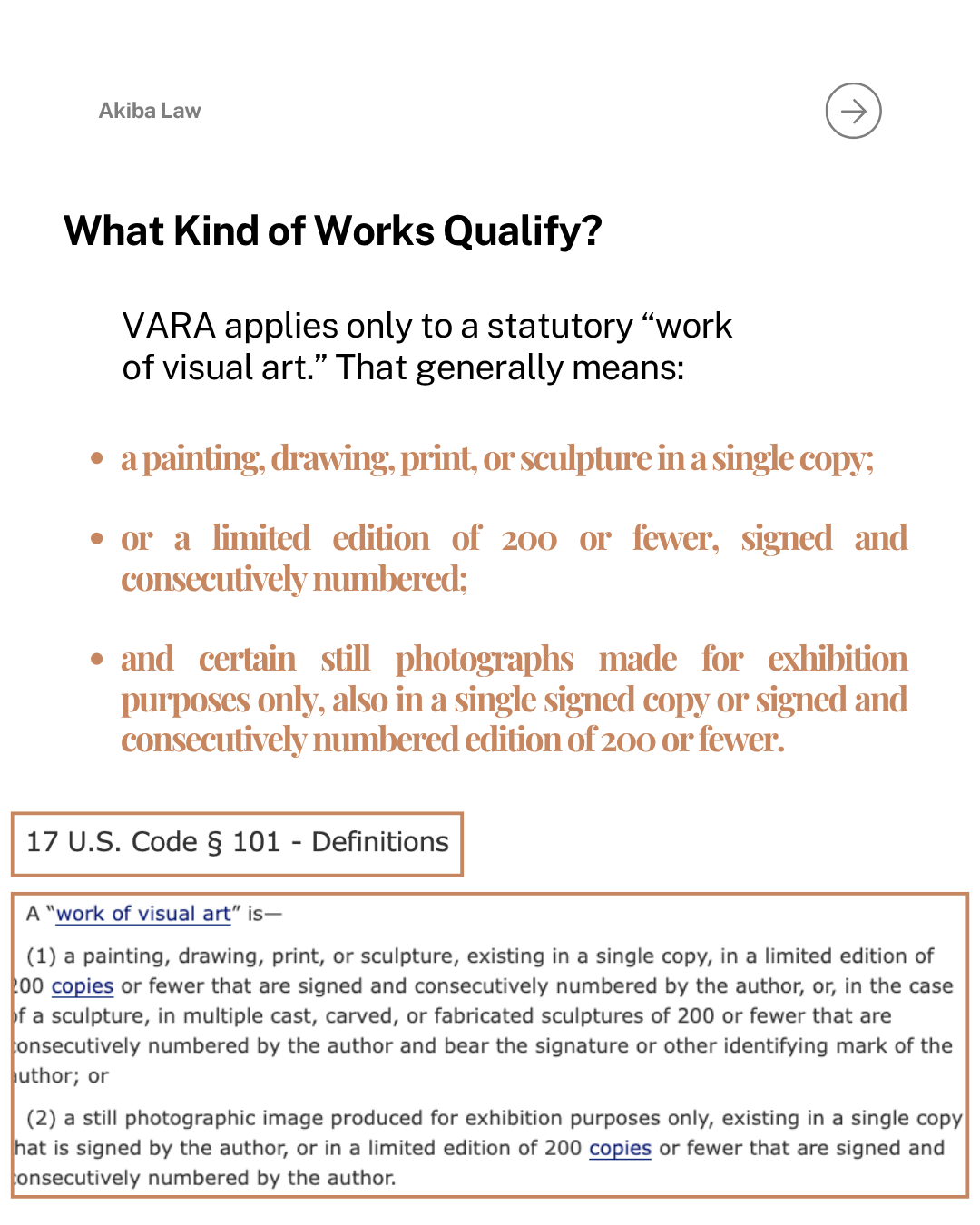
The definition is narrower than the phrase may sound. Under 17 U.S.C. § 101, a “work of visual art” generally includes a painting, drawing, print, or sculpture existing in a single copy, or in a limited edition of 200 copies or fewer that are signed and consecutively numbered by the author.
The statute also covers certain still photographic images, but only if they are produced for exhibition purposes and exist in a single signed copy or a signed and consecutively numbered limited edition of 200 or fewer.
So the threshold question in any VARA analysis is not simply whether the work is creative or valuable. The threshold question is whether the work fits the statute.
VARA does not cover everything an artist creates.
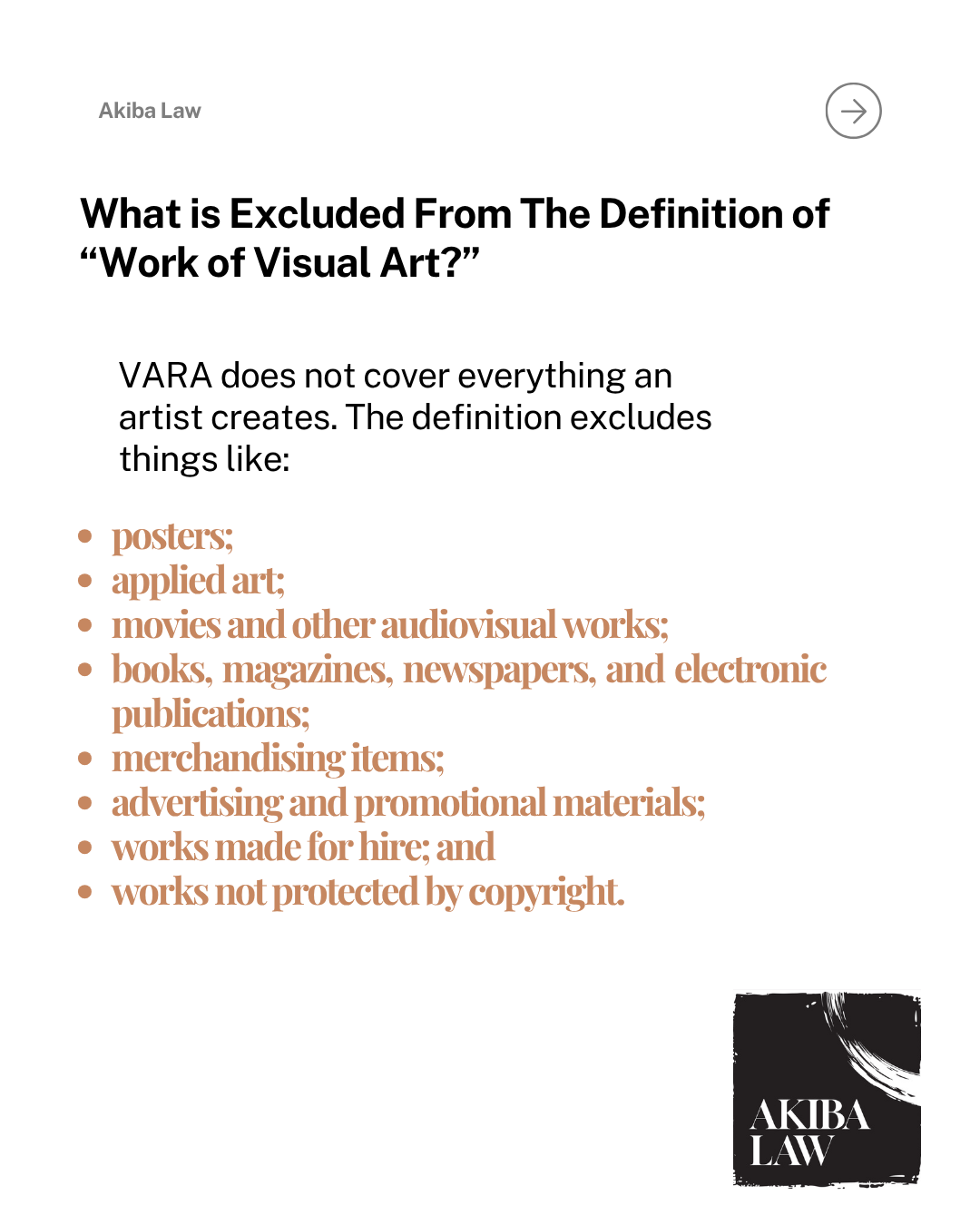
The statute excludes several categories from the definition of “work of visual art.” Those exclusions include posters, maps, technical drawings, applied art, motion pictures, audiovisual works, books, magazines, newspapers, electronic publications, merchandising items, advertising materials, promotional materials, packaging materials, works made for hire, and works not protected by copyright.
That can surprise people. A work may be creative, commercially valuable, and protected by ordinary copyright law, but still fall outside VARA.
This is especially important for businesses and brands that commission creative work. Commercial graphics, packaging, advertising assets, merchandise, promotional designs, and work-made-for-hire materials may raise copyright or contract issues, but they often do not receive VARA treatment.
VARA has important limits.
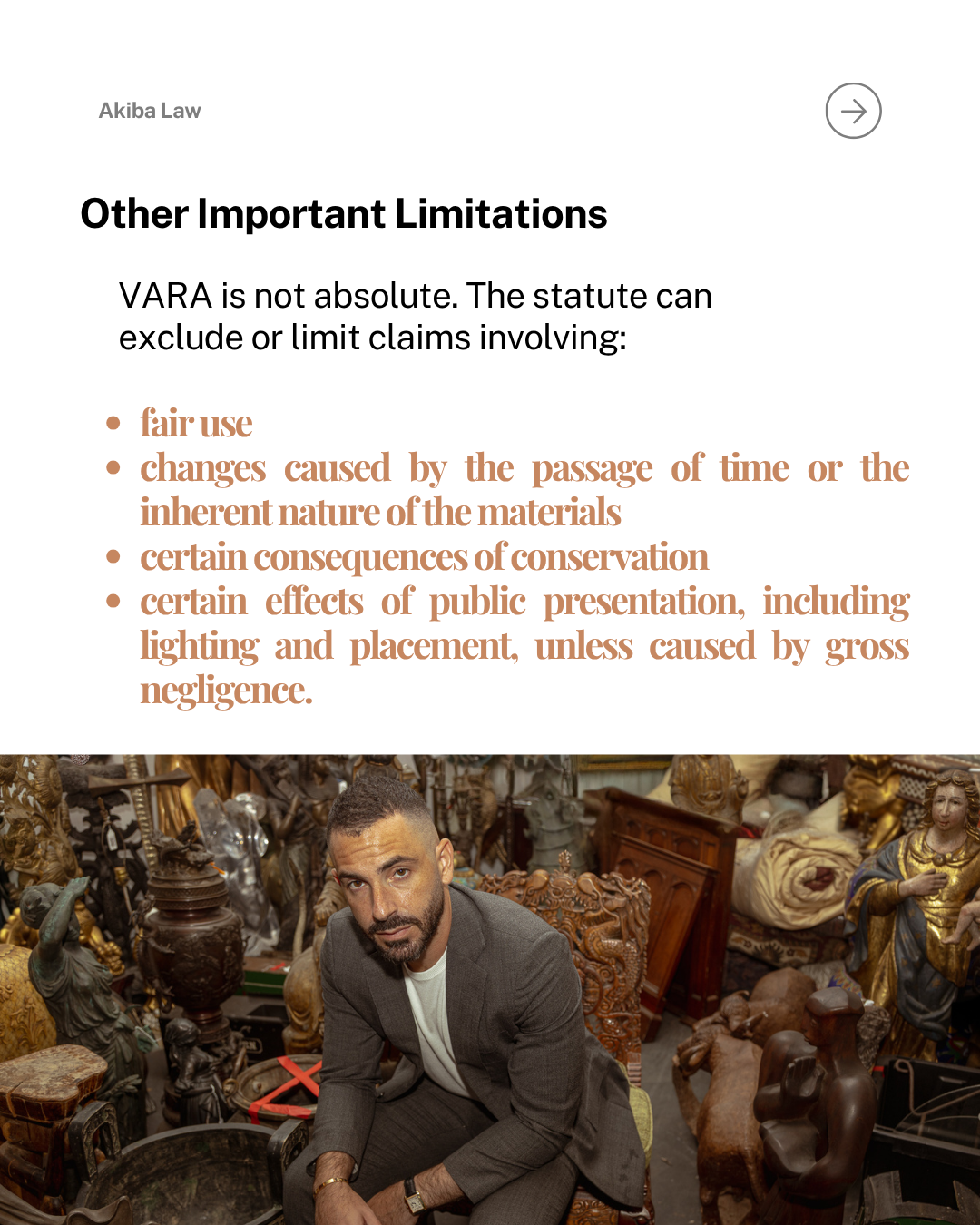
VARA is not absolute. The statute does not treat every change, aging process, conservation decision, or display condition as a legal violation.
For example, changes caused by the passage of time or the inherent nature of the materials are not treated as distortion, mutilation, or modification under the statute. Certain conservation-related changes and certain effects of public presentation, including lighting and placement, may also fall outside VARA unless gross negligence is involved.
That matters because art changes. Materials degrade. Works are moved, stored, cleaned, lit, displayed, and conserved. VARA does not turn every physical change into a federal claim. The specific cause of the change, the nature of the work, the conduct involved, and the statutory exception all matter.
Art incorporated into buildings raises special issues.
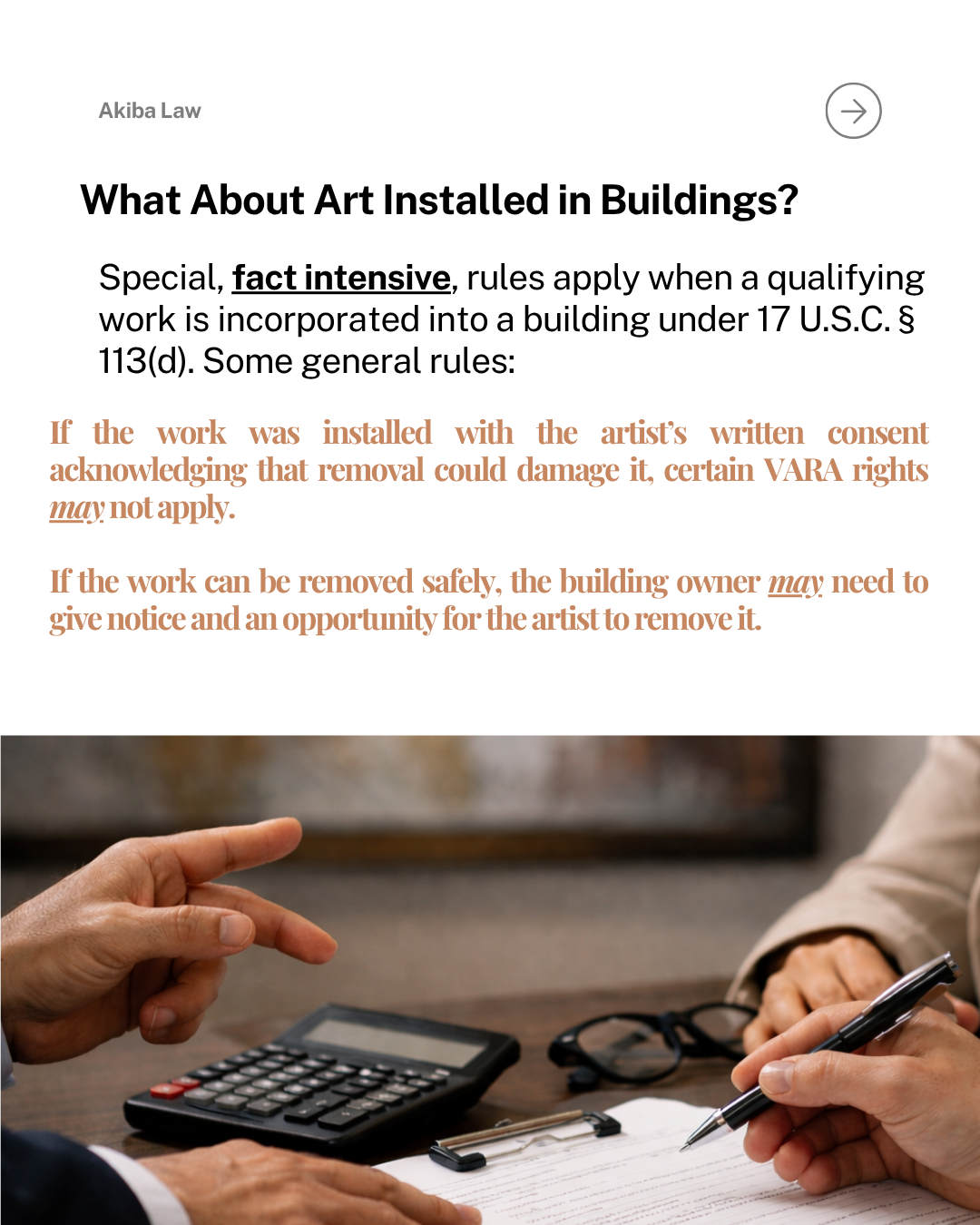
VARA has specific rules for qualifying works incorporated into buildings. These rules are especially important for murals, installations, sculptural works, and other works that may be physically connected to real property.
If the work cannot be removed from the building without destruction, distortion, mutilation, or other modification, certain VARA rights may not apply if the artist signed a written instrument acknowledging that removal could cause that result.
If the work can be removed safely, the building owner may need to provide notice and give the artist an opportunity to remove the work or pay for its removal. The statute includes a 90-day period after written notice is received.
This is why written agreements matter at the time of installation. The rights of the artist and the future rights of the building owner may depend on what was signed, what was disclosed, and whether the work can be removed without damage.
VARA rights cannot be transferred, but they can be waived.
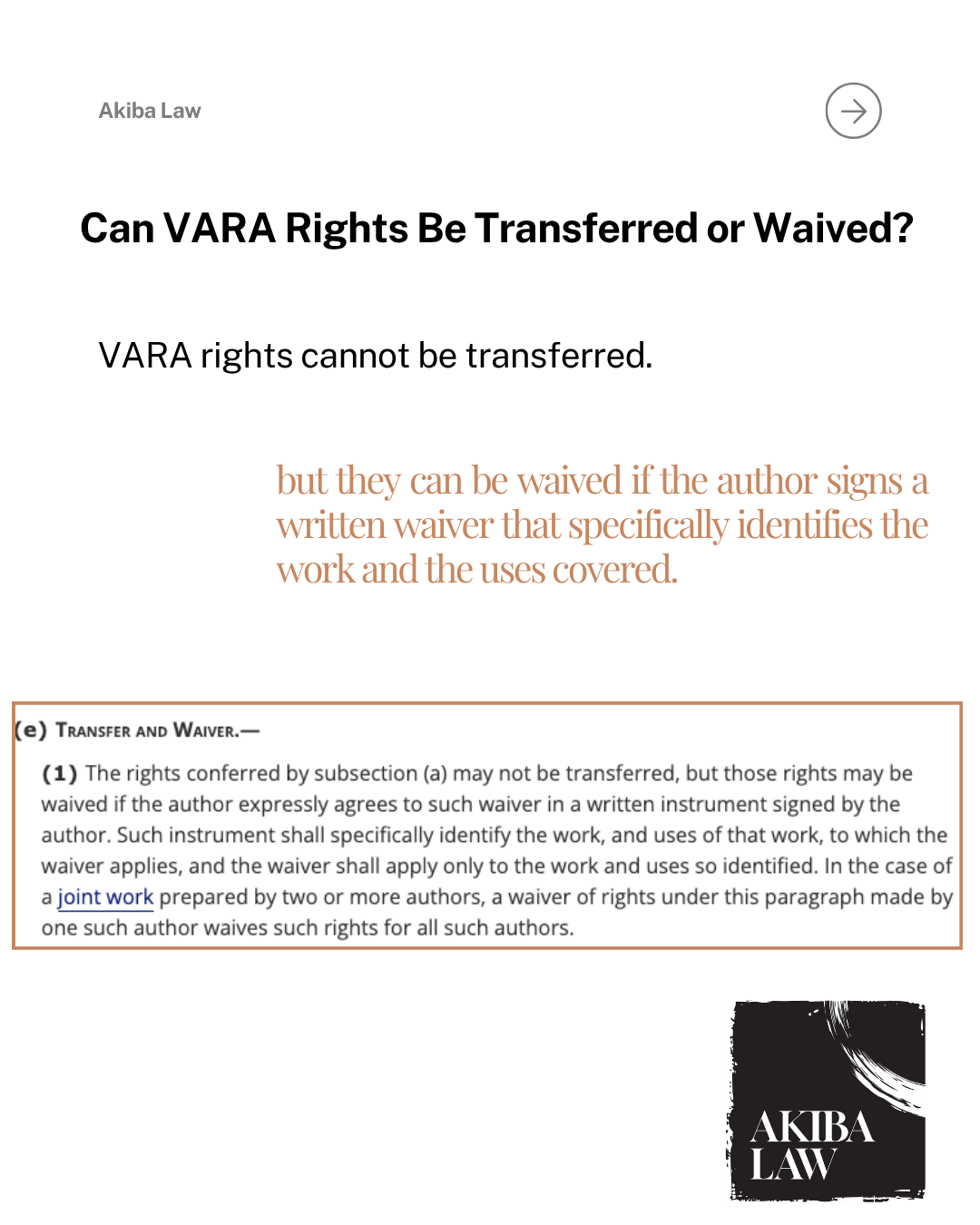
The statute is clear: VARA rights may not be transferred. But the author can waive them.
A waiver must be express, in writing, and signed by the author. It must specifically identify the work and the uses of the work to which the waiver applies. The waiver applies only to the work and uses identified in the waiver.
This is a critical drafting point. A general contract clause may not be enough. If a party wants a VARA waiver, the document should clearly identify the work, the scope of the waiver, and the covered uses.
A sale of the physical work, a transfer of copyright, or a transfer of other rights does not automatically waive VARA rights.
VARA is narrow, but it can be powerful.
It does not apply to every artwork. It does not replace ordinary copyright law. It does not prevent every alteration, movement, conservation decision, or destruction of a creative work. But when VARA applies, it gives the artist rights that can survive ownership changes and exist separately from copyright ownership.
For artists, VARA can protect attribution, reputation, and the integrity of qualifying works.
For collectors, galleries, developers, property owners, and businesses, VARA is a reminder that owning the object is not always the same as owning every right connected to the object.
The practical takeaway is simple: before altering, removing, destroying, commissioning, installing, or purchasing significant visual art, ask whether VARA applies. The answer may depend on the type of work, the edition size, authorship, ownership history, written waivers, installation documents, building-removal rules, and whether the work has recognized stature.
This article is for general educational and informational purposes only and does not constitute legal advice.
Akiba Law PLLC is a boutique law firm based in Miami, Florida. The firm represents artists, creators, brands, entrepreneurs, collectors, galleries, and businesses in matters involving art law, intellectual property, trademark protection, copyright, contracts, business disputes, and brand enforcement.
warning Disclaimer
This article is for general educational and informational purposes only and does not constitute legal advice. Reading this article does not create an attorney-client relationship with Akiba Law PLLC or any attorney. Florida law may apply differently depending on the specific facts, legal issues, and parties involved. Individuals and businesses should consult qualified legal counsel about their specific circumstances. For questions, concerns, or additional information, please contact Akiba Law PLLC to speak with a qualified attorney.

From a Real Estate Listing to Restitution: Argentina Orders Return of Nazi-Looted Old Master to Sole Remaining Heir of Jacques Goudstikker
More than eighty years after an Old Master painting disappeared during the Nazi era, an Argentine court has ordered its…

Case Update: Solar Drops Second Gang Starr Lawsuit After Judge Questions Prospect of Duplicative Litigation
When I first wrote about the latest chapter in the legal battle surrounding Gang Starr in September 2025, producer John…

Art Law in Florida: A Practitioner’s Handbook
Akiba Law PLLC is a Miami-based law firm advising artists, collectors, galleries, dealers, auction businesses, museums, and creative entrepreneurs on…

2 Live Crew Tried to Take Back Its Copyrights. A Decades-Old Bankruptcy Got in the Way.
Copyright ownership can last for decades, and the Copyright Act gives many creators an unusual second chance to revisit deals…

When Does a Sculpture Become a Building? East Hampton’s Lawsuit Over Matt Johnson’s Meditating Figure
Large-scale public and private art installations can raise issues well beyond copyright, contracts, and exhibition agreements. Once an artwork reaches…
Eden Gallery Sues Collector Over Alleged $822,390 Unpaid Balance: Lessons for Art Sales on Credit
High-value art transactions are often built on relationships. A collector may purchase repeatedly from the same gallery, payments may be…
MoMA v. MOMACHA: Trademark Strength, Brand Similarity, and Consumer Confusion
A trademark dispute does not always begin with two businesses offering the same product. Confusion can arise when a newer…

When a $2.5 Million Art Loan Ends in Litigation: Lessons for Galleries, Curators, and Property Owners
Long-term art placements can benefit everyone involved. Galleries gain access to potential collectors, property owners enhance their spaces, and residents…

When a Gallery Sells Consigned Art but Does Not Pay the Artist: The Hole Lawsuit and New York’s Trust-Fund Rules
An artwork consignment is not simply an informal arrangement in which a gallery agrees to sell a work and pay…
Your Logo Is on the Shirt. Does That Count as Trademark Use?
Launching a clothing brand involves more than creating a name, designing a logo, and placing it on a garment. How…

45 Antiquities Seized from the Metropolitan Museum of Art: Provenance, Repatriation, and the Importance of Due Diligence
On July 8, 2026, the Manhattan District Attorney’s Office announced the return of 59 antiquities, collectively valued at more than…

Florida Interior Designers and Decorators: Are You Regulated? Do You Need a License?
Interior designers and decorators in Florida often face a practical question: am I subject to Florida regulation, and do I…