Consigning Art in Florida: Why Written Agreements, Notices, and Statutory Formalities Matter
Consignment is common in the art market. An artist may deliver work to a dealer, gallery, or other art business for sale, exhibition and sale, or placement into the market. But in Florida, consignment is not just a handshake arrangement.
Florida’s Artists’ Consignment Act, located at Florida Statutes §§ 686.501–686.506, creates specific rules for certain art consignments. Those rules address the consignment relationship, public notice, trust treatment of sale proceeds, written contract requirements, loss or damage, minimum sale price, use or display of the work, and priority against the dealer’s creditors.
Florida Statutes § 686.502 provides the starting point. When a consignor delivers a work of art to a consignee for sale, or exhibition and sale, to the public on commission or another compensation basis, the delivery and acceptance are deemed to be “on consignment.” The statute also treats the consignee as the consignor’s agent with respect to the work.
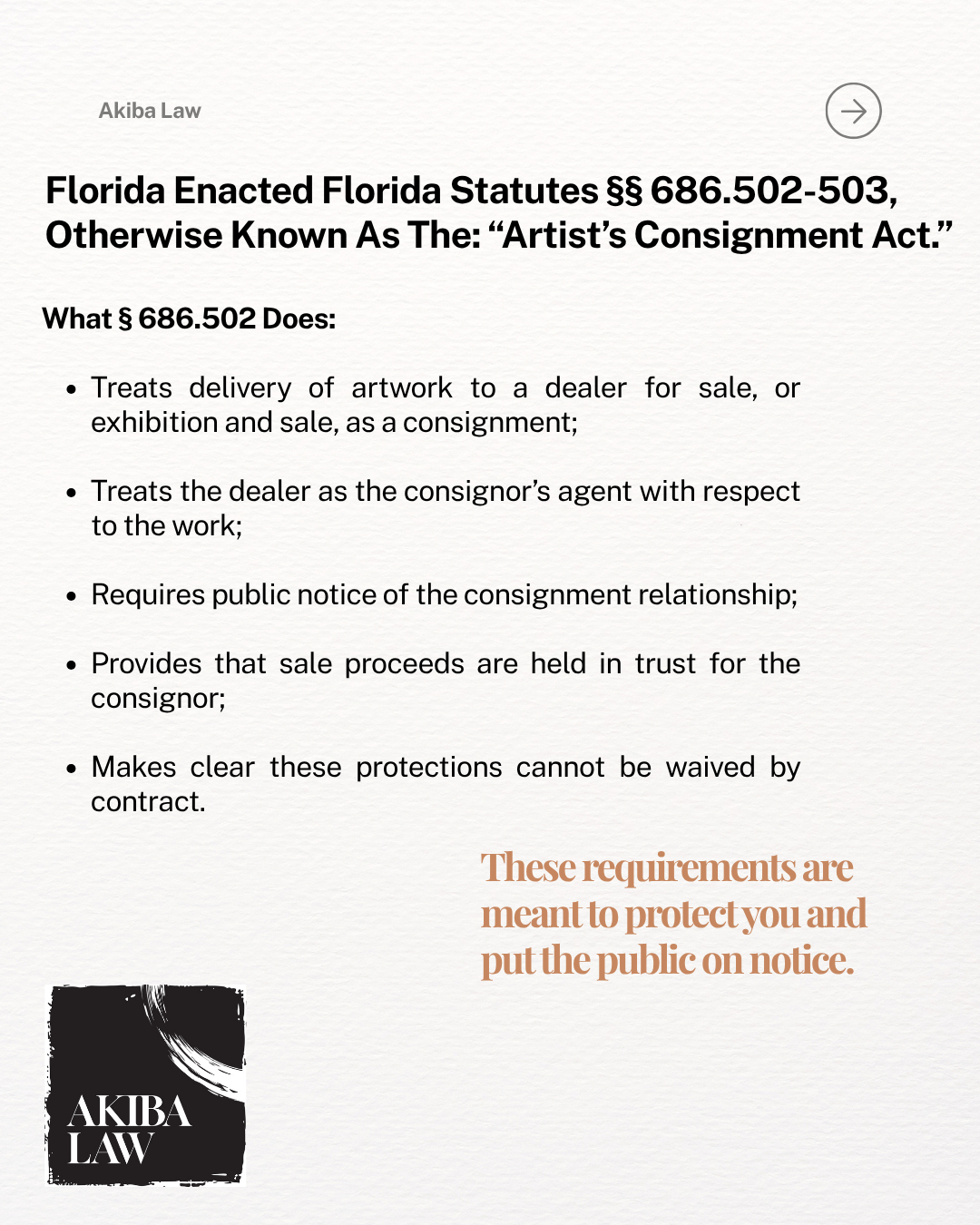
The same section requires public notice of the consignment relationship, provides that sale proceeds are held in trust for the consignor, and makes clear that the consignor cannot waive the protections of that section by contract. In other words, the statute is not just defining a relationship. It is creating protections that are meant to follow the artwork into the marketplace.
Section 686.503 adds structure to the relationship. When a consignee accepts artwork for sale, or exhibition and sale, there must be a written contract or agreement between the consignor and consignee. That agreement must address several key points, including when proceeds will be paid, responsibility for loss or damage, and the agreed minimum sale price.
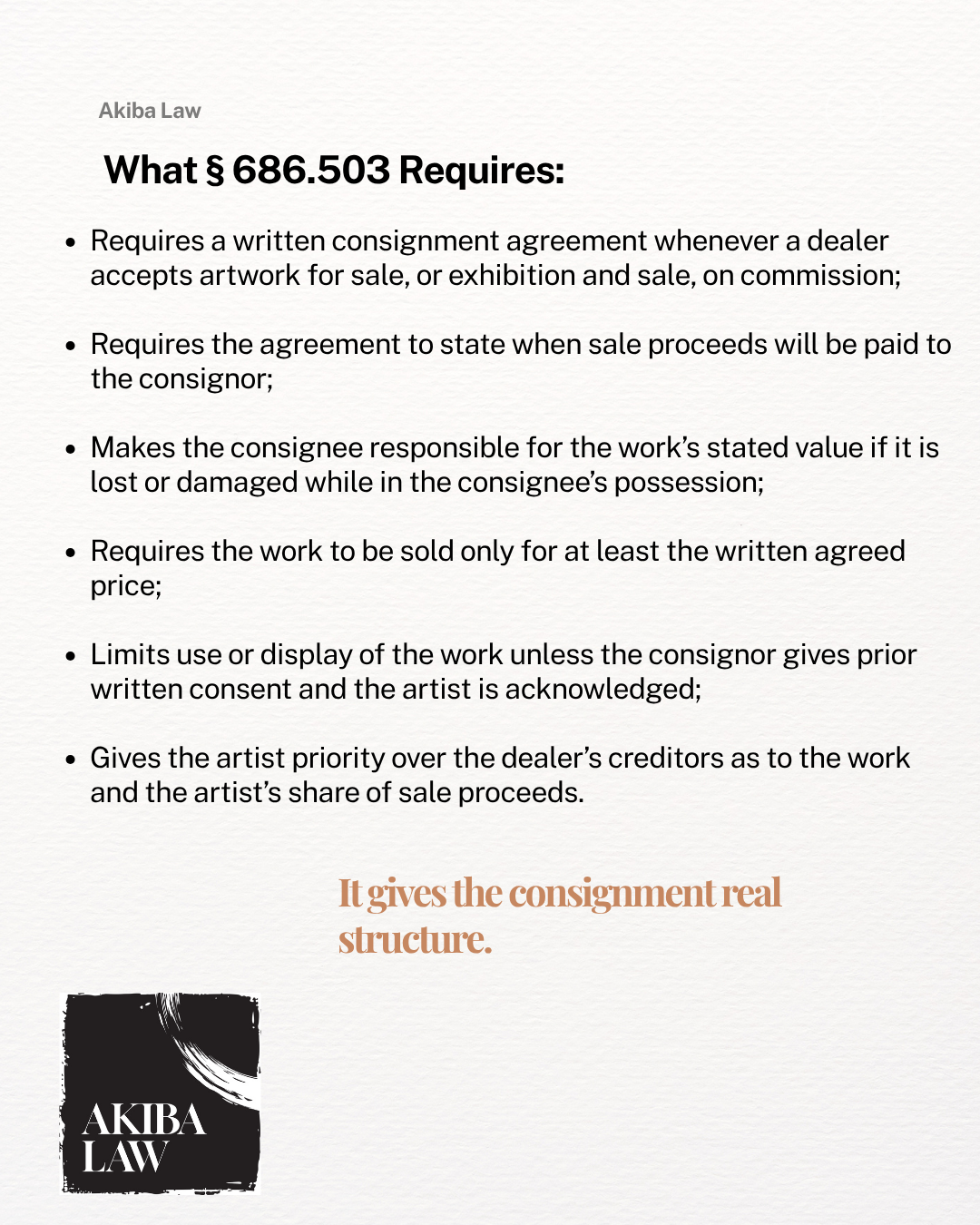
The statute also limits use or display of the work without the consignor’s prior written consent and requires the artist to be acknowledged in that use or display. It further provides that artwork delivered by an artist to an art dealer for exhibition or sale, along with the artist’s share of sale proceeds, creates a priority in favor of the artist over the dealer’s creditors, notwithstanding the Uniform Commercial Code.
These provisions do more than describe the artist-dealer relationship. They establish formalities that can matter when artwork moves through the market and third parties begin relying on who appears to own, control, or have rights in the work.
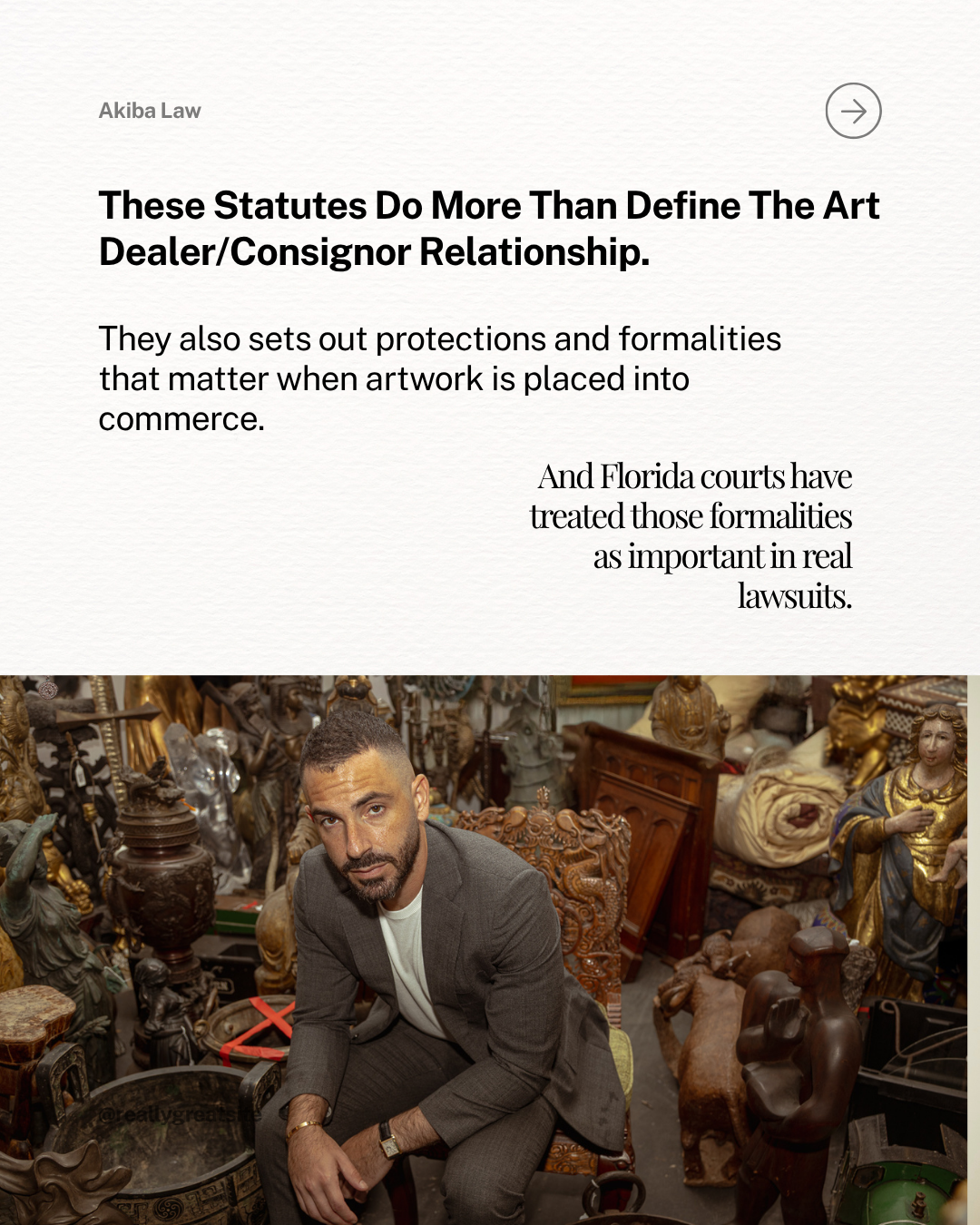
That is why tags, labels, notices, written agreements, and clear records matter. A consignment may feel private between artist and dealer, but once the work enters the stream of commerce, the outside world may rely on how that relationship appears.
The importance of those formalities appears in Shuttie v. Festa Restaurant, Inc. There, an artist, Zois Shuttie, consigned 16 of his paintings to a local art dealer named John Guggenheim who owned and operated the “Guggenheim Gallery” in Coral Gables. Shuttie v. Festa Restaurant, Inc., 566 So. 2d 554, 554 (Fla. 3d DCA 1990). However, the consignment agreements consisted of nothing more than single sentence sheets and nothing more. There were no other written terms of the consignment; all other terms were “oral in nature or assumed to be generally understood by persons in the artist/art dealer business.” Id. Also, the consignor failed to affix to any one of the consigned works a sign or tag alerting the public that the works were being sold subject to a consignment agreement. Id. at 555. Nor was there any sign in the gallery conspicuously alerting to the public that some goods were being sold on consignment. Id. Guggenheim, who was not a named defendant in the action, then approached a restaurant and suggested that the paintings be displayed in the restaurant for sale. Id. In the event of sale, the restaurant would be entitled to a 20% commission. Id. The restaurant agreed and displayed the paintings therein, subject to a loan agreement between Guggenheim and the restaurant after Guggenheim represented the paintings as being of his own personal collection. Id. Although Guggenheim was not a party to the action, the artist characterized this transaction as a breach of his consignment agreement with Guggenheim. Id. Relying on its possession of the paintings, the restaurant then loaned $25,000.00 to Guggenheim, using the paintings as security for the loan. Id. The artist then filed an action for replevin, seeking the return of the paintings. Id. The artist lost at the trial level and appealed.
The Third District Court of Appeal affirmed the judgment in favor of the restaurant. In doing so, the court held that:
As a matter of law, when an artist fails to avail himself of the Artist’s Consignment Act, Section 686.501 et seq., Florida Statutes, and places in commerce paintings of art with no notation as to ownership thereon, an innocent third party who takes a security position in these paintings has a superior possessory interest, vis-as-vis the artist under the long established principle of law that as between two innocent parties, the one that created the situation causing the loss, will not be held to have a superior position to the completely innocent party. . . and that the UCC has not altered this common principle.”
Id. at 558 (internal citation omitted).
In so holding, the court reasoned that the artist was estopped from relying on sub-section (5) of Section 686.503 to establish a superior interest in the paintings because the artist either overlooked or failed to comply with subsections (1)-(4) of that statute and also failed to comply with the notice requirements of Section 686.502(2). To wit, “an invalidating irregularity may not be claimed and availed of in one instance and be overlooked or considered innocuous in another. The knife cuts both ways.” Id. at 557 (quoting City of Coral Gables v. Sackett, 253 So. 2d 890, 896 (Fla. 3rd DCA 1971)).
The result in Shuttie is a reminder that statutory protections may depend on statutory compliance. If the work is left unmarked, no compliant notices are posted, and the paperwork does not track the statute, an innocent third party may be able to argue that it relied on the dealer’s apparent ownership or authority.
Failure to comply with these formal requirements may result in the consignor losing its interest in the art work to superior secured creditors.
For instance, in Rayfield Inc. Co. v. Kreps, a capital lender loaned funds to a Palm Beach art gallery—Style de Vie—and perfected its security interest in all of the gallery’s inventory by filing a UCC-1 financing statement. 35 So. 3d 63, 64 (Fla. 4th DCA 2010). After the perfection of the lender’s security interest, a consignor consigned a painting by Cortes to the gallery, which the gallery was free to sell for not less than $42,000.00. Id. The consignor, however, did not “attach any tag or legend to the painting . . . . [n]or did he file a UCC-1 financing statement in Florida giving notice of his prior interest in the painting.” Id. Following the gallery’s default on the loan, the lender sued to foreclose its security interest on the gallery’s inventory and ultimately obtained a judgment and writ of replevin for the inventory. Id. The consignor intervened after the lender’s replevin of the painting and prevailed at the trial level. Id. The trial court, finding the consignor’s interest superior to the lender’s perfected interest, reasoned that the lender had actual knowledge that the gallery sold antiques on consignment and had even entered into a Profit Participation Agreement with the gallery, which contemplated participation in the profits of the sale of consigned goods. Id. at 64-65.
The lender appealed and the Fourth District Court of Appeal reversed. Id. at 65, 67. The court began its analysis with UCC Article 9 and its definition of “consignment.” Id. at 65 (quoting Fla. Stat. § 679.1021(1)(t) (2009)). First, the court focused on the fact that the consignor “did nothing to perfect a prior interest in the painting by filing a UCC-1, by affixing a tag or by having the gallery post a sign that some inventory is on consignment.” Id. This reasoning suggests that a consignor can perfect a prior interest in a consigned work of art merely by placing a tag on the work of art or by having the gallery post a sign that some inventory is on consignment. Further, although the lender knew that there were some consignment goods for sale, there was no evidence as to whether the gallery was “generally known by its creditors to be substantially engaged in selling the goods of others.” Id. (quoting Fla. Stat. § 679.1021(1)(t) (2009)). Therefore, the appellate court found that it was “clear this case involves a prior perfected security interest in inventory and a subsequent unperfected security interest in a painting placed with the gallery for sale on consignment.” Id.
To bolster its holding, the court further reasoned, in line with UCC Article 9, that a perfected security interest in goods takes priority over all subsequently perfected and unperfected security interests in the same goods. Id. Also, Florida law provides that a consignor’s interest in goods placed for sale with a consignee who routinely sells such goods is merely an unperfected security interest subject to the claims of those with prior perfected security interests. Id. at 35 So. 3d 6365. So, the consignor could have defeated the secured creditors’ priority “only by proving that a majority of creditors knew that it was substantially engaged in consignment sales.” Id. at 66. In other words, the consignor’s failure to prove that a majority of the gallery’s creditors knew the gallery was substantially engaged in consignment sales was fatal because that showing was necessary to avoid Article 9’s default treatment of the painting as an unperfected security interest subject to the claims of a prior perfected lender. Without that evidence, the consignor remained an unperfected interest holder, and the lender’s perfected security interest took priority. Because of this, and the consignor’s failure to perfect his prior security interest, the court held the lender’s perfected security interest superior to the consignor’s unperfected security interest. Id. at 66-67.
For artists and collectors, the practical lesson is straightforward: consignment is not just a private understanding. It is a legal and commercial arrangement that should be documented carefully.
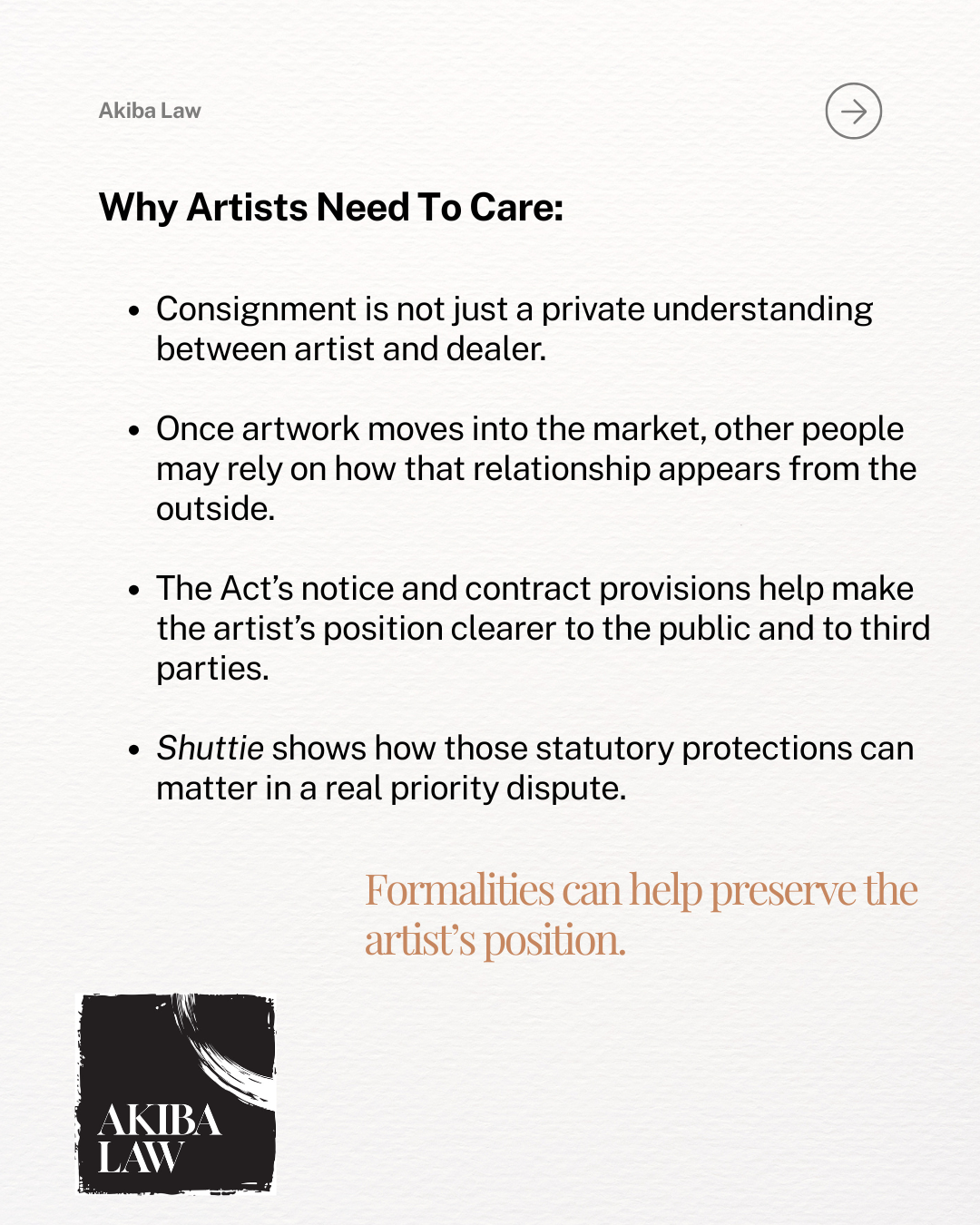
Before delivering work to a dealer, gallery, or other art business, artists should consider whether there is a written consignment agreement, whether sale proceeds and timing are clearly addressed, whether loss or damage responsibility is stated, whether minimum sale terms are in writing, and whether the required notice is being given.
Florida’s Artists’ Consignment Act gives artists important protections, but the protections work best when the statutory formalities are followed. A written agreement, proper notice, clear identification of the work, and careful documentation can make the difference between a protected consignment and a priority dispute.
For artists, this is not just paperwork. It is risk management.
For dealers and galleries, it is also good business. Clear consignment records protect the relationship, reduce misunderstandings, and help ensure that artwork moving through the market is treated consistently with the parties’ rights and expectations.
For more information on the Artist’s Consignment Act and an explanation of its other Sections, please refer to Art Law in Florida: A Practitioner’s Handbook.
This article is for general educational and informational purposes only and does not constitute legal advice.
Akiba Law PLLC is a boutique law firm based in Miami, Florida. The firm represents artists, creators, brands, entrepreneurs, collectors, galleries, and businesses in matters involving art law, intellectual property, trademark protection, copyright, contracts, business disputes, and brand enforcement.
warning Disclaimer
This article is for general educational and informational purposes only and does not constitute legal advice. Reading this article does not create an attorney-client relationship with Akiba Law PLLC or any attorney. Florida law may apply differently depending on the specific facts, legal issues, and parties involved. Individuals and businesses should consult qualified legal counsel about their specific circumstances. For questions, concerns, or additional information, please contact Akiba Law PLLC to speak with a qualified attorney.

From a Real Estate Listing to Restitution: Argentina Orders Return of Nazi-Looted Old Master to Sole Remaining Heir of Jacques Goudstikker
More than eighty years after an Old Master painting disappeared during the Nazi era, an Argentine court has ordered its…

Case Update: Solar Drops Second Gang Starr Lawsuit After Judge Questions Prospect of Duplicative Litigation
When I first wrote about the latest chapter in the legal battle surrounding Gang Starr in September 2025, producer John…

Art Law in Florida: A Practitioner’s Handbook
Akiba Law PLLC is a Miami-based law firm advising artists, collectors, galleries, dealers, auction businesses, museums, and creative entrepreneurs on…

2 Live Crew Tried to Take Back Its Copyrights. A Decades-Old Bankruptcy Got in the Way.
Copyright ownership can last for decades, and the Copyright Act gives many creators an unusual second chance to revisit deals…
When Does a Sculpture Become a Building? East Hampton’s Lawsuit Over Matt Johnson’s Meditating Figure
Large-scale public and private art installations can raise issues well beyond copyright, contracts, and exhibition agreements. Once an artwork reaches…
Eden Gallery Sues Collector Over Alleged $822,390 Unpaid Balance: Lessons for Art Sales on Credit
High-value art transactions are often built on relationships. A collector may purchase repeatedly from the same gallery, payments may be…
MoMA v. MOMACHA: Trademark Strength, Brand Similarity, and Consumer Confusion
A trademark dispute does not always begin with two businesses offering the same product. Confusion can arise when a newer…

When a $2.5 Million Art Loan Ends in Litigation: Lessons for Galleries, Curators, and Property Owners
Long-term art placements can benefit everyone involved. Galleries gain access to potential collectors, property owners enhance their spaces, and residents…

When a Gallery Sells Consigned Art but Does Not Pay the Artist: The Hole Lawsuit and New York’s Trust-Fund Rules
An artwork consignment is not simply an informal arrangement in which a gallery agrees to sell a work and pay…
Your Logo Is on the Shirt. Does That Count as Trademark Use?
Launching a clothing brand involves more than creating a name, designing a logo, and placing it on a garment. How…

45 Antiquities Seized from the Metropolitan Museum of Art: Provenance, Repatriation, and the Importance of Due Diligence
On July 8, 2026, the Manhattan District Attorney’s Office announced the return of 59 antiquities, collectively valued at more than…

Florida Interior Designers and Decorators: Are You Regulated? Do You Need a License?
Interior designers and decorators in Florida often face a practical question: am I subject to Florida regulation, and do I…