Artists Build Brands Too: Why Visual Artists Should Think About Trademarks
Artists often think about copyright first. That makes sense. Copyright protects the artwork itself.
But for many visual artists, the business does not stop at the canvas, sculpture, print, collectible, or edition. Over time, artists also build names, symbols, signatures, studio identities, merchandise lines, collaborations, and visual cues that the market begins to recognize.
That is where trademark law comes in.

This is not just a theory for luxury brands, fashion houses, or large companies. Some of the most recognizable visual artists in the world have used trademark registration as part of a broader brand protection strategy.
The point is not that every artist needs to register every name, symbol, or logo. The point is that artists should understand when their creative identity has also become a commercial identifier.

Copyright and trademark protect different things.
Copyright generally protects original artistic expression. Trademark protects words, names, symbols, designs, or other indicators that identify the source of goods or services.
For artists, the same visual language can sometimes sit at the intersection of both. A character, symbol, signature, or name may be creative expression in one context and a brand identifier in another.

So what can function as a trademark for an artist?
Possibly more than you think. An artist’s name, studio name, signature, recurring symbol, logo, character, or other distinctive identifier may be protectable if it is used in a way that signals source to the public.
The key question is not simply whether something is visually interesting. The key question is whether the market understands it as identifying you, your studio, your goods, or your services.
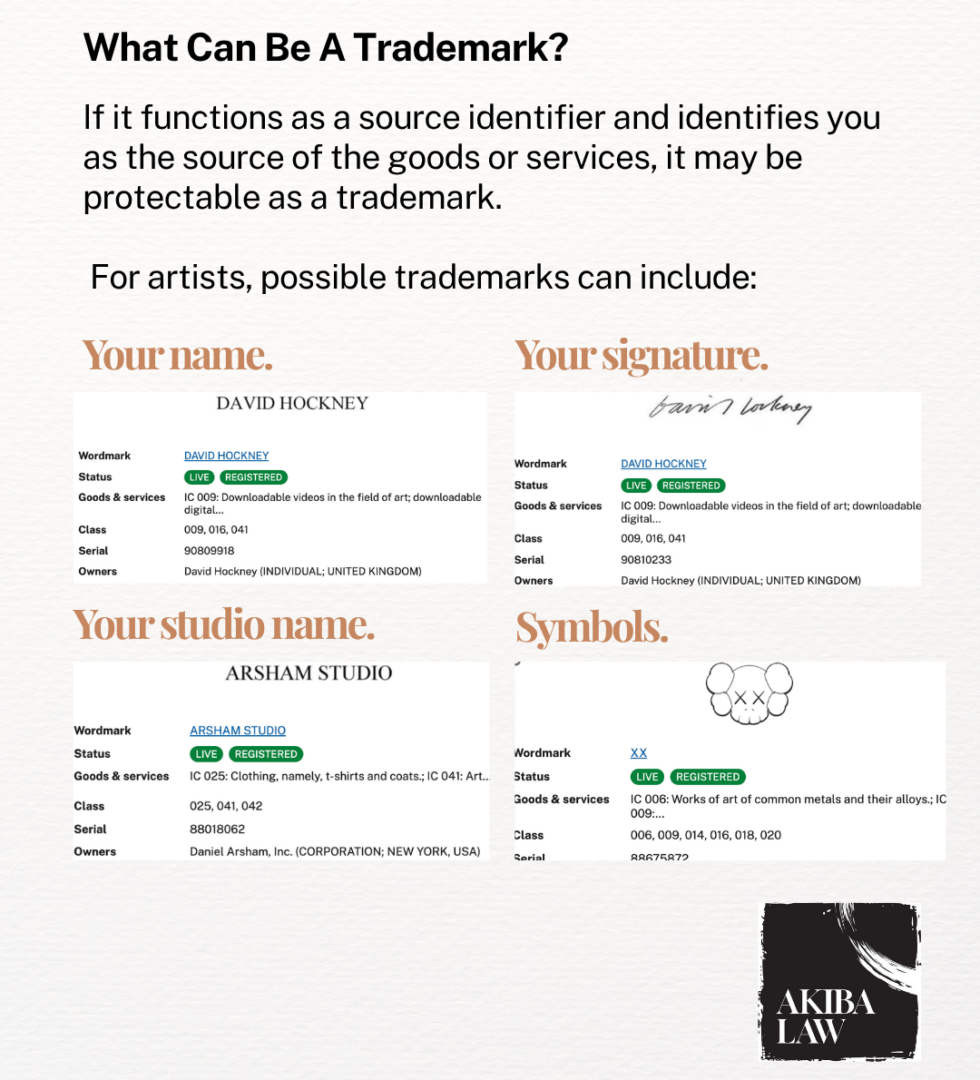
Use matters.
A mark does not exist in a vacuum. It appears somewhere. It appears on something. It is presented to collectors, buyers, collaborators, galleries, retailers, or the public in a particular commercial context.
That context can matter when deciding whether something is functioning as a trademark.
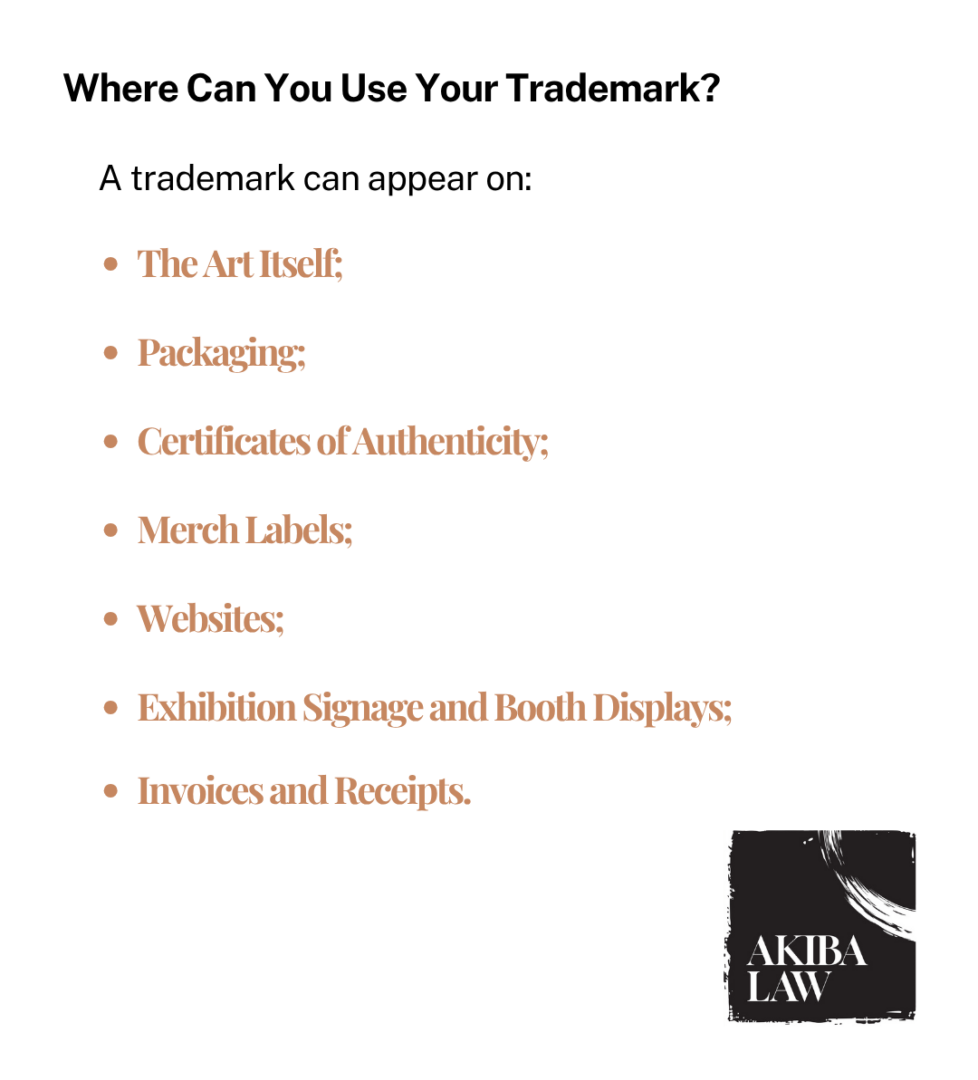
For artists, trademark use may show up in many places: on the artwork itself, packaging, certificates of authenticity, merchandise labels, websites, exhibition signage, booth displays, invoices, receipts, and other buyer-facing materials.
This is why brand protection should not be an afterthought. The way an artist uses a name, symbol, or signature today may affect the strength of that artist’s rights tomorrow.

Trademark registration is not magic. It does not turn every artistic element into a protectable brand asset.
But when used correctly, it can strengthen enforcement, support licensing and collaborations, help protect merchandise and product lines, and give structure to the business value being built around an artist’s identity.
For artists whose work is expanding into editions, apparel, objects, commercial collaborations, digital goods, retail, or studio-branded offerings, trademark strategy deserves serious attention.

Artists build more than artwork.
They build names, symbols, reputations, communities, and visual identities that the market learns to recognize. When that identity starts functioning as a brand, trademark protection may become an important part of the artist’s legal toolkit.
The best time to think about this is usually before the collaboration, merch drop, licensing deal, or dispute. Not after.
This article is for general educational and informational purposes only and does not constitute legal advice.
Akiba Law PLLC is a boutique law firm based in Miami, Florida. The firm represents artists, creators, brands, entrepreneurs, collectors, galleries, and businesses in matters involving art law, intellectual property, trademark protection, copyright, contracts, business disputes, and brand enforcement.
warning Disclaimer
This article is for general educational and informational purposes only and does not constitute legal advice. Reading this article does not create an attorney-client relationship with Akiba Law PLLC or any attorney. Florida law may apply differently depending on the specific facts, legal issues, and parties involved. Individuals and businesses should consult qualified legal counsel about their specific circumstances. For questions, concerns, or additional information, please contact Akiba Law PLLC to speak with a qualified attorney.

Case Update: Solar Drops Second Gang Starr Lawsuit After Judge Questions Prospect of Duplicative Litigation
When I first wrote about the latest chapter in the legal battle surrounding Gang Starr in September 2025, producer John…

Art Law in Florida: A Practitioner’s Handbook
Akiba Law PLLC is a Miami-based law firm advising artists, collectors, galleries, dealers, auction businesses, museums, and creative entrepreneurs on…

2 Live Crew Tried to Take Back Its Copyrights. A Decades-Old Bankruptcy Got in the Way.
Copyright ownership can last for decades, and the Copyright Act gives many creators an unusual second chance to revisit deals…

When Does a Sculpture Become a Building? East Hampton’s Lawsuit Over Matt Johnson’s Meditating Figure
Large-scale public and private art installations can raise issues well beyond copyright, contracts, and exhibition agreements. Once an artwork reaches…
Eden Gallery Sues Collector Over Alleged $822,390 Unpaid Balance: Lessons for Art Sales on Credit
High-value art transactions are often built on relationships. A collector may purchase repeatedly from the same gallery, payments may be…
MoMA v. MOMACHA: Trademark Strength, Brand Similarity, and Consumer Confusion
A trademark dispute does not always begin with two businesses offering the same product. Confusion can arise when a newer…

When a $2.5 Million Art Loan Ends in Litigation: Lessons for Galleries, Curators, and Property Owners
Long-term art placements can benefit everyone involved. Galleries gain access to potential collectors, property owners enhance their spaces, and residents…

When a Gallery Sells Consigned Art but Does Not Pay the Artist: The Hole Lawsuit and New York’s Trust-Fund Rules
An artwork consignment is not simply an informal arrangement in which a gallery agrees to sell a work and pay…
Your Logo Is on the Shirt. Does That Count as Trademark Use?
Launching a clothing brand involves more than creating a name, designing a logo, and placing it on a garment. How…

45 Antiquities Seized from the Metropolitan Museum of Art: Provenance, Repatriation, and the Importance of Due Diligence
On July 8, 2026, the Manhattan District Attorney’s Office announced the return of 59 antiquities, collectively valued at more than…

Florida Interior Designers and Decorators: Are You Regulated? Do You Need a License?
Interior designers and decorators in Florida often face a practical question: am I subject to Florida regulation, and do I…
Jacques Goudstikker’s Stolen Collection Is Still Being Found and Returned
Restitution can’t undo the Holocaust but it can return what was taken and every returned work matters. A Nazi-looted painting…